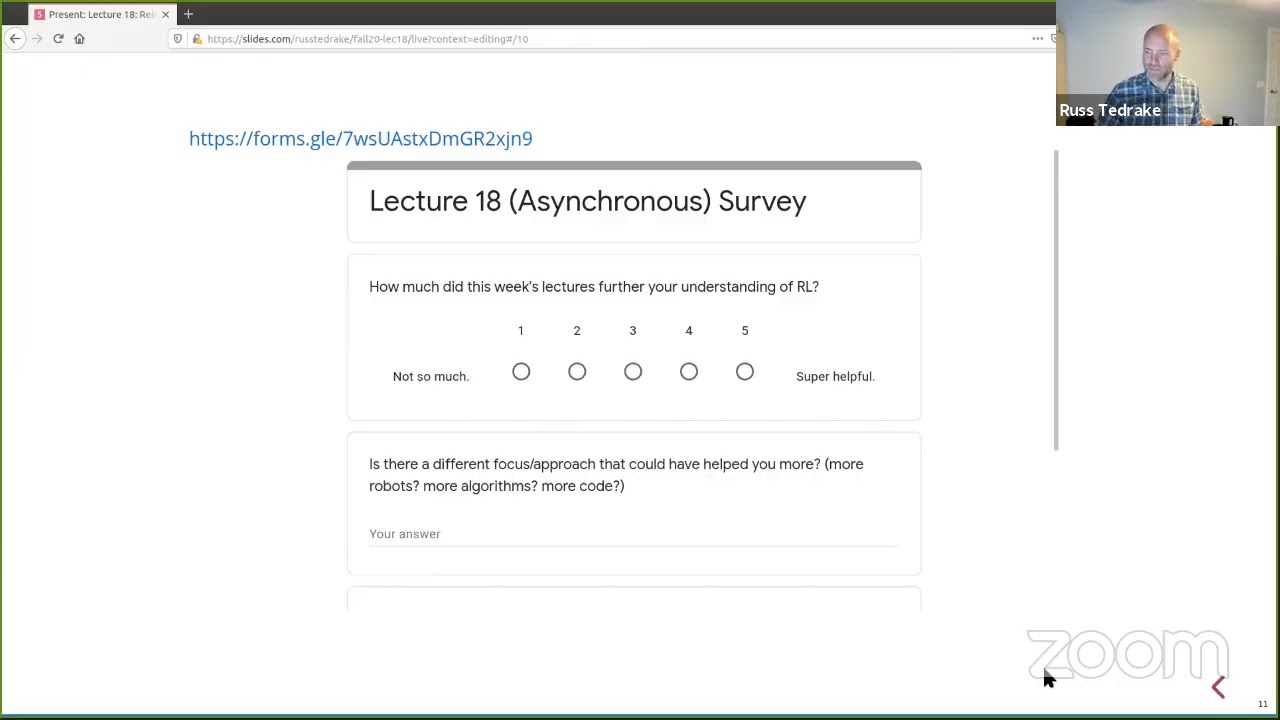
Lecture 18 | MIT 6.881 (Robotic Manipulation), Fall 2020 | Reinforcement Learning (Part 2)
Keywords
Summary
151 words
Critical Evaluation
This lecture is a masterclass in teaching reinforcement learning, specifically policy gradient methods, to an audience with a strong mathematical background. The instructor, Russ Tedrake, is a renowned expert in robotics and manipulation, and his expertise shines through in the clarity and depth of the presentation. The content is well-structured, starting with a clear motivation for the topic and then systematically building up the necessary concepts. The lecture strikes an excellent balance between theoretical foundations and practical insights, making it valuable for both students and practitioners.
The mathematical rigor is commendable. Tedrake carefully derives the policy gradient theorem and explains the intuition behind it, avoiding hand-waving. He also discusses the variance reduction techniques, such as baselines and actor-critic methods, which are crucial for making policy gradient methods work in practice. The use of whiteboard-style explanations, despite the limitations of remote teaching, helps in following the derivations step by step.
The lecture is well-supported by references to the textbook and slides, which are freely available online. This enhances its credibility and allows viewers to delve deeper into the material. The instructor also provides practical advice on optimization algorithms like Adam, acknowledging their importance in training neural network policies.
One minor criticism is that the lecture assumes a certain level of prior knowledge in optimization and probability, which might be challenging for absolute beginners. However, this is appropriate for a graduate-level course. Additionally, the lecture focuses primarily on policy gradient methods, leaving other RL approaches like Q-learning less covered, but this is a deliberate choice to provide depth in one area.
The adéquation between the title and content is perfect: it is indeed a lecture on reinforcement learning, with a focus on policy gradient methods, as part of a robotic manipulation course. The title could be more specific, but it accurately reflects the content.
Overall, this is an excellent educational resource, offering a rigorous and insightful treatment of policy gradient RL. It is highly recommended for anyone seeking a deep understanding of this topic.
332 words
Title / Content Match
The title accurately reflects the content: a lecture on reinforcement learning, specifically focusing on policy gradient methods, as part of a course on robotic manipulation.
Quality & Reliability
9/10
Lecture by MIT professor Russ Tedrake, based on a textbook and slides, providing a rigorous mathematical treatment of policy gradient methods in reinforcement learning. The content is well-structured, with clear derivations and references to standard optimization techniques. The source is authoritative (MIT OpenCourseWare) and the material is presented with appropriate technical depth.
Key Moments
Markers derived by PSI from the transcript: the creator did not define chapters.
- Introduction and overview of the lecture's focus on policy gradient methods.
- Discussion of the two extremes: exact gradient computation and black-box optimization.
- Review of gradient descent and introduction of stochastic gradient descent (SGD).
- Explanation of finite difference approximations for gradient estimation.
- Derivation of the policy gradient theorem and its implications.
- Discussion of variance reduction techniques, including baselines and actor-critic methods.
- Introduction of natural gradients and trust region methods.
- Application of policy gradient methods to robotic manipulation tasks.
- Practical considerations and use of optimization algorithms like Adam.
- Conclusion and summary of key takeaways.
Cited Sources
- Robotic Manipulation Textbook — The textbook accompanying the course, providing detailed background and references.
- Lecture Slides — Live slides used during the lecture, containing the mathematical derivations and figures.
Concurring Sources
- Reinforcement Learning: An Introduction — The standard textbook by Sutton and Barto, which covers policy gradient methods in depth.
- OpenAI Spinning Up — A practical resource for understanding and implementing policy gradient algorithms.
Contribution & Novelties
This lecture provides a clear and rigorous exposition of policy gradient methods, bridging the gap between theoretical foundations and practical implementation in robotic manipulation. It offers a unique perspective by situating policy gradient RL within the spectrum of optimization techniques, from exact gradient descent to black-box methods. The lecture emphasizes the importance of stochastic gradient descent and variance reduction, which are often glossed over in introductory treatments.
Pour aller plus loin :
- Policy Gradient Theorem — The original paper by Sutton et al. (1999) establishing the policy gradient theorem.
- Trust Region Policy Optimization — A key paper by Schulman et al. introducing TRPO, a robust policy gradient method.
- Proximal Policy Optimization — A popular and effective policy gradient algorithm by Schulman et al.
- Natural Gradient — Wikipedia article explaining the concept of natural gradients, which is discussed in the lecture.
140 words
Radar Profile
The radar profile shows high scores across all dimensions, indicating a well-rounded and authoritative lecture. The strongest aspects are the quantity and quality of information, as well as the reliability, reflecting the instructor's expertise and the rigorous content. The technical level is also high, making it suitable for advanced learners.