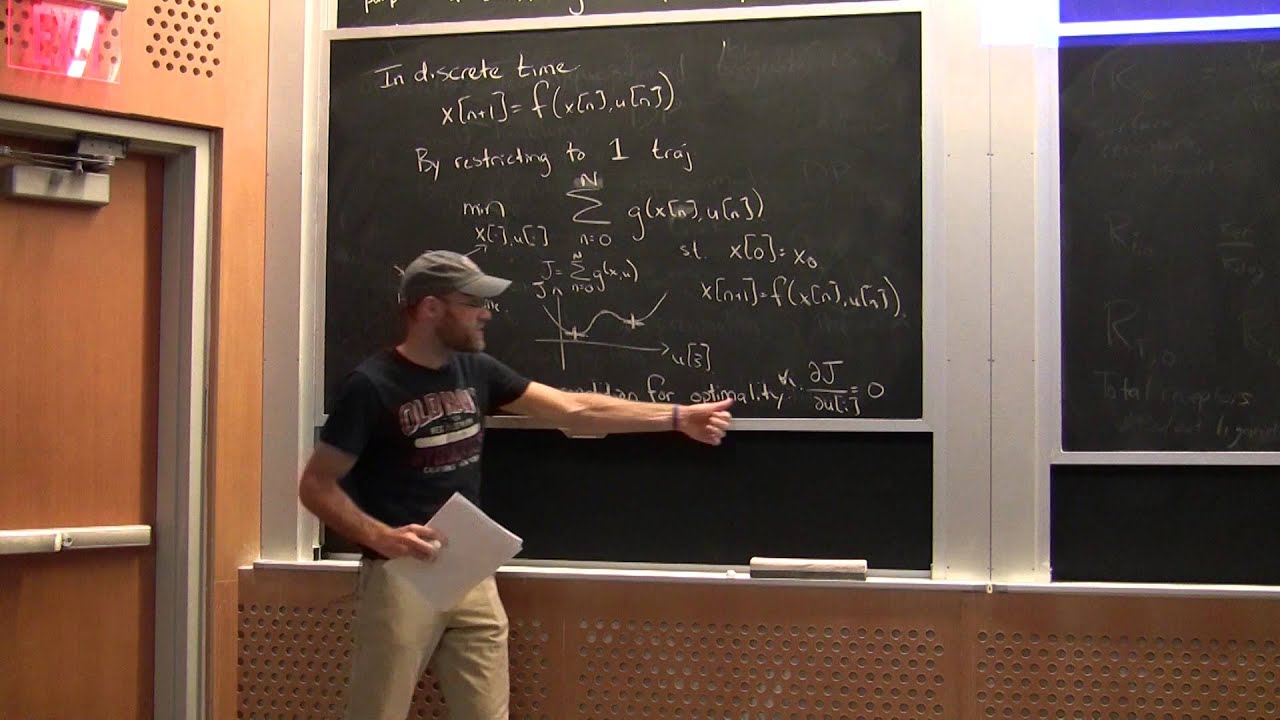
Lecture 09 for MIT 6.832 (Underactuated Robotics)
Keywords
Summary
177 words
Critical Evaluation
This lecture provides a rigorous and insightful introduction to the concept of local optimality in trajectory optimization. The instructor’s pedagogical approach is effective: he first establishes the big picture of the course, then narrows down to the specific problem of local optimality, and finally connects it to the broader toolbox of control design. The mathematical content is presented with clarity, and the instructor takes care to explain the intuition behind the formal definitions. The discussion of the value function and the HJB equation is particularly well done, as it bridges the gap between dynamic programming and trajectory optimization. The lecture also benefits from the instructor’s experience and his ability to field student questions, which adds depth to the presentation. However, the lecture is quite technical and assumes a solid background in control theory and optimization. It may be challenging for viewers without prior exposure to these topics. Additionally, the lecture is part of a series, so some context from previous lectures is assumed. The video quality is adequate, but the lack of visual aids (due to a broken Wacom tablet) makes it slightly harder to follow the mathematical derivations. Overall, this is a high-quality lecture that offers valuable insights into the theory of optimal control, but it is best suited for an audience with a strong technical foundation.
218 words
Title / Content Match
The title accurately reflects the content, which is a lecture on underactuated robotics focusing on local optimality.
Quality & Reliability
8/10
Lecture from MIT OpenCourseWare, presented by an expert in the field, with rigorous mathematical content and clear explanations. The content is well-structured and aligns with established control theory.
Key Moments
Markers derived by PSI from the transcript: the creator did not define chapters.
- Introduction and big picture of the course
- Review of objective functions and solution techniques
- Discussion of Lyapunov verification and region of attraction
- Introduction to local optimality and the value function
- Derivation of the Hamilton-Jacobi-Bellman equation
- Discussion of computational challenges and trajectory optimization
- Limitations of local methods and need for global verification
- Q&A and concluding remarks
Contribution & Novelties
This lecture provides a clear and rigorous exposition of the concept of local optimality in trajectory optimization, bridging dynamic programming and trajectory optimization. It emphasizes the importance of understanding the value function and the HJB equation as necessary conditions for optimality, and discusses the computational challenges in high-dimensional systems. The lecture also highlights the role of Lyapunov-based verification in complementing local methods.
Pour aller plus loin :
- Hamilton-Jacobi-Bellman equation — Provides a formal definition and context for the HJB equation.
- Optimal control — Overview of optimal control theory, including dynamic programming and trajectory optimization.
- Underactuated robotics — Course website with additional resources and lecture notes.
105 words
Radar Profile
The radar profile shows high scores in quality of information and technical level, indicating a dense and rigorous lecture. The quantity of information is also high, but the reliability score is slightly lower, possibly due to the lack of external sources cited. Overall, the lecture is strong in content but may be less accessible to a general audience.