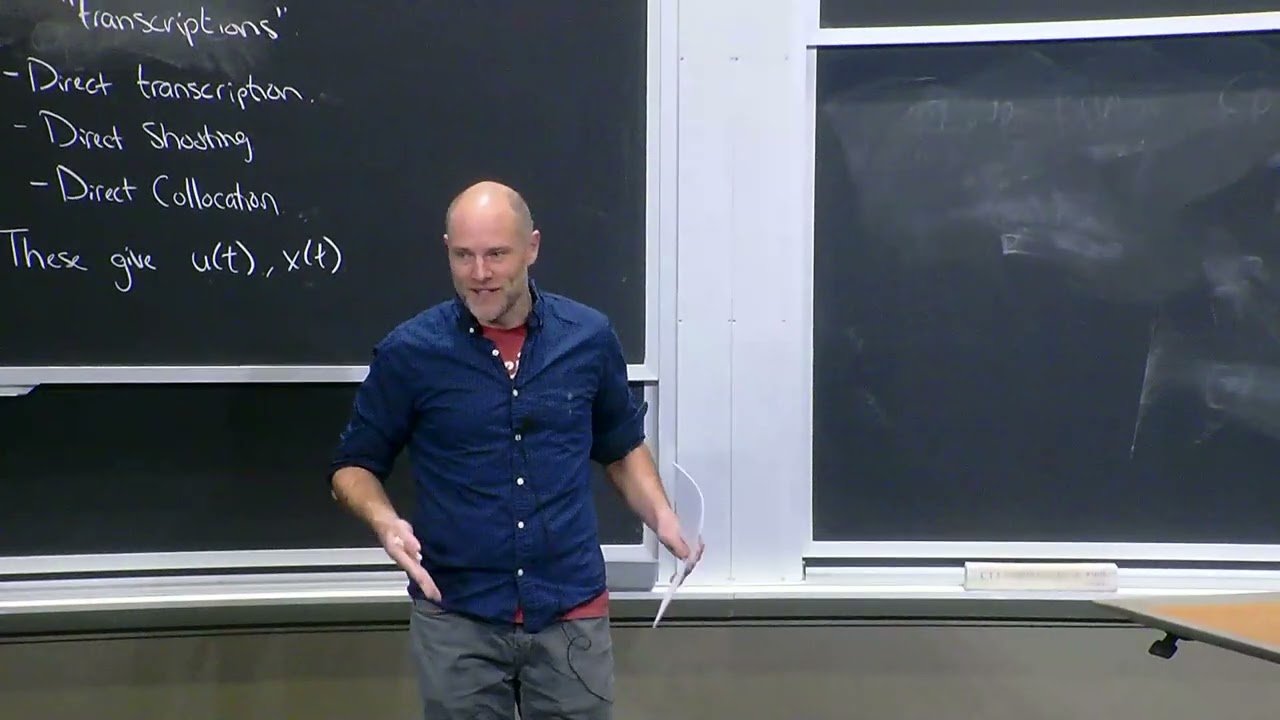
6.8210 Spring 2024 Lecture 12: Trajectory Stabilization
Keywords
Summary
182 words
Critical Evaluation
The lecture provides a rigorous and insightful treatment of trajectory stabilization, a key topic in control of underactuated systems. The instructor, presumably a leading expert, delivers content with clarity and depth, building on previous lectures. The mathematical derivations are sound, and the use of the cart-pole example effectively illustrates the concepts, particularly the subtle issue of control authority degradation. The demonstration that open-loop control fails even with perfect models due to numerical integration discrepancies is a valuable pedagogical point, highlighting the necessity of feedback. The explanation of the time-varying LQR and the Riccati equation is thorough, and the visualization of the cost-to-go level sets provides strong intuition. The lecture also touches on sums-of-squares for funnels and introduces iLQR, setting the stage for advanced topics. The content is highly technical and assumes prior knowledge of control theory and optimization, but it is well-paced for an advanced audience. The sources cited are primarily the course materials and standard textbooks, which are reliable. The title accurately reflects the content. Overall, the lecture is of high quality, offering both theoretical depth and practical insights, though it may be challenging for those without a strong background in the subject.
194 words
Title / Content Match
The title accurately reflects the content, which focuses on stabilizing trajectories using time-varying LQR and related methods.
Quality & Reliability
8/10
Lecture from MIT OpenCourseWare, presented by an expert in the field, with rigorous mathematical derivations and practical demonstrations. The content is well-structured and aligns with established control theory principles.
Key Moments
Markers derived by PSI from the transcript: the creator did not define chapters.
- Introduction and overview of the lecture topics: trajectory stabilization, funnels, and iterative LQR.
- Review of trajectory optimization methods and their limitations, emphasizing the curse of dimensionality and local minima.
- Demonstration of direct collocation for the cart-pole swing-up, showing the open-loop trajectory.
- Simulation of open-loop control showing failure due to numerical integration differences.
- Introduction of finite-horizon LQR for trajectory stabilization, including the time-varying Riccati equation.
- Simulation with feedback control showing successful stabilization of the cart-pole.
- Discussion of control authority loss when cosine theta is zero, using the cart-pole example.
- Plotting the largest eigenvalue of S(t) to illustrate the cost-to-go behavior and the 'choke point'.
- Visualization of cost-to-go level sets over time, emphasizing the need to hit a narrow gap.
- Introduction to iterative LQR (iLQR) as a method for simultaneous trajectory optimization and feedback design.
Cited Sources
- Underactuated Robotics Course Materials — Course website with lecture notes and additional resources.
- MIT OpenCourseWare — Platform hosting the course video and materials.
Concurring Sources
- Underactuated Robotics Course Materials — Course materials align with the lecture content.
Contribution & Novelties
This lecture provides a clear and detailed exposition of trajectory stabilization using finite-horizon LQR, emphasizing the practical importance of feedback for underactuated systems. It offers valuable intuition about control authority and the cost-to-go function, and introduces iterative LQR as a natural extension. The lecture is a valuable resource for students and practitioners in robotics and control.
Pour aller plus loin :
- Iterative Linear Quadratic Regulator (iLQR) — Overview of iLQR algorithm.
- Riccati equation — Mathematical background on Riccati equations.
- Linear-quadratic regulator — Standard reference for LQR.
86 words
Radar Profile
The radar profile shows high scores in technical level and information quality, with slightly lower but still strong scores in quantity and reliability. This indicates a technically dense and reliable lecture, suitable for advanced learners.