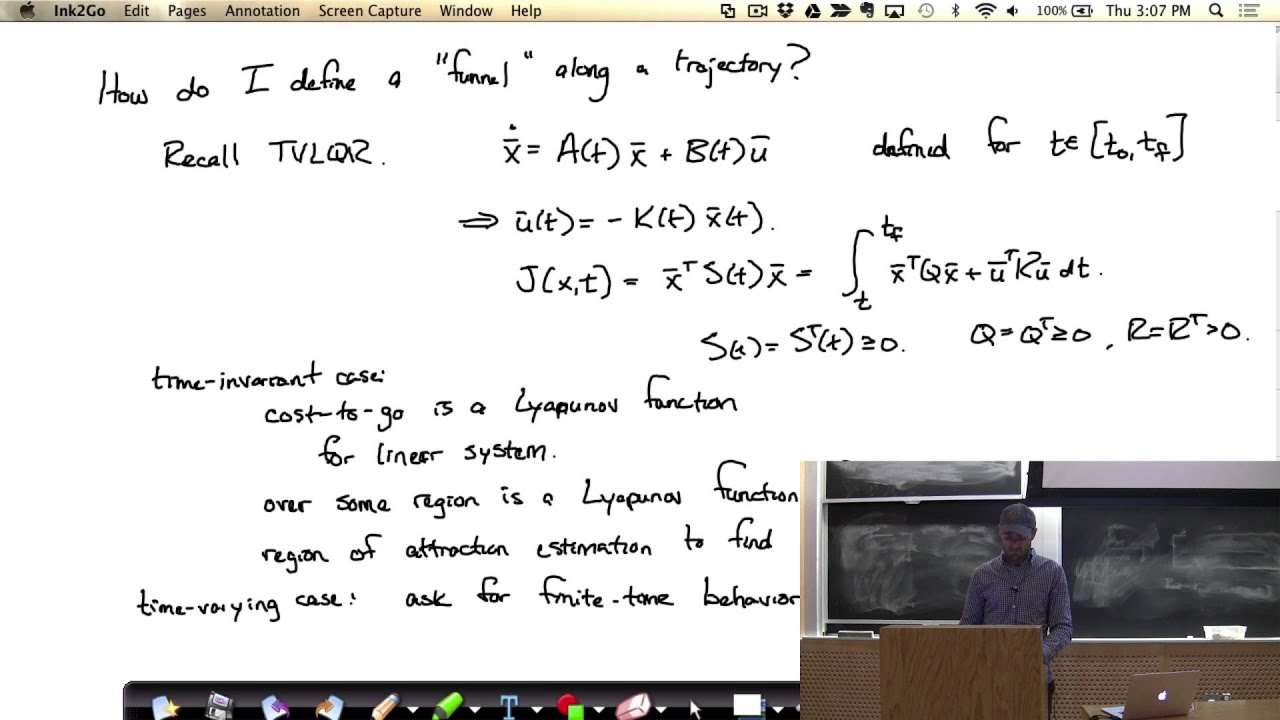
lecture19 final clip2 funnelsaroundtrajectories
Keywords
Summary
189 words
Critical Evaluation
The lecture provides a rigorous and insightful introduction to the concept of funnels around trajectories, a key tool in nonlinear control. The instructor, Russ Tedrake, is a leading expert in the field, and the content reflects his deep understanding. The presentation is mathematically precise, building on Lyapunov theory and sums-of-squares optimization, and it clearly explains the intuition behind the concepts. The argumentation is solid: the instructor motivates the need for funnels, derives the time-varying Lyapunov conditions, and highlights the importance of invariance over convergence. The use of a pendulum example helps ground the abstract ideas. However, the lecture assumes prior knowledge of LQR and Lyapunov stability, making it inaccessible to beginners. The video is a recording of a live lecture, so the quality is typical of such recordings, with some visual aids that may be hard to read. The sources are not explicitly cited in the video, but the instructor references the work of colleagues and mentions that the formulations are available in notes and papers. The title is somewhat vague but accurately reflects the content. Overall, the lecture is of high quality and provides valuable insights for advanced students and researchers in robotics and control.
196 words
Title / Content Match
The title is descriptive but incomplete; it indicates the topic (funnels around trajectories) but omits the lecture context.
Quality & Reliability
8/10
The lecture is part of MIT OpenCourseWare's Underactuated Robotics course, delivered by a recognized expert. It presents rigorous mathematical concepts (Lyapunov theory, sums-of-squares) with clear derivations and references to established literature. The content is technically sound, though it lacks formal citations in the video itself.
Key Moments
Markers derived by PSI from the transcript: the creator did not define chapters.
- Introduction: motivation for combining local controllers and trajectory optimization.
- Discussion on limitations of local stabilization for a pendulum.
- Introduction of the funnel concept and its history.
- Formulation of time-varying LQR and cost-to-go as Lyapunov function.
- Extension of region of attraction estimation to time-varying case.
- Definition of funnels as time-varying sublevel sets and conditions for convergence.
- Generalization to time-varying rho(t) and interpretation of moving boundaries.
- Use of sums-of-squares optimization to verify funnels.
- Key insight: invariance instead of convergence, and boundary conditions.
- Practical considerations: non-analytic trajectories and numerical robustness.
Cited Sources
- Underactuated Robotics course materials — Course notes and references for the lecture content.
Concurring Sources
- Underactuated Robotics course materials — The course notes likely contain the detailed formulations and references.
Contribution & Novelties
The lecture provides a clear pedagogical explanation of funnels around trajectories, a concept that is often scattered in research papers. It emphasizes the shift from convergence to invariance, which is crucial for practical implementation. The use of sums-of-squares for verification is highlighted as a powerful tool.
Pour aller plus loin :
- Sum-of-squares optimization — Relevant for the verification method used.
- Lyapunov stability — Foundational concept for the funnels.
- Trajectory optimization — Context for generating nominal trajectories.
76 words
Radar Profile
The radar profile shows high scores in technical level and information quality, with slightly lower scores in information quantity and reliability. This indicates a technically dense lecture with solid content, but limited breadth and formal citations.