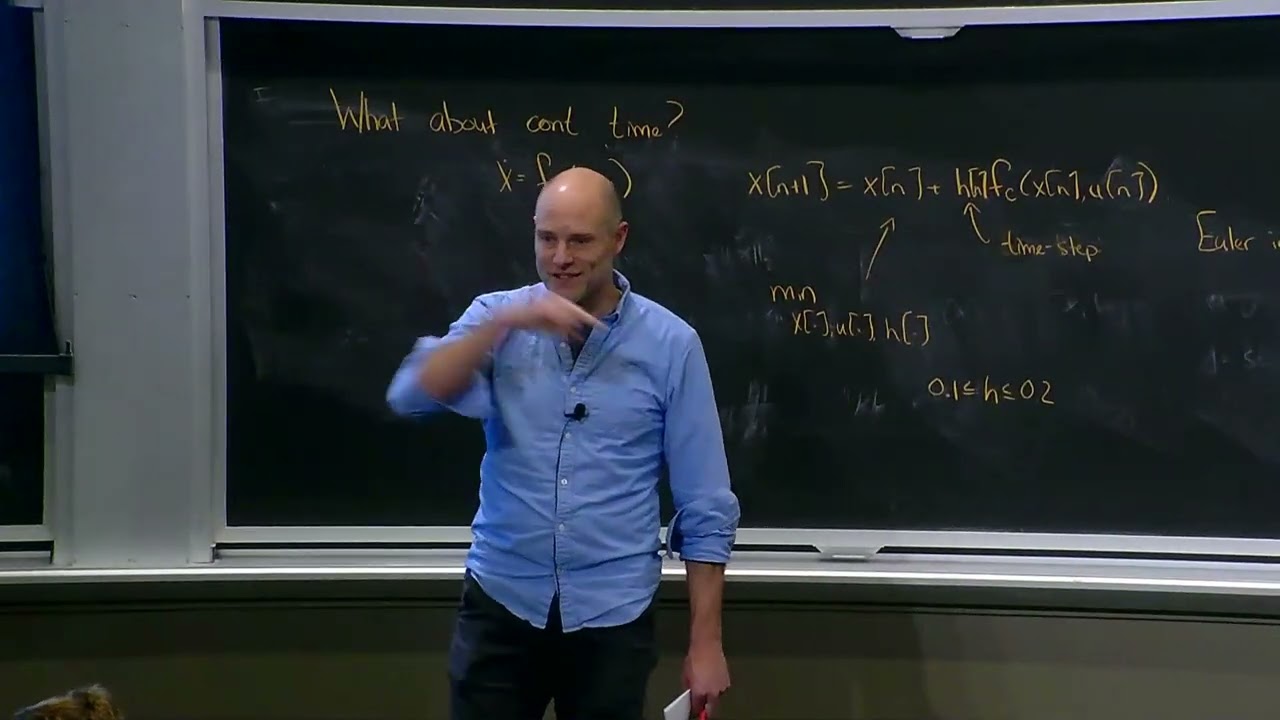
6.8210 Spring 2024 Lecture 11: Trajectory Optimization II
Keywords
Summary
147 words
Critical Evaluation
This lecture provides a rigorous and detailed exposition of trajectory optimization methods, specifically focusing on direct collocation. The instructor, a leading expert in the field, presents the material with clarity and depth, making it suitable for graduate-level students and researchers. The content is well-structured, building upon previous lectures and gradually introducing new concepts. The explanation of direct collocation is particularly strong, as it clearly derives the method from the idea of fitting a cubic spline through state and derivative samples, and then enforcing dynamics at collocation points. This approach demystifies the method and highlights its connection to numerical integration. The lecture also addresses practical considerations, such as the use of variable time steps and the potential pitfalls of allowing time to be a decision variable. The instructor’s emphasis on the trade-offs between accuracy and computational cost is valuable, as it reflects real-world engineering decisions. The sources cited are primarily the course notes and the instructor’s own textbook, which are authoritative in the field. The lecture does not include any commercial content or bias. The title accurately reflects the content, and the lecture delivers on its promise to cover trajectory optimization in depth. Overall, this is an excellent educational resource that provides both theoretical foundations and practical insights.
207 words
Title / Content Match
The title accurately reflects the content: a lecture on trajectory optimization, specifically covering direct collocation and related transcription methods.
Quality & Reliability
9/10
Lecture from MIT's graduate-level robotics course, presented by an expert in the field. Content is rigorous, well-structured, and based on established numerical optimization methods. No commercial bias detected.
Key Moments
Markers derived by PSI from the transcript: the creator did not define chapters.
- Introduction and logistics, including midterm and project proposal announcements.
- Review of direct transcription and direct shooting methods from previous lecture.
- Discussion on discretizing continuous time using numerical integration.
- Introduction of time step as a decision variable and its implications.
- Explanation of direct collocation method, using cubic splines and collocation points.
- Detailed derivation of the direct collocation constraints and the choice of collocation points.
- Example with double integrator, showing the benefits of variable time steps.
- Discussion on stabilization and the importance of accurate integration in trajectory optimization.
- Mention of receding horizon control and future topics.
Cited Sources
- Underactuated Robotics course notes — The course notes provide detailed derivations and additional examples for the topics covered in the lecture.
- Tedrake, R. (2023). Underactuated Robotics: Algorithms for Walking, Running, Swimming, Flying, and Manipulation (Course Notes). MIT. — The textbook is the primary reference for the course and contains the theoretical background for trajectory optimization.
Concurring Sources
- Betts, J. T. (2010). Practical Methods for Optimal Control and Estimation Using Nonlinear Programming. — This book provides a comprehensive treatment of direct transcription methods, including direct collocation, and is a standard reference in the field.
- Kelly, M. (2017). An Introduction to Trajectory Optimization: How to Do Your Own Direct Collocation. — This paper offers a tutorial on direct collocation, providing additional insights and examples.
Contribution & Novelties
This lecture provides a clear and accessible introduction to direct collocation, a key method in trajectory optimization. It bridges the gap between theory and practice by explaining the mathematical foundations and practical considerations. The lecture’s emphasis on the connection between numerical integration and transcription methods is particularly insightful.
Pour aller plus loin :
- Direct collocation method — Overview of the method and its applications.
- Cubic Hermite spline — Mathematical background for the spline interpolation used in direct collocation.
- Numerical integration — General concepts of numerical integration, relevant to the discretization of dynamics.
92 words
Radar Profile
The radar profile shows high scores across all dimensions, indicating a well-rounded and authoritative lecture. The strongest aspects are the quality of information and technical depth, while the quantity of information is also substantial. The lecture is highly reliable and provides a solid foundation for further study.