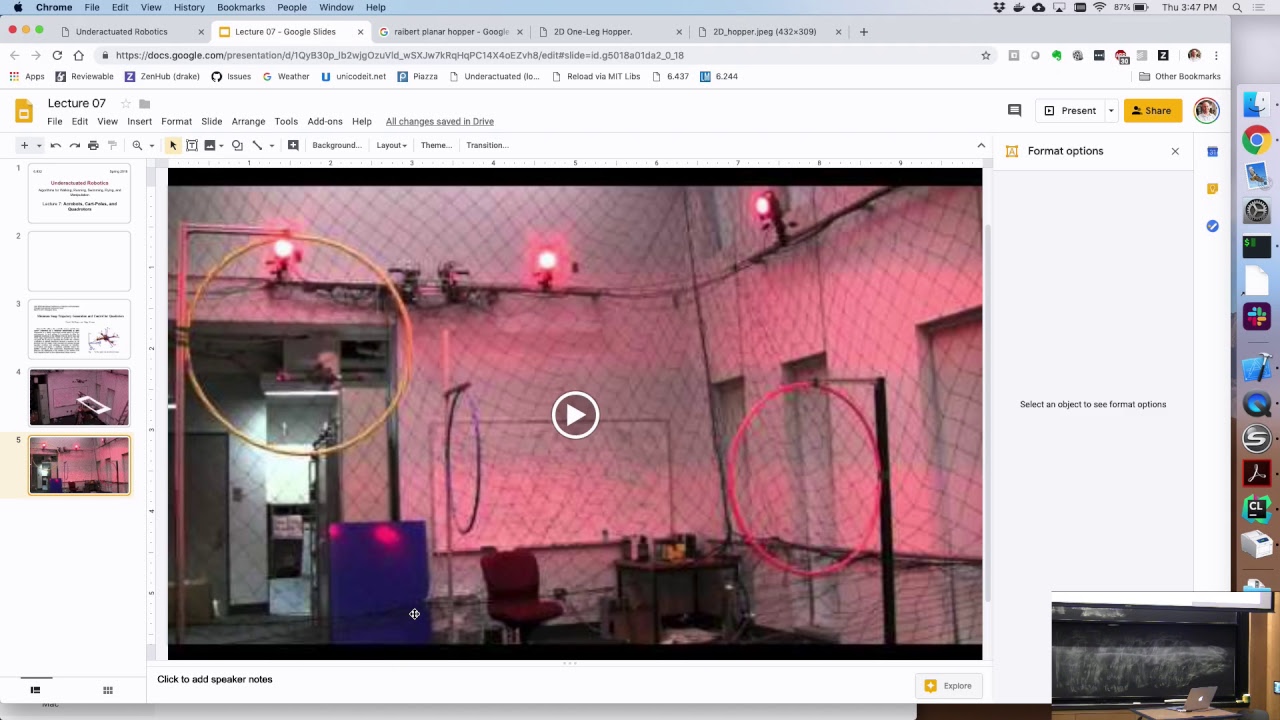
Lecture 7 | MIT 6.832 (Underactuated Robotics), Spring 2019
Keywords
Summary
167 words
Critical Evaluation
The lecture provides a rigorous and insightful treatment of partial feedback linearization and differential flatness, two fundamental tools in underactuated robotics. The instructor’s explanation is mathematically precise, deriving the conditions for controllability and highlighting the importance of inertial coupling. The use of the cart-pole and acrobot examples effectively illustrates the concepts, making them accessible despite the technical depth. The lecture is well-structured, building on previous material and connecting the ideas to practical applications. However, it lacks explicit citations to external sources, relying instead on the course’s own materials. The presentation is somewhat dense, and viewers without a strong background in dynamics may find it challenging. The discussion of differential flatness is brief and could benefit from more examples. Overall, the lecture is a valuable resource for graduate students and researchers in robotics, offering a solid conceptual foundation and practical insights. The instructor’s expertise is evident, and the content is accurate and up-to-date. The main limitation is the absence of references to the broader literature, which would enhance its scholarly value.
170 words
Title / Content Match
The title accurately reflects the content: a lecture on underactuated robotics, specifically covering partial feedback linearization and differential flatness.
Quality & Reliability
8/10
Lecture from MIT's Underactuated Robotics course, presented by a leading expert in the field. The content is rigorous, mathematically grounded, and based on established control theory. The lecture is part of a well-known open courseware series, ensuring academic credibility. However, as a lecture, it may not include the latest research or external citations.
Key Moments
Markers derived by PSI from the transcript: the creator did not define chapters.
- Introduction and recap of previous lecture on Lyapunov and energy pumping.
- Discussion of partial feedback linearization for cart-pole and the concept of collocated vs non-collocated control.
- Generalization of partial feedback linearization to manipulator equations with passive and actuated joints.
- Explanation of inertial coupling and its state-dependent nature, with examples.
- Introduction to differential flatness and its application to underactuated systems.
- Discussion of flat outputs and how they simplify planning and control.
- Examples of differentially flat systems and their properties.
- Comparison of partial feedback linearization and differential flatness.
- Conclusion and summary of key takeaways.
Cited Sources
- Underactuated Robotics Course Website — Official course website with lecture notes, assignments, and additional resources.
Concurring Sources
- Underactuated Robotics Course Website — The course website provides lecture notes and materials that align with the content of this lecture.
Contribution & Novelties
This lecture provides a clear and systematic exposition of partial feedback linearization and differential flatness, two powerful techniques for controlling underactuated systems. It clarifies the conditions under which these methods are applicable, particularly the role of inertial coupling. The lecture’s contribution lies in its pedagogical approach, making these advanced concepts accessible to students.
Pour aller plus loin :
- Underactuated Robotics Textbook — The accompanying textbook by Russ Tedrake, which expands on these topics.
- Differential Flatness - Wikipedia — Overview of differential flatness in control theory.
- Partial Feedback Linearization - Research Paper — A foundational paper on partial feedback linearization by Spong.
- Acrobot - Wikipedia — Background on the acrobot system used as an example.
114 words
Radar Profile
The radar profile shows high scores in information quality and technical level, indicating a technically rigorous and informative lecture. The quantity of information is also high, but the global reliability is slightly lower due to the lack of external citations. Overall, the lecture is a strong educational resource.