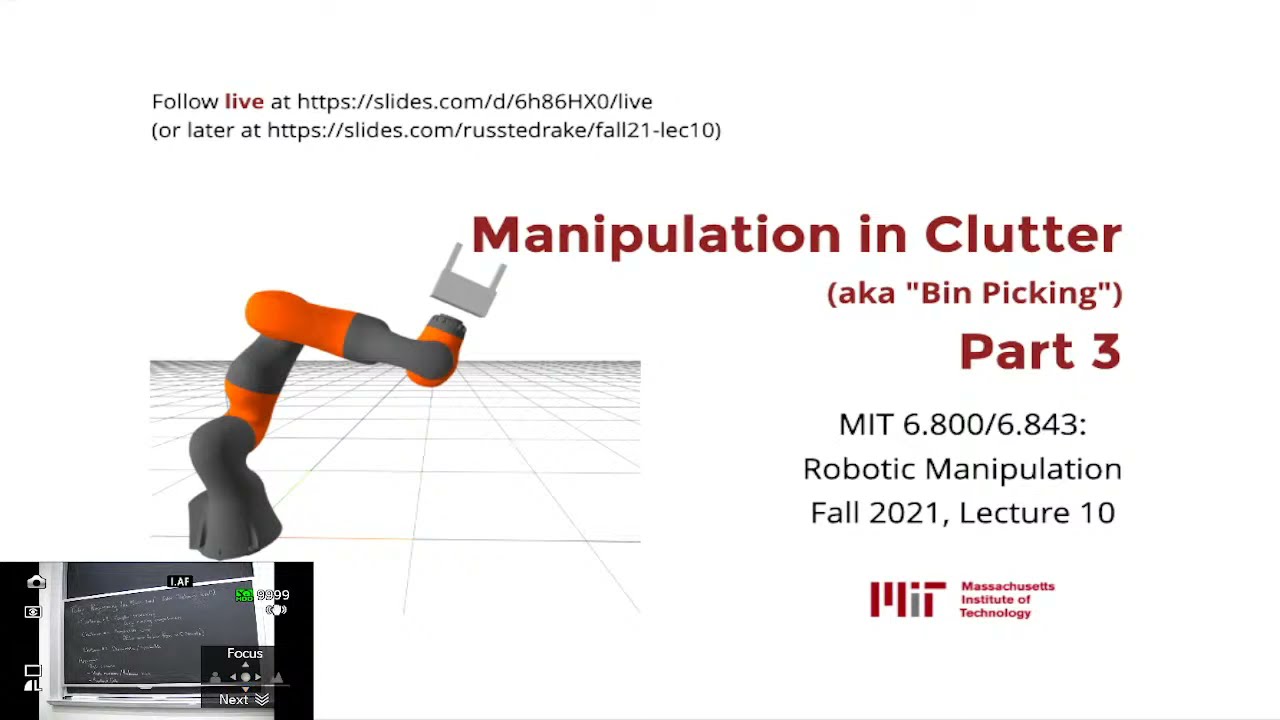
Lecture 10: MIT 6.800/6.843 Robotics Manipulation (Fall 2021) | "Manipulation in Clutter (Part 3)"
Keywords
Summary
164 words
Critical Evaluation
This lecture provides a valuable perspective on the practical challenges of robotic manipulation in cluttered environments, moving beyond idealized assumptions to address real-world failures. The instructor, Russ Tedrake, is a leading expert in the field, and his experience is evident in the concrete examples and the case study of the dish-loading system. The content is technically solid, introducing STRIPS and PDDL as formal planning languages, and correctly identifies the need for robust task-level planning to handle the uncertainty and branching inherent in such tasks. The lecture is well-structured, starting with a review of the pipeline and then systematically discussing failure modes, which sets the stage for the introduction of planning. The case study is particularly illuminating, showing how a complex task can be decomposed into primitives and sequenced using a planner. However, the lecture lacks explicit citations to external sources, which is typical for a lecture but limits the ability to verify claims. The discussion of the ‘contract’ between high-level logic and low-level control is insightful but could be more detailed. Overall, the lecture is rigorous and provides a solid foundation for understanding task planning in robotics. The title accurately reflects the content, and the lecture is suitable for an audience with some background in robotics. The main weakness is the absence of references, but the material is presented with sufficient clarity and authority. The lecture does not include any advertising or sponsored content.
234 words
Title / Content Match
The title accurately reflects the content: a lecture on manipulation in clutter, specifically addressing failure handling and task planning.
Quality & Reliability
8/10
Lecture from MIT OpenCourseWare by a recognized expert in robotics manipulation. Content is technically rigorous, based on established planning frameworks (STRIPS, PDDL) and practical experience. No citations to external sources, but the material is well-structured and grounded in the field.
Key Moments
Markers derived by PSI from the transcript: the creator did not define chapters.
- Introduction and administrative notes about GPU resources for projects.
- Review of the simplified bin-picking pipeline and identification of potential failure points.
- Discussion of the need for a more robust framework to handle branching and decision-making.
- Introduction to STRIPS and task planning as a solution.
- Case study: dish-loading system and its decomposition into primitives.
- Discussion of the contract between high-level logic and low-level control.
- Introduction to PDDL as a generalization of STRIPS.
- Conclusion and summary of key points.
Cited Sources
- Lecture slides — Slides for this lecture, providing visual aids and additional details.
Concurring Sources
- MIT OpenCourseWare — Hosts the course materials, aligning with the lecture's academic nature.
Contribution & Novelties
This lecture provides a practical perspective on handling failures in robotic manipulation, emphasizing the need for task-level planning. It bridges the gap between low-level control and high-level decision-making, using STRIPS as a formal framework. The case study of the dish-loading system offers a concrete example of how to decompose a complex task into primitives and sequence them.
Pour aller plus loin :
- STRIPS — Foundational planning language discussed in the lecture.
- PDDL — Modern generalization of STRIPS, mentioned as PDDL.
- Robotic manipulation — Overview of the field, relevant to the lecture’s context.
92 words
Radar Profile
The radar profile shows high scores across all dimensions, indicating a well-rounded and informative lecture. The balance between technical depth and practical examples is particularly strong.