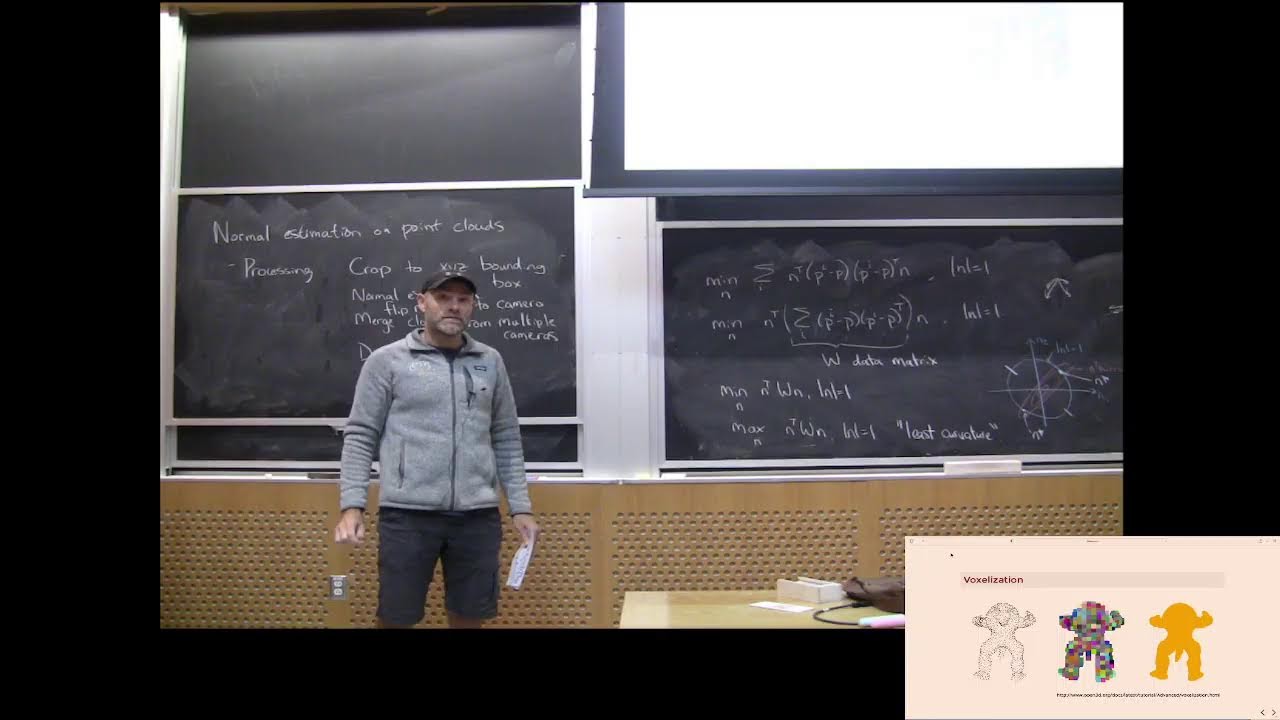
Fall 2022 6.4210/2 Lecture 9: Grasp selection
Keywords
Summary
154 words
Critical Evaluation
The lecture provides a comprehensive overview of grasp selection, bridging classical analytical methods and modern learning-based techniques. The instructor’s expertise is evident, and the content is well-structured, progressing from basic concepts like form closure to more advanced topics like force closure and contact wrenches. The presentation is clear, with mathematical formulations and intuitive examples. The lecture is particularly valuable for its balanced perspective: it acknowledges the limitations of classical methods in real-world scenarios while also showing that pure geometric reasoning can be surprisingly effective, as demonstrated by the student project. The discussion of deep learning approaches, such as DexNet, is timely and relevant. However, the lecture is a single perspective and does not include a formal literature review or citations to specific papers, which limits its use as a standalone reference. The technical depth is high, but some concepts may require prior knowledge of robotics and mechanics. The adéquation between title and content is excellent. Overall, this is a high-quality educational resource that offers valuable insights into the state of the art in robotic grasping.
175 words
Title / Content Match
The title accurately reflects the content: a lecture on grasp selection, covering both classical and learning-based methods.
Quality & Reliability
8/10
Lecture from MIT course 6.4210/2, presented by an expert in robotics. The content is technically rigorous, grounded in classical grasp analysis and modern learning-based approaches. The presentation is clear and well-structured, with references to established concepts (form closure, force closure, friction cones) and recent research (DexNet, deep learning for grasping). The video is a formal educational resource, though it lacks peer-reviewed citations and is a single perspective.
Key Moments
Markers derived by PSI from the transcript: the creator did not define chapters.
- Introduction and recap of previous lectures on pick and place.
- Discussion of the task of clearing a bin and the challenges of unknown objects.
- Introduction to contact mechanics and the friction cone.
- Comparison of classical grasp analysis and deep learning approaches.
- Definition of form closure and its formal conditions.
- Introduction to force closure and static analysis.
- Explanation of contact wrenches and the grasp matrix.
- Geometric reasoning approach to grasp selection without deep learning.
- Combining geometric reasoning with deep learning for robust grasping.
- Conclusion and summary of key takeaways.
Cited Sources
- Lecture slides — The slides used in the lecture, containing the detailed content and figures.
Concurring Sources
- Handbook of Robotics — The instructor references chapters on grasping from the Handbook of Robotics, which provide classical analysis methods.
Contribution & Novelties
The lecture provides a clear and accessible synthesis of classical grasp analysis and modern learning-based methods, highlighting the trade-offs and offering a practical geometric reasoning alternative. It emphasizes the importance of understanding the friction cone and contact wrenches for robust grasping.
Pour aller plus loin :
- Form closure - Wikipedia — Provides a formal definition and examples of form closure in grasping.
- Force closure - Wikipedia — Explains the concept of force closure and its relation to friction.
- DexNet - Berkeley — A deep learning approach to grasping, mentioned in the lecture.
92 words
Radar Profile
The radar profile shows high scores in information quantity, quality, and technical level, with a slightly lower but still strong reliability score. This indicates a dense, well-presented, and technically rigorous lecture, though it relies on a single source (the instructor) and lacks external citations.