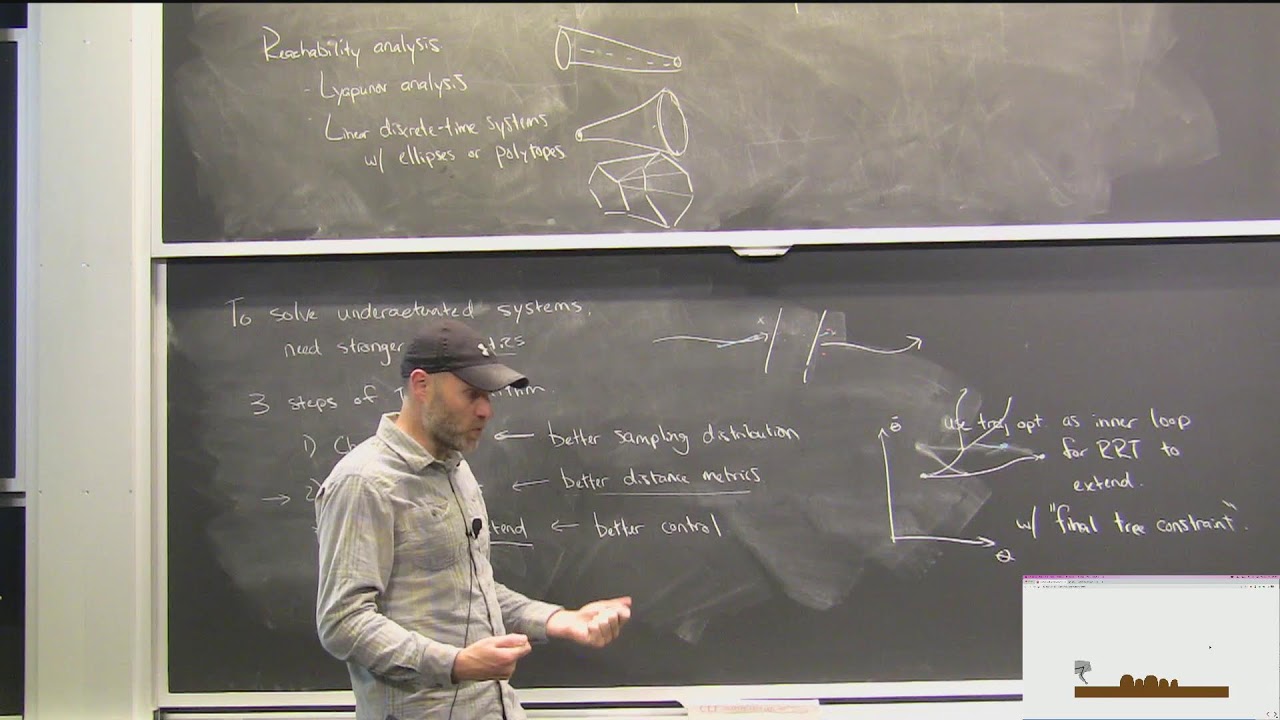
Lecture 19: MIT 6.832 Underactuated Robotics (Spring 2022) | "Global Motion Planning"
Keywords
Summary
137 words
Critical Evaluation
This lecture provides a rigorous and insightful introduction to global motion planning, specifically focusing on sampling-based methods. The instructor, a leading expert in the field, effectively motivates the need for these algorithms by highlighting the limitations of trajectory optimization in complex, cluttered environments. The use of real-world examples, such as the DARPA Robotics Challenge and UAV navigation, grounds the theoretical concepts in practical applications. The explanation of the Probabilistic Roadmap (PRM) algorithm is thorough, covering its key components: sampling, collision checking, and graph construction. The concept of probabilistic completeness is clearly defined and contrasted with deterministic completeness, providing a nuanced understanding of the algorithm’s guarantees. The lecture also touches on important practical considerations, such as the approximate nature of collision checking and the trade-offs between grid-based and sampling-based discretizations. The instructor’s pedagogical approach is effective, building on previous lectures and connecting to broader themes in robotics. The content is well-structured and accessible to an audience with a background in robotics or optimization. The lecture does not include formal citations on slides, but the academic context and the instructor’s expertise ensure high reliability. The title accurately reflects the content, and the lecture successfully achieves its goal of introducing global motion planning concepts. Overall, this is an excellent educational resource that balances theoretical depth with practical insights.
215 words
Title / Content Match
The title accurately reflects the content: a lecture on global motion planning, focusing on sampling-based methods and their application to underactuated robotics.
Quality & Reliability
9/10
Lecture from MIT's graduate-level course, presented by a leading expert in robotics. Content is rigorous, well-structured, and based on established algorithms and literature. The presentation includes clear explanations, examples, and references to key works. Minor limitations: no formal citations in slides, but the academic context and quality of exposition ensure high reliability.
Key Moments
Markers derived by PSI from the transcript: the creator did not define chapters.
- Introduction and motivation for global motion planning, referencing complex tasks like the DARPA Robotics Challenge and UAV navigation.
- Discussion of the limitations of trajectory optimization in local minima, using the example of a UAV navigating through a forest.
- Introduction to kinematic motion planning and the canonical problem of a point robot navigating through obstacles.
- Comparison of grid-based discretization with sampling-based methods, highlighting the issue of completeness.
- Detailed explanation of the Probabilistic Roadmap (PRM) algorithm, including sampling, collision checking, and graph construction.
- Discussion of probabilistic completeness and the advantages of randomness in sampling-based planning.
- Further insights into PRM properties, including multi-query capabilities and practical considerations.
Cited Sources
- Planning Algorithms — Recommended as a comprehensive book on motion planning, covering both kinematic and sampling-based methods.
Concurring Sources
- Probabilistic Roadmaps for Path Planning in High-Dimensional Configuration Spaces — Original paper introducing PRM, providing theoretical foundations and experimental results.
Contribution & Novelties
This lecture provides a clear and rigorous introduction to global motion planning, specifically focusing on sampling-based methods like PRM. It bridges the gap between trajectory optimization and discrete search, offering a foundation for understanding more advanced planning algorithms. The lecture’s strength lies in its pedagogical clarity and the way it connects theoretical concepts to practical robotics challenges.
Pour aller plus loin :
- Probabilistic Roadmap Method — Overview of PRM and its variants.
- Rapidly-exploring Random Tree (RRT) — A related sampling-based planner widely used in robotics.
- Motion Planning — General overview of the field and its challenges.
96 words
Radar Profile
The radar profile shows high scores in information quantity, quality, and reliability, with a slightly lower but still strong technical level. This indicates a lecture that is both comprehensive and accessible, balancing depth with clarity.