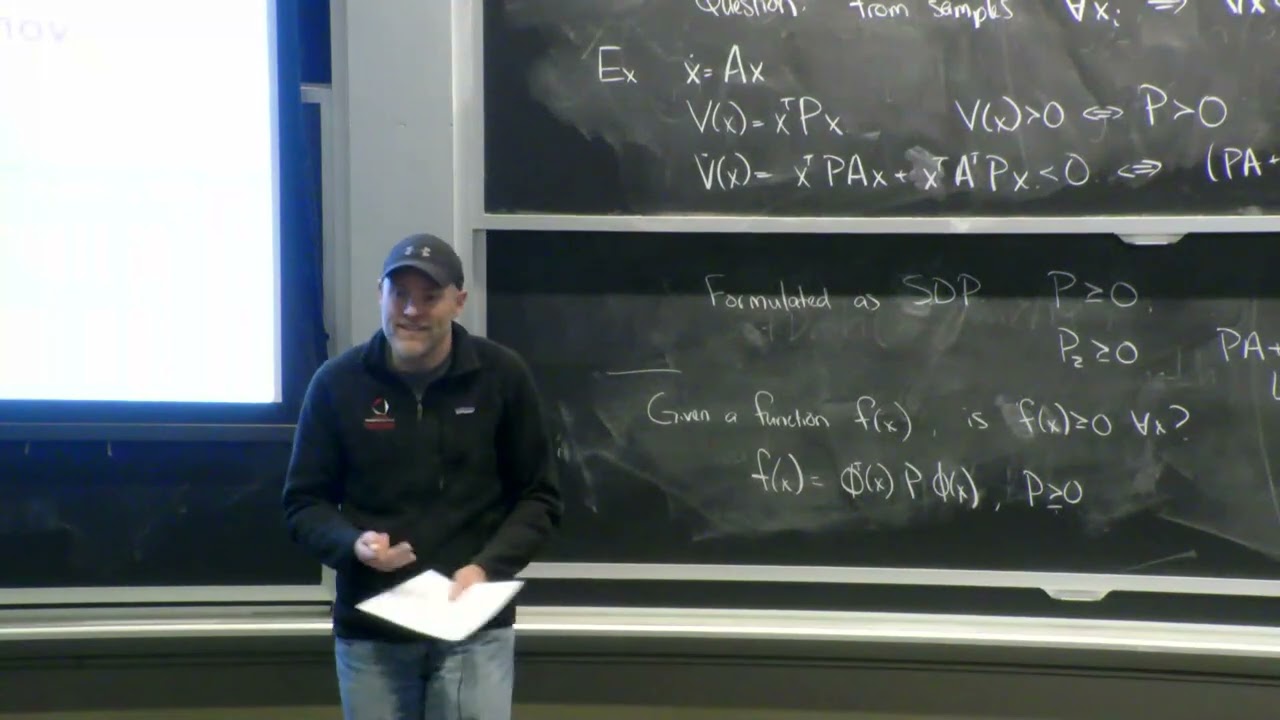
6.8210 Spring 2024 Lecture 9: Computing Lyapunov Functions II
Keywords
Summary
134 words
Critical Evaluation
This lecture provides a rigorous and insightful introduction to computing Lyapunov functions using sum-of-squares (SOS) programming. The instructor, a leading expert in the field, clearly explains the mathematical foundations and practical implementation details. The content is well-structured, building from the basics of Lyapunov theory to the advanced use of semidefinite programming (SDP) for nonlinear systems. The lecture excels in connecting theoretical concepts with computational tools, making it highly valuable for graduate students and researchers in control theory and robotics.
The argumentation is solid, with careful derivations and illustrative examples. The instructor emphasizes the importance of certification and the limitations of sampling-based approaches, which is a crucial point for ensuring reliability in safety-critical applications. The use of SOS as a certificate for non-negativity is well-motivated, and the lecture provides a clear path from the problem formulation to the SDP solution.
However, the lecture assumes a certain level of prior knowledge in linear algebra and optimization, which may be challenging for beginners. Some concepts, such as the choice of basis functions and the computational complexity of SDP, are only briefly touched upon. Additionally, the lecture does not delve into the potential conservatism of SOS methods or compare them with alternative approaches in detail.
The sources cited are primarily the instructor’s own course materials and standard references in the field, which are appropriate for a lecture. The lecture does not include a formal bibliography, but the content is consistent with established literature on SOS and Lyapunov analysis.
Overall, this is an excellent lecture that provides a deep understanding of a powerful technique for verifying stability of nonlinear systems. It is particularly valuable for those interested in formal guarantees and safety-critical control.
278 words
Title / Content Match
The title accurately reflects the content: the lecture focuses on computing Lyapunov functions using sum-of-squares and semidefinite programming, continuing from a previous lecture.
Quality & Reliability
8/10
Lecture from MIT's Underactuated Robotics course, presented by an expert in the field. The content is mathematically rigorous, with clear explanations of convex optimization and sum-of-squares techniques. The presentation is well-structured and builds on previous lectures. The main limitation is that it is a lecture, not a peer-reviewed publication, and some details are glossed over.
Key Moments
Markers derived by PSI from the transcript: the creator did not define chapters.
- Introduction and recap of previous lecture on Lyapunov functions and convex optimization.
- Discussion of linear matrix inequalities (LMIs) and semidefinite programming (SDP) for linear systems.
- Introduction to sum-of-squares (SOS) decomposition as a certificate for non-negativity.
- Example of SOS decomposition for a simple polynomial.
- Explanation of how to set up an SOS program using SDP solvers.
- Discussion on choosing basis functions and monomial basis.
- Practical considerations: numerical tolerance and certificates.
- Preview of algorithms for computing Lyapunov functions using SOS.
- Conclusion and summary of key takeaways.
Cited Sources
- Underactuated Robotics (course website) — Course materials and lecture notes for 6.8210.
Concurring Sources
- Underactuated Robotics (course website) — Course materials and lecture notes for 6.8210.
Contribution & Novelties
This lecture provides a clear and accessible explanation of how to compute Lyapunov functions using sum-of-squares programming, bridging the gap between theoretical control theory and practical computational tools. It emphasizes the importance of formal certificates for stability verification, which is crucial for safety-critical systems.
Pour aller plus loin :
- Sum-of-squares optimization — Provides an overview of SOS optimization and its applications.
- Semidefinite programming — Background on SDP, the underlying optimization framework.
- Lyapunov stability — Foundational concept in control theory.
- Parrilo’s thesis on SOS — Seminal work on SOS and SDP for control.
92 words
Radar Profile
The radar profile shows high scores in technical level and information quality, indicating a mathematically rigorous and well-presented lecture. The lower score in information quantity reflects the focused scope of the lecture, which is appropriate for a single session.