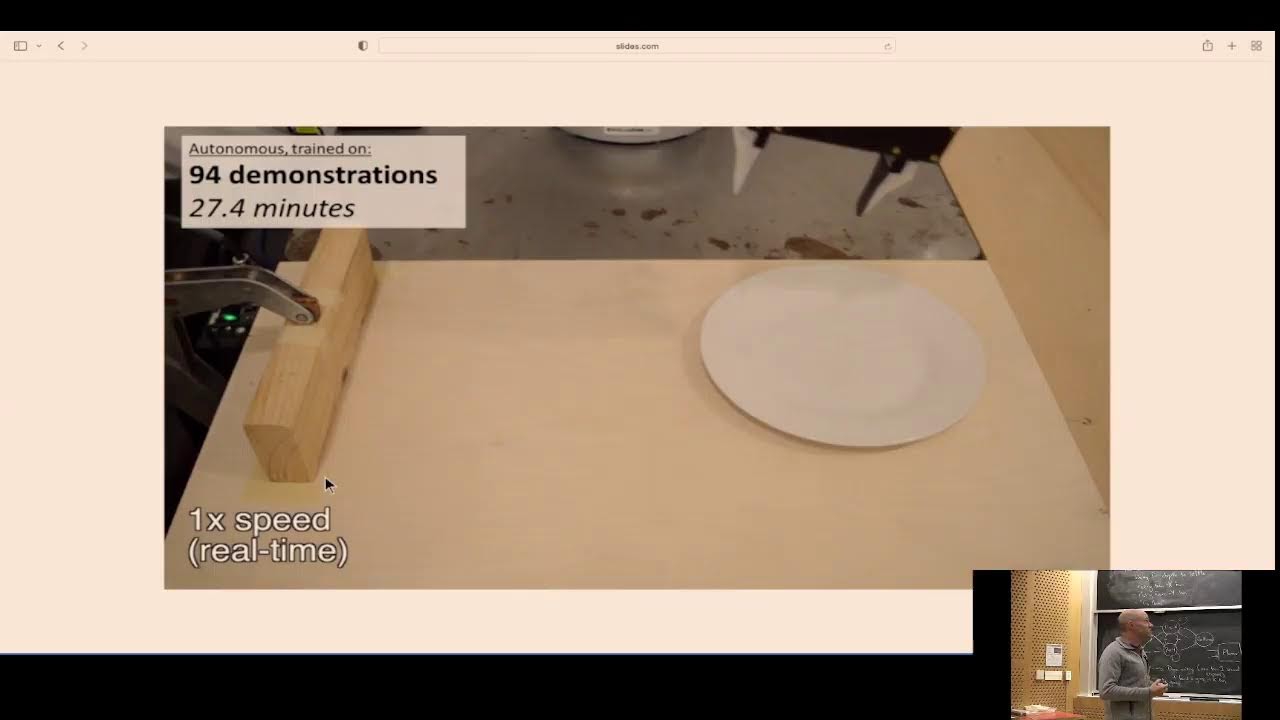
Fall 2022 6.4210/2 Lecture 10: Programming tasks
Keywords
Summary
145 words
Critical Evaluation
The lecture provides a solid introduction to the challenges and tools for programming robot manipulation tasks. The instructor, Russ Tedrake, is a renowned expert in robotics, and his explanations are grounded in both theoretical principles and practical experience. The revisit of friction cones and wrench spaces is particularly valuable, as it clarifies a fundamental concept that is often misunderstood. The use of a 3D visualization helps to make the abstract mathematics more intuitive. The discussion of state machines and PDDL is well-motivated, showing how these tools can be used to structure complex behaviors. However, the lecture is primarily an overview, and it does not delve deeply into the implementation details of these tools. The lack of formal citations is a minor weakness, but the content is consistent with established robotics literature. The title accurately reflects the content, and the lecture is well-structured, with clear transitions between topics. Overall, this is a high-quality educational resource that would benefit students and practitioners interested in robotic manipulation.
164 words
Title / Content Match
The title accurately reflects the content: the lecture focuses on programming tasks for robot manipulation, including task authoring and state machines.
Quality & Reliability
8/10
Lecture by a leading expert in robotics (Russ Tedrake) from MIT, based on established theory (friction cones, wrench spaces) and practical experience. The content is well-structured and pedagogically sound, though it lacks formal citations and is primarily an educational presentation.
Key Moments
Markers derived by PSI from the transcript: the creator did not define chapters.
Cited Sources
- Lecture slides — Slides used during the lecture, containing visualizations and key concepts.
Concurring Sources
- Robotic Manipulation: Perception, Planning, and Control — Course website by Russ Tedrake, providing comprehensive materials on robotic manipulation.
Contribution & Novelties
The lecture provides a clear pedagogical explanation of friction cones and wrench spaces, enhanced by a custom 3D visualization. It also offers a practical introduction to task authoring using state machines and PDDL, bridging theory and implementation.
Pour aller plus loin :
- Robotic Manipulation: Perception, Planning, and Control — Course website with additional resources and lecture notes.
- PDDL - Planning Domain Definition Language — Overview of the planning language used in AI planning.
- State Machine — Fundamental concept in computer science and robotics for modeling behavior.
86 words
Radar Profile
The radar profile shows high scores in information quantity, quality, and reliability, with a slightly lower technical level, indicating a well-balanced educational resource that is both informative and accessible.