6.8210 Spring 2024 Lecture 16: Humanoid Robots
Keywords
Summary
208 words
Critical Evaluation
This lecture provides a rigorous and insightful overview of model-based control for humanoid robots, delivered by a leading expert in the field. The content is highly technical and assumes a solid background in robotics, dynamics, and control theory. The instructor effectively builds upon previous lectures in the series, referencing the mathematical framework for hybrid dynamics and stability, and then introduces the key insight that with high degrees of freedom, the problem becomes tractable again through abstraction. The spacecraft thought experiment is a clever pedagogical tool that clarifies the separation of center-of-mass dynamics from joint dynamics, a fundamental concept in humanoid control. The lecture is well-structured, with clear explanations and mathematical derivations. The use of notation is heavy but necessary for the complexity of the topic. The instructor also provides practical context by referencing real humanoid robots like ASIMO and Atlas, and discusses the current state of the art in the field. The sources cited are primarily the instructor’s own textbook and research, which are highly credible. The lecture does not include any advertising or sponsorship. The title accurately reflects the content. Overall, this is an excellent lecture that provides deep insights into the challenges and solutions in humanoid robot control, making it a valuable resource for advanced students and researchers in robotics.
212 words
Title / Content Match
The title accurately reflects the content, which focuses on humanoid robot control and planning.
Quality & Reliability
9/10
Lecture by a leading MIT professor, based on established robotics theory and research, with clear mathematical derivations and references to real systems. High reliability.
Key Moments
Markers derived by PSI from the transcript: the creator did not define chapters.
- Introduction to the lecture and overview of model-based control for humanoids.
- Discussion of the increasing complexity with more degrees of freedom and the key message that things get easier with enough joints.
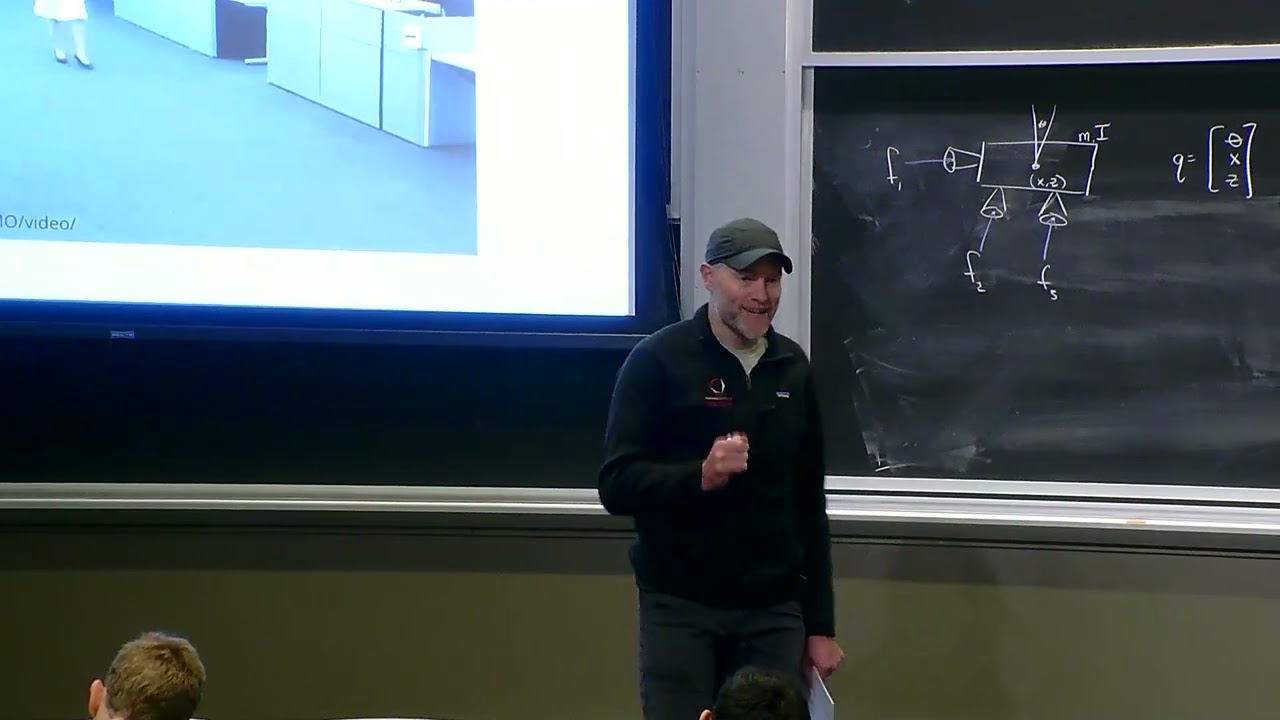
- Introduction of the spacecraft thought experiment to illustrate the separation of center-of-mass dynamics.
- Derivation of the equations of motion for a single rigid body with thrusters, emphasizing the importance of frame parameterization.
- Discussion of the challenges of planning with contact regions and the need for trajectory optimization.
- Introduction of the concept of centroidal dynamics and its role in humanoid control.
- Discussion of whole-body control and the use of LQR for stabilization.
- Examples of humanoid robots and the application of model-based methods in practice.
- Conclusion and summary of the key takeaways from the lecture.
Cited Sources
- Underactuated Robotics (course textbook) — The lecture is based on the instructor's textbook, which provides the theoretical foundation for the course.
- Drake (robotics toolbox) — The instructor references the Drake toolbox for multibody dynamics and optimization, which is used in the course.
Concurring Sources
- Underactuated Robotics (course textbook) — The lecture is based on the instructor's textbook, which provides the theoretical foundation for the course.
- Drake (robotics toolbox) — The instructor references the Drake toolbox for multibody dynamics and optimization, which is used in the course.
Contribution & Novelties
This lecture provides a clear and insightful perspective on model-based control for humanoid robots, emphasizing the importance of abstraction and the separation of center-of-mass dynamics from joint dynamics. The spacecraft thought experiment is a novel pedagogical approach that helps students grasp this key concept. The lecture also highlights the challenges of planning with contact constraints and the role of trajectory optimization and LQR in addressing them.
Pour aller plus loin :
- Centroidal dynamics — A key concept in humanoid control, separating the center-of-mass dynamics from the joint dynamics.
- Whole-body control — A control approach that coordinates all degrees of freedom to achieve tasks while maintaining balance.
- Model predictive control — A control method that uses an optimization-based approach to compute control actions over a finite horizon, often used in humanoid control.
131 words
Radar Profile
The radar profile shows high scores across all dimensions, indicating a lecture that is rich in information, technically deep, and highly reliable. The balance between quantity and quality is excellent, with a strong emphasis on technical rigor.