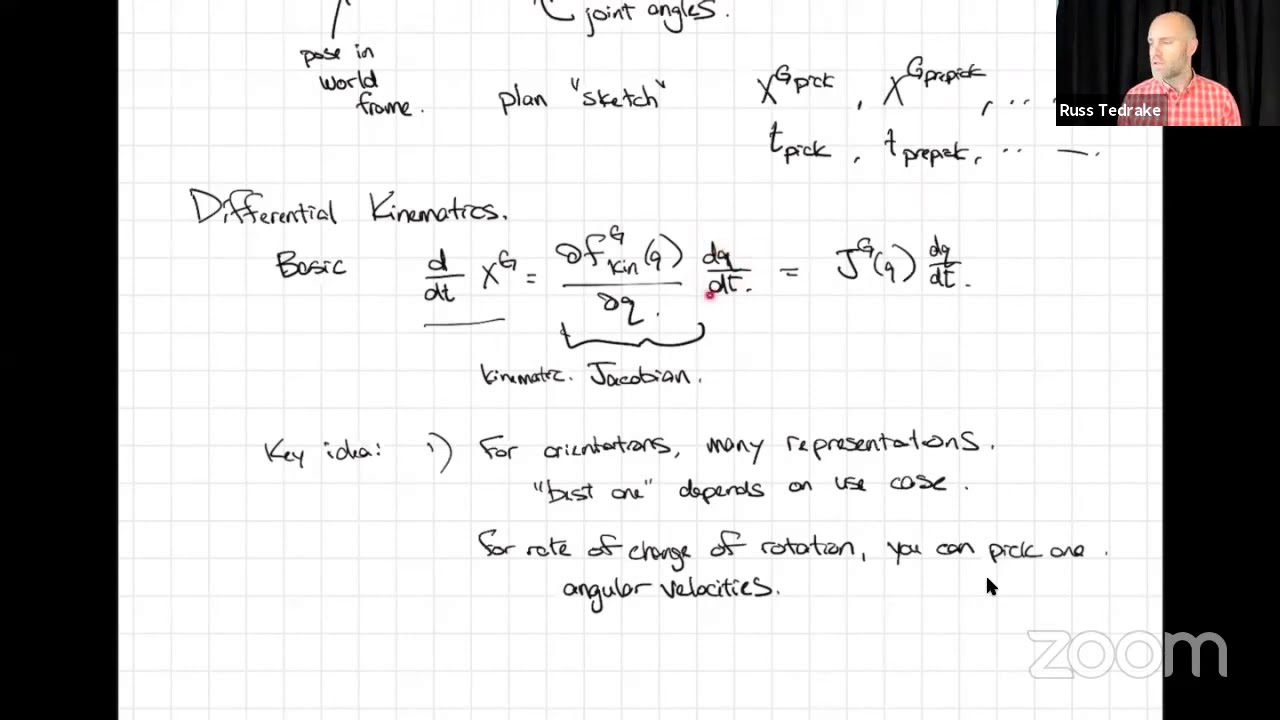
Lecture 4 | MIT 6.881 (Robotic Manipulation), Fall 2020 | Basic Pick and Place Part 2
Keywords
Summary
139 words
Critical Evaluation
The lecture provides a solid foundation in differential kinematics for robotic manipulation. The instructor, Russ Tedrake, is a renowned expert in robotics, and the content is well-structured and pedagogically effective. He clearly explains the concept of the Jacobian and its role in relating joint velocities to end-effector velocities, using intuitive examples and visual aids. The discussion on rotation representations is particularly valuable, as it clarifies why angular velocity is a preferred choice for velocity computations, avoiding issues like gimbal lock. The lecture is technically rigorous, with mathematical derivations and references to a textbook and slides. However, it is a lecture, not a peer-reviewed source, and some parts rely on live demonstrations that may not be fully accessible to all viewers. The adéquation titre/contenu is excellent, as the title accurately describes the content. The lecture does not include any advertising or sponsored content. Overall, the information is reliable and valuable for students and practitioners in robotics, though it requires a certain level of prior knowledge to fully benefit.
167 words
Title / Content Match
The title accurately reflects the content: a lecture on basic pick and place, part 2, covering differential kinematics and trajectory planning.
Quality & Reliability
8/10
Lecture from MIT OpenCourseWare by an expert in robotics, with clear explanations and references to a textbook and slides. The content is technically sound and well-structured, though it is a lecture rather than peer-reviewed research.
Key Moments
Markers derived by PSI from the transcript: the creator did not define chapters.
- Introduction and plan for the lecture: basic pick and place, differential kinematics.
- Review of forward kinematics and the need for differential kinematics.
- Introduction to the Jacobian matrix and its role in relating joint and end-effector velocities.
- Discussion on rotation representations: rotation matrices, quaternions, Euler angles, axis-angle.
- Explanation of angular velocity and why it is sufficient for velocity computations.
- Derivation of the Jacobian for a robotic arm and its dependence on joint configuration.
- Discussion on inverse differential kinematics and its applications.
- Practical example: using the Jacobian to command the robot for pick and place.
- Interactive notebook demonstration and experiments.
- Conclusion and summary of key concepts.
Cited Sources
- Robotic Manipulation Textbook — The textbook website for the course, providing additional material and references.
- Live Slides for Lecture 4 — The slides used during the lecture, containing the visual aids and derivations.
Concurring Sources
- Modern Robotics: Mechanics, Planning, and Control — A widely used textbook covering similar topics in robotics, including kinematics and Jacobians.
Contribution & Novelties
This lecture provides a clear and accessible introduction to differential kinematics for robotic manipulation, emphasizing the practical use of the Jacobian for pick and place tasks. It clarifies the choice of rotation representations and angular velocity, which is often a source of confusion. The lecture is part of a comprehensive course, offering a structured learning path.
Pour aller plus loin :
- Jacobian matrix and determinant — Provides mathematical background on Jacobians.
- Rotation representation — Overview of different rotation representations and their properties.
- Gimbal lock — Explanation of the phenomenon that motivates the use of angular velocity.
96 words
Radar Profile
The radar profile shows high scores across all dimensions, indicating a well-balanced and comprehensive lecture. The technical depth is appropriate for an advanced undergraduate or graduate course, and the information is both accurate and well-presented.
💬 No comments were provided for analysis.