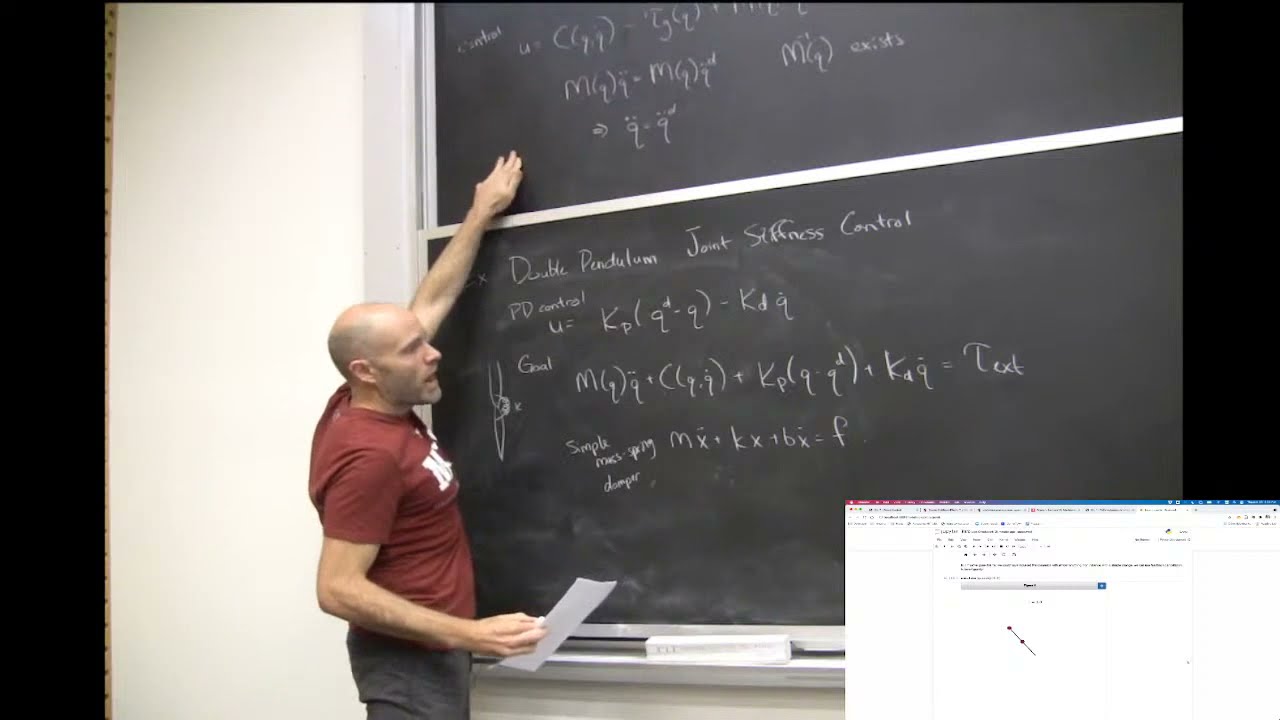
Lecture 14: MIT 6.800/6.843 Robotics Manipulation (Fall 2021) | "Manipulator Control"
Keywords
Summary
194 words
Critical Evaluation
The lecture is a high-quality educational resource, delivered by an expert in the field. The content is well-structured, building from basic concepts to more advanced topics. The instructor uses clear examples, such as the double pendulum, to illustrate abstract ideas like feedback canceling control. The mathematical derivations are presented in a way that is accessible to students with a background in robotics and control theory. The lecture emphasizes practical considerations, such as the limitations of model-based control and the importance of torque limits. The use of slides and references enhances the learning experience. The title accurately reflects the content, which is focused on manipulator control. The lecture is part of a broader course, so it assumes prior knowledge from previous lectures, but it is still self-contained enough for a general audience interested in robotics. The only minor criticism is that the lecture could benefit from more visual demonstrations of the concepts, but the instructor’s explanations are clear. Overall, this is an excellent lecture that provides valuable insights into force control for robotic manipulation.
173 words
Title / Content Match
The title accurately describes the lecture content on manipulator control.
Quality & Reliability
9/10
Lecture from MIT OpenCourseWare by an expert professor, based on established robotics theory, with slides and references. High reliability.
Key Moments
Markers derived by PSI from the transcript: the creator did not define chapters.
- Introduction and recap of force control concepts
- Introduction to feedback canceling control
- Example of making a double pendulum act like a single pendulum
- Discussion of limitations and underactuation
- Introduction to stiffness control
- Mathematical formulation of stiffness control
- Discussion of practical considerations and torque limits
- Preview of case studies on Franka robots
Cited Sources
- Lecture slides — Slides used in the lecture, containing the main content and references.
Concurring Sources
- Underactuated Robotics — Companion course by the same instructor, covering similar topics.
Contribution & Novelties
The lecture provides a clear and rigorous introduction to force and stiffness control for robotic manipulators, building on the concept of feedback canceling control. It offers a pedagogical approach that connects theoretical concepts to practical applications. The lecture is part of a well-known MIT course, and the slides are publicly available.
Pour aller plus loin :
- Underactuated Robotics — The companion course by Russ Tedrake, covering related topics in depth.
- Impedance Control — A related concept in robotics, providing a broader perspective on interaction control.
- Manipulator equation — Background on the dynamic model used in the lecture.
97 words
Radar Profile
The radar profile shows high scores across all dimensions, indicating a well-balanced and comprehensive lecture. The strong scores in information quantity and quality reflect the depth of content, while the technical level is appropriate for an advanced undergraduate or graduate audience. The high reliability score is consistent with the instructor's expertise and the academic context.
💬 No comments were provided for analysis.