Lecture 22 for MIT 6.832 (Underactuated Robotics)
Keywords
Summary
158 words
Critical Evaluation
This lecture provides an excellent synthesis of the state of the art in underactuated robotics, offering a critical perspective on the limitations of model-based control methods. Tedrake’s argument that these methods are heavily dependent on accurate models and full-state feedback is well-founded and supported by examples from his own research and the broader field. He candidly admits that for simple systems like a pendulum, hand-crafted energy shaping controllers outperform the best computational tools, which is a refreshing and honest assessment. The lecture effectively motivates the need for learning-based approaches, particularly for systems where models are difficult to obtain, such as in fluid dynamics. The discussion of output feedback control is particularly insightful, highlighting the surprising difficulty of even static output feedback for linear systems. Tedrake’s expertise is evident throughout, and he provides a clear roadmap for future research directions. The lecture is well-structured, with a logical flow from summarizing past methods to introducing new paradigms. The content is highly relevant for advanced students and researchers in robotics and control. The only minor weakness is that the lecture is an overview and does not delve into the technical details of learning control methods, but this is appropriate for a final lecture that aims to provide context and motivation. Overall, this is an outstanding lecture that offers valuable insights and critical thinking about the field.
223 words
Title / Content Match
The title accurately reflects the content: a lecture on underactuated robotics, focusing on learning and output feedback.
Quality & Reliability
9/10
Lecture by a leading expert in robotics, providing a high-level overview of the field, discussing limitations of model-based methods and introducing learning-based approaches. The content is well-structured, technically accurate, and reflects deep expertise.
Key Moments
Markers derived by PSI from the transcript: the creator did not define chapters.
- Introduction and summary of the course's computational methods.
- Discussion of the two major flaws of model-based methods: model dependence and full-state feedback.
- Comparison of computational tools to energy shaping control for a pendulum.
- Introduction to the output feedback problem and its difficulty even for linear systems.
- Motivation for learning control from biology and fluid dynamics.
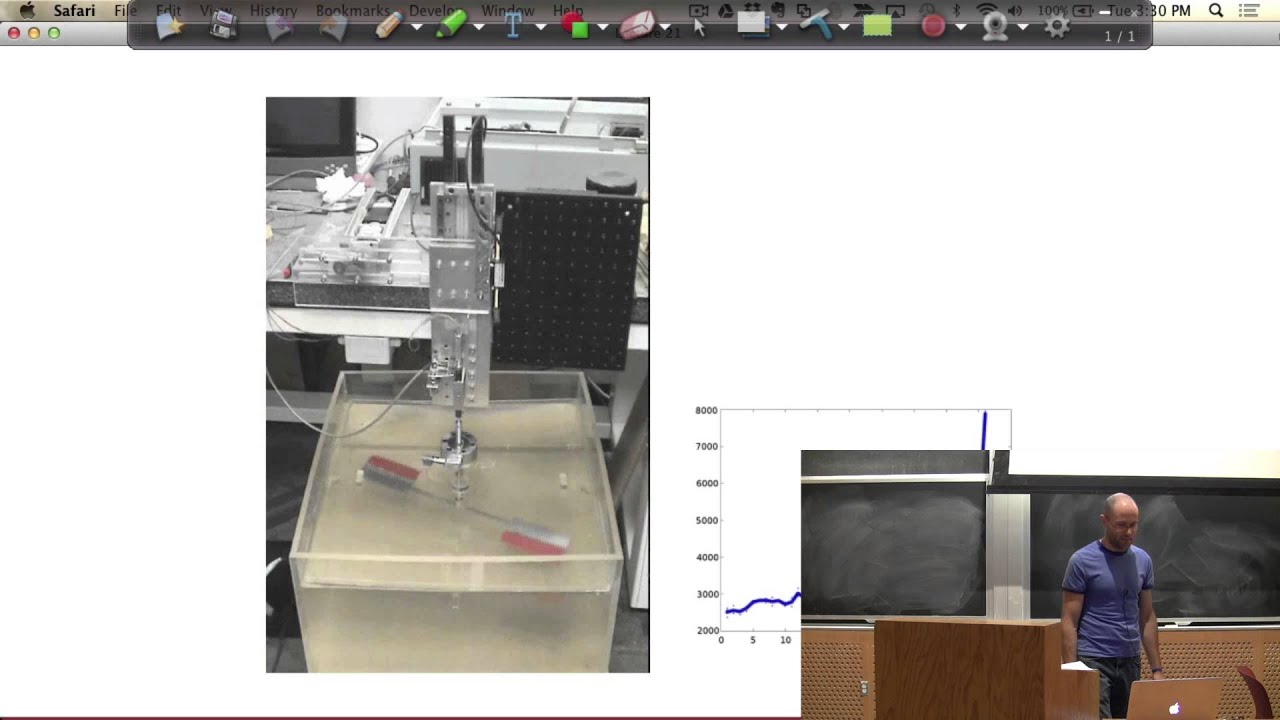
- Introduction to the heaving foil model as a motivating example.
Contribution & Novelties
This lecture provides a high-level synthesis of the limitations of model-based control and motivates the need for learning-based approaches. It offers a critical perspective on the field and suggests future research directions.
Pour aller plus loin :
- Underactuated Robotics — The course website with lecture notes and additional resources.
- Russ Tedrake’s publications — Research papers on robotics and control.
- Output feedback control — Overview of the output feedback problem.
- Energy shaping control — Concept of energy shaping in control.
- Heaving foil — Description of the heaving foil model.
88 words
Radar Profile
The radar profile shows high scores across all dimensions, indicating a lecture that is rich in information, technically rigorous, and highly reliable. The balance between information quantity and quality is excellent, with a strong emphasis on technical depth.