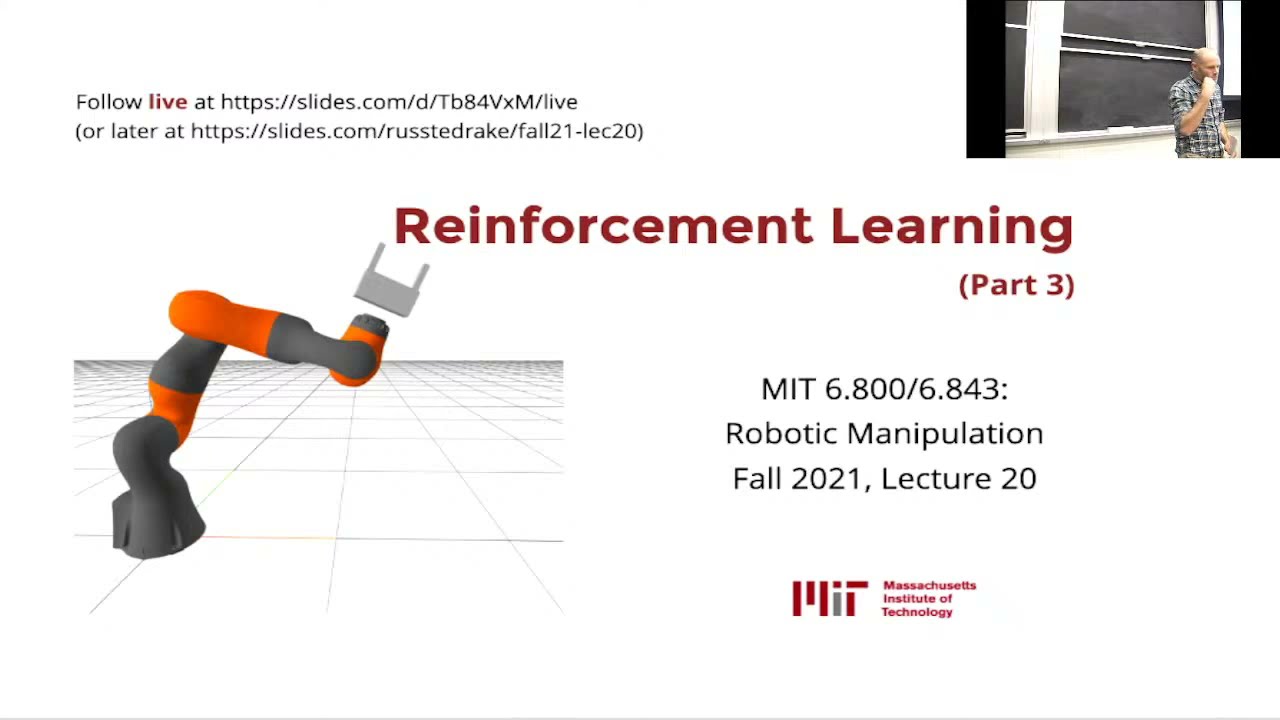
Lecture 20: MIT 6.800/6.843 Robotics Manipulation (Fall 2021) | "Reinforcement Learning (Part 3)"
Keywords
Summary
179 words
Critical Evaluation
The lecture provides a rigorous and insightful overview of reinforcement learning for robotic manipulation, building on previous lectures and connecting theoretical concepts to practical implementation. Tedrake’s approach is methodical: he starts by revisiting the black-box optimization perspective, then introduces policy gradients and actor-critic methods, and finally demonstrates their application on a concrete example. The use of a running example (flipping a Cheez-It box) is effective in illustrating the challenges and solutions in RL, such as the choice of action space, reward design, and algorithm selection. The discussion of PPO versus SAC is particularly valuable, as it highlights the trade-offs between sample efficiency and computational efficiency, which is crucial for real-world applications. Tedrake also addresses the importance of simulation step size and control frequency, a subtle but critical aspect of RL in robotics. The lecture is well-supported by references to recent research, such as the OpenAI dexterity work and the best paper at CoRL, which adds credibility. However, the lecture is primarily a survey and practical guide rather than a presentation of new research, so its novelty is limited. The technical depth is high, but it assumes prior knowledge of RL and robotics, making it less accessible to beginners. Overall, the lecture is of high quality, with clear explanations and practical insights, making it a valuable resource for graduate students and researchers in robotics and AI.
225 words
Title / Content Match
The title accurately reflects the content: a lecture on reinforcement learning for robotic manipulation, specifically the third part of the RL series.
Quality & Reliability
9/10
Lecture by a leading MIT professor, based on established RL theory and practical experience, with references to recent research and open-source tools. The content is technically accurate and well-structured, though it is a lecture rather than a peer-reviewed publication.
Key Moments
Markers derived by PSI from the transcript: the creator did not define chapters.
- Introduction and overview of the lecture's goals
- Recap of RL as black-box optimization and policy gradients
- Discussion of actor-critic methods and sample efficiency
- Introduction of the Cheez-It box flipping example
- Choice of RL algorithm: PPO vs SAC
- Setting up the RL environment with Drake and stable-baselines3
- Demonstration of PPO learning a policy for box flipping
- Discussion of recent research on in-hand reorientation
- Q&A on simulation step size and control frequency
- Conclusion and summary of key takeaways
Cited Sources
- Lecture slides — Slides for this lecture, containing additional details and references.
Concurring Sources
- Proximal Policy Optimization Algorithms — PPO is a widely used RL algorithm, consistent with the lecture's emphasis on its popularity.
- Soft Actor-Critic: Off-Policy Maximum Entropy Deep Reinforcement Learning with a Stochastic Actor — SAC is highlighted as a data-efficient alternative, aligning with the lecture's discussion.
Dissenting Sources
- No discordant sources found — The lecture aligns with established RL literature and practices.
Contribution & Novelties
This lecture provides a practical bridge between theoretical RL concepts and their implementation in robotic manipulation, using a concrete example to illustrate the decision-making process in algorithm selection and environment setup. It emphasizes the importance of sample efficiency and the trade-offs between different RL algorithms, offering valuable insights for practitioners.
Pour aller plus loin :
- Proximal Policy Optimization Algorithms — The original PPO paper, foundational for understanding the algorithm.
- Soft Actor-Critic: Off-Policy Maximum Entropy Deep Reinforcement Learning with a Stochastic Actor — The SAC paper, relevant for data-efficient RL.
- OpenAI Learning Dexterity — A notable application of PPO to robotic manipulation.
- Stable-Baselines3 — The library used in the lecture for RL algorithms.
112 words
Radar Profile
The radar profile shows high scores across all dimensions, indicating a well-rounded and authoritative lecture. The strongest aspects are the quality and quantity of information, with a slightly lower but still high score on technical level, reflecting the advanced nature of the content.