Lecture 19 | MIT 6.881 (Robotic Manipulation), Fall 2020 | Parameter Estimation and Adaptive Control
Keywords
Summary
168 words
Critical Evaluation
This lecture provides a rigorous and insightful treatment of parameter estimation and adaptive control in the context of robotic manipulation. Tedrake masterfully bridges classical control theory with modern learning-based approaches, offering a balanced perspective that is often missing in contemporary discussions. The value of the information is high: he not only explains the mathematical foundations but also provides historical context, showing how these ideas were successfully implemented decades ago. The argumentation is solid, as he carefully derives the equations and justifies each step, making the material accessible to graduate students while still being technically deep. The scientific rigor is exemplary; he clearly distinguishes between what is known and what is uncertain, and he openly questions the necessity of complex learning methods when simpler estimation techniques might suffice. The sources cited are appropriate, including classic papers by Slotine and recent work on residual learning. The adéquation between title and content is perfect, as the lecture indeed focuses on parameter estimation and adaptive control. One minor weakness is that the lecture is quite dense and may require prior knowledge of robotics and control theory, but this is expected for a graduate-level course. Overall, this is an excellent lecture that provides both theoretical depth and practical insights, making it a valuable resource for anyone interested in robotic manipulation.
215 words
Title / Content Match
The title accurately reflects the content: the lecture focuses on parameter estimation and adaptive control in robotic manipulation.
Quality & Reliability
9/10
Lecture by a renowned MIT professor (Russ Tedrake) with rigorous mathematical derivations and references to classic and recent research. High technical accuracy and pedagogical clarity.
Key Moments
Markers derived by PSI from the transcript: the creator did not define chapters.
- Introduction and motivation for the lecture on parameter estimation and adaptive control.
- Discussion of a tossing robot project and the combination of physics with deep learning.
- Historical example: Slotine's adaptive controller that estimates mass and throws a ball into a hoop.
- Derivation of ballistic trajectory equations and the role of center of mass.
- Introduction to multi-body parameter estimation and the linearity of inverse dynamics.
- Discussion on persistent excitation and practical considerations for estimation.
- Teaser on adaptive control and online parameter updates.
Cited Sources
- MIT 6.881 Robotic Manipulation course materials — Course website with lecture notes and additional resources.
- Slotine and Li, 'Adaptive manipulator control: A case study' — Referenced as a classic paper on adaptive control for manipulators.
- Zeng et al., 'TossingBot: Learning to Throw Arbitrary Objects with Residual Physics' — Recent work combining physics-based models with deep learning for tossing.
Concurring Sources
- TossingBot paper — Recent work on learning to throw with residual physics.
Contribution & Novelties
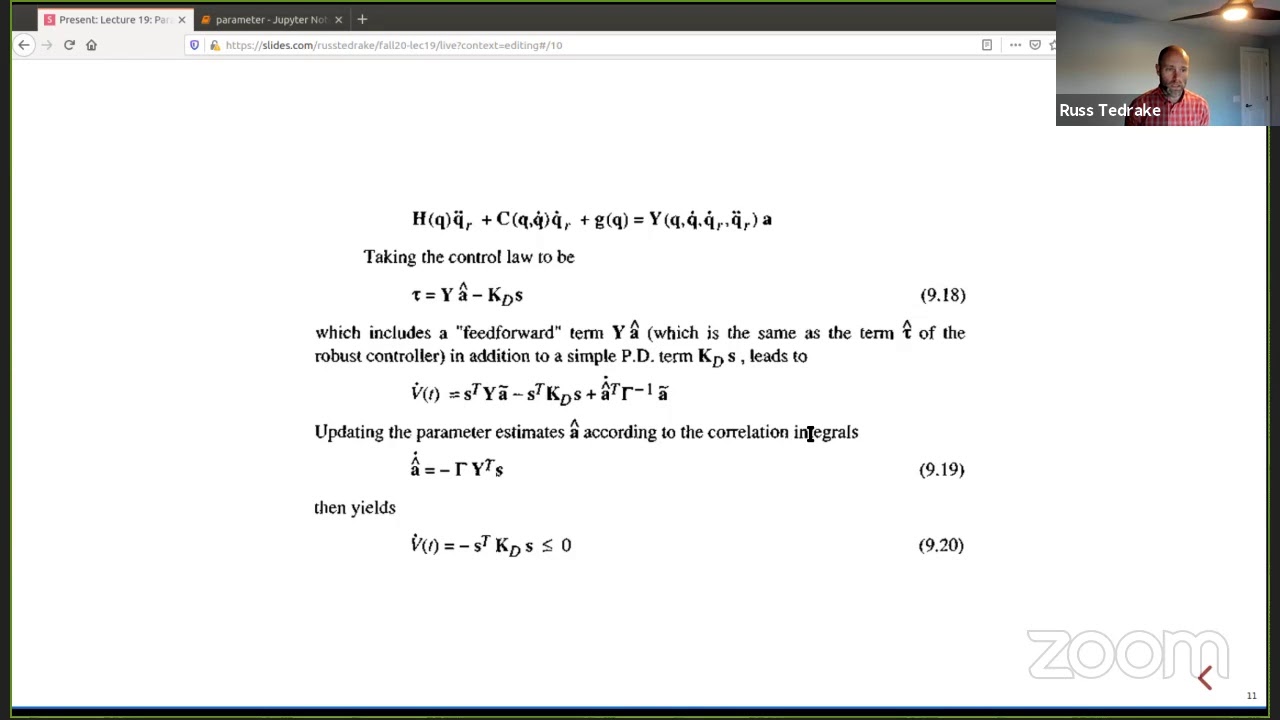
The lecture provides a clear and rigorous explanation of how parameter estimation can be used in robotic manipulation, emphasizing the importance of estimating the center of mass and inertia. It bridges classical adaptive control with modern learning-based approaches, offering a historical perspective that is often overlooked. The key insight is that inverse dynamics are linear in the inertial parameters, enabling efficient least-squares estimation.
Pour aller plus loin :
- Adaptive Control — Overview of adaptive control theory.
- Rigid Body Dynamics — Background on equations of motion for rigid bodies.
- Least Squares — Mathematical method for parameter estimation.
96 words
Radar Profile
The radar profile shows high scores across all dimensions, indicating a well-balanced lecture with strong technical depth, reliable information, and effective communication. The lowest score is in 'quantite_information' (9), but this is still very high, reflecting the dense content covered.
💬 Sur les 0 commentaires analysés, aucune tendance n'est disponible.