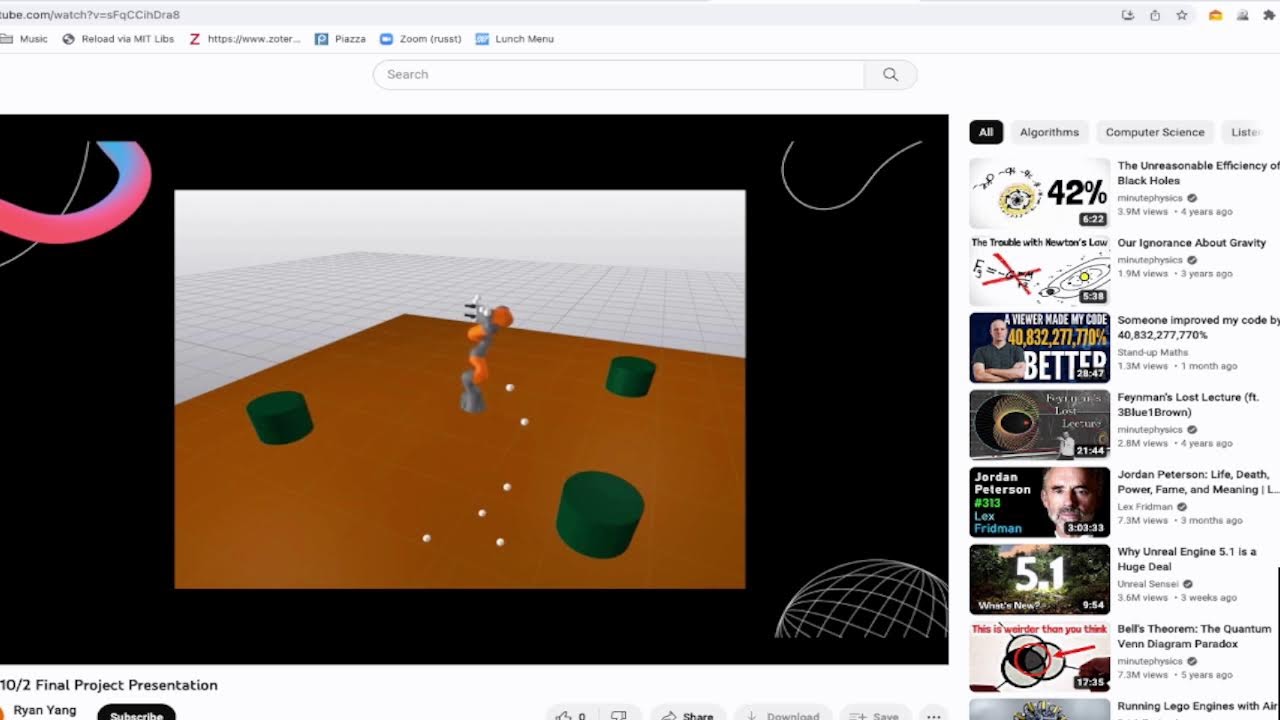
Fall 2022 6.4210/2 Lecture 23: Final Presentations
Keywords
Summary
202 words
Critical Evaluation
The video provides a valuable insight into the application of robotics and machine learning concepts in a project-based setting. The first project on robotic juggling demonstrates a systematic engineering approach, from kinematic planning to control implementation and real-world testing. The students clearly articulate the challenges they faced, such as tracking lag and ball collisions, and the solutions they implemented, which adds credibility to their work. The use of optimization for trajectory generation and the integration of perception systems are well-explained. However, the presentation is concise and lacks detailed mathematical derivations, which may limit its depth for advanced audiences. The second project on implicit neural representations for deformable objects is more theoretical and experimental. The students provide a clear explanation of GINRs and their potential advantages for deformable object modeling. The experimental setup is well-described, and the results are presented with appropriate caveats. The discussion of limitations, such as sensitivity to undersampling, shows critical thinking. The video’s scientific rigor is moderate; while the projects are based on established principles, they are student projects and not peer-reviewed. The sources cited are not explicitly mentioned, but the projects likely draw from standard robotics and ML literature. The title accurately reflects the content, and the video is well-structured. Overall, the video offers a good overview of current research directions in robotics and machine learning, but viewers seeking in-depth technical details may need to consult additional resources.
232 words
Title / Content Match
The title accurately describes the content: a lecture session featuring final project presentations from a robotics course.
Quality & Reliability
7/10
The video presents final student projects from a robotics course, demonstrating applied engineering work with clear methodology and results. The content is original and grounded in established robotics principles, but lacks peer review and detailed citations.
Key Moments
Markers derived by PSI from the transcript: the creator did not define chapters.
- Introduction and logistics for the final presentations.
- First project presentation begins: robotic juggling.
- Discussion of trajectory optimization and control issues.
- Implementation of perception system for real-world juggling.
- Second project presentation begins: implicit neural representations for deformable objects.
- Experimental setup and results for key point prediction.
- Q&A session and closing remarks.
Contribution & Novelties
The video showcases two student projects that demonstrate novel applications of existing techniques. The robotic juggling project applies trajectory optimization and control to achieve a complex dynamic task, highlighting practical challenges and solutions. The implicit neural representations project explores a relatively new approach to modeling deformable objects, showing potential for key point prediction. These projects contribute to the field by providing case studies and insights into the application of these methods.
Pour aller plus loin :
- Robotic manipulation and control — Provides background on robotic arms and control.
- Implicit neural representations — Original paper on INR for 3D scenes.
- Spectral graph theory — Relevant to GINR embeddings.
107 words
Radar Profile
The radar profile shows high scores in quantity of information, technical level, and reliability, indicating a content-rich and technically advanced video. The quality of information is also high, but slightly lower, possibly due to the lack of formal citations. Overall, the video is a solid resource for those interested in applied robotics and machine learning.