6.832 Lecture 08 clip 3 (SOS programming)
Keywords
Summary
180 words
Critical Evaluation
The lecture provides a clear and concise introduction to sums of squares programming, a powerful technique in convex optimization. The instructor’s explanation is mathematically sound, building from the basic idea of positive semidefinite matrices to the factorization of polynomials via SDP. The use of simple examples effectively illustrates the concept, making it accessible to students with a background in optimization. The mention of Pablo Parrilo’s work adds credibility and situates the topic within the broader research context. However, the lecture is brief and does not delve into the computational details or the practical implementation of SOS solvers. The discussion of the gap between positive and SOS polynomials is important but could be expanded to give a fuller picture of the limitations. The analogy to the kernel trick is helpful but may oversimplify the complexity. Overall, the content is accurate and well-presented, but it assumes prior knowledge of convex optimization and control theory. The lack of references to specific papers or resources is a minor weakness, as students may wish to explore further. The lecture’s focus on the theoretical foundation rather than practical applications means it serves as a good starting point but not a comprehensive treatment of the subject.
199 words
Title / Content Match
The title accurately describes the content: a lecture clip on SOS programming.
Quality & Reliability
8/10
Lecture from MIT OpenCourseWare (6.832) by a faculty member, presenting established theory (sums of squares optimization) with clear mathematical reasoning. The content is technically accurate and aligns with known results in convex optimization and control theory.
Key Moments
Markers derived by PSI from the transcript: the creator did not define chapters.
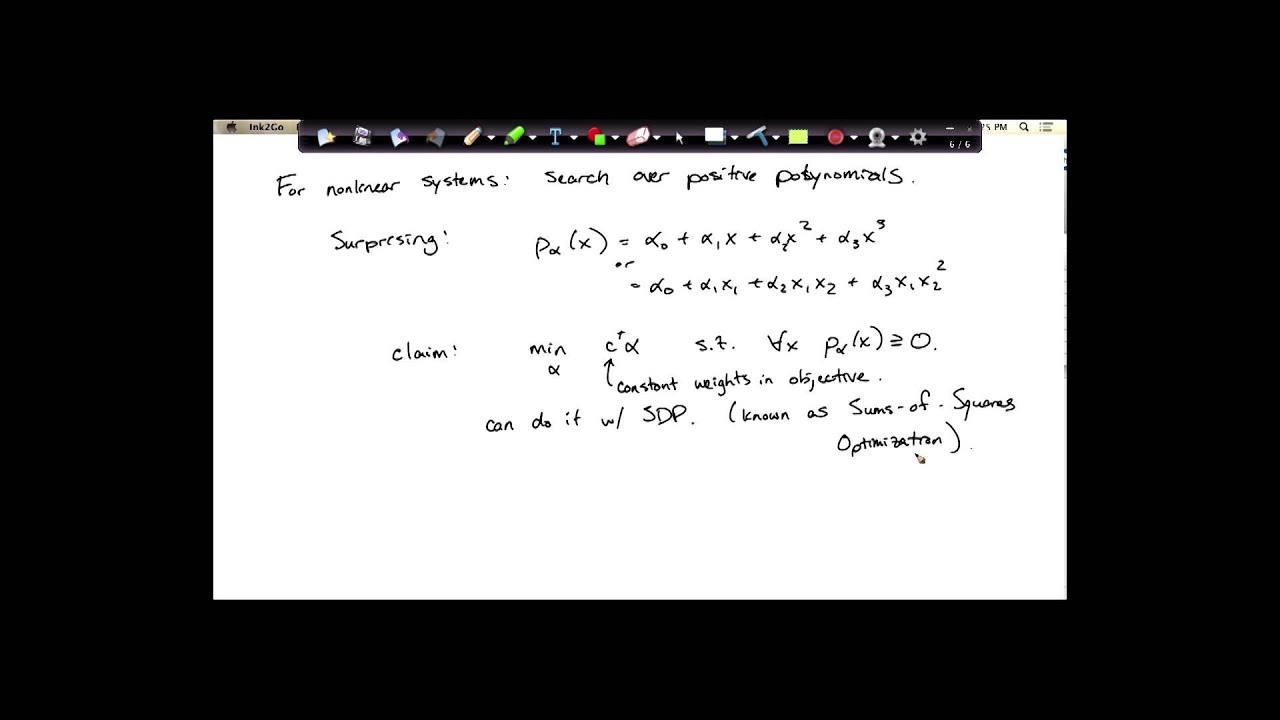
- Introduction to searching over positive polynomials using convex optimization.
- Explanation of the analogy between positive semidefinite matrices and positive polynomials.
- Formulation of the optimization problem: minimize linear objective subject to polynomial nonnegativity.
- Introduction to sums of squares optimization and mention of Pablo Parrilo's contributions.
- Example: proving a quadratic polynomial is positive by writing it as a sum of squares.
- Key idea: using an SDP solver to find the SOS decomposition by parameterizing a positive semidefinite matrix.
- Linear constraints on the matrix elements to ensure equality with the polynomial.
- Discussion of the gap between positive polynomials and SOS polynomials.
- Analogy to the kernel trick in machine learning and the role of basis functions.
Cited Sources
- Pablo Parrilo's PhD thesis on SOS and systems theory — Mentioned as background reading and as the source of the connection between SOS polynomials and systems theory.
Concurring Sources
- Sum-of-squares optimization (Wikipedia) — General reference for SOS optimization, consistent with the lecture's content.
- Semidefinite programming (Wikipedia) — Background on SDP, which is the core tool used in SOS programming.
Contribution & Novelties
The lecture provides a clear pedagogical explanation of how sums of squares programming can be used to search over positive polynomials via semidefinite programming, highlighting the connection to Lyapunov analysis for nonlinear systems. It emphasizes the surprising fact that polynomial nonnegativity can be addressed with convex optimization tools.
Pour aller plus loin :
- Sum-of-squares optimization — Overview of SOS optimization and its applications.
- Semidefinite programming — Background on SDP, the underlying optimization framework.
- Pablo Parrilo’s publications — Research on SOS and control theory.
83 words
Radar Profile
The radar profile shows high scores in quality of information and technical level, indicating a technically dense and accurate lecture. The quantity of information is moderate, as the clip is short and focused. The overall reliability is high, reflecting the academic context and clear presentation.