Lecture 10 - clip C for MIT 6.832 (Underactuated Robotics)
Keywords
Summary
120 words
Critical Evaluation
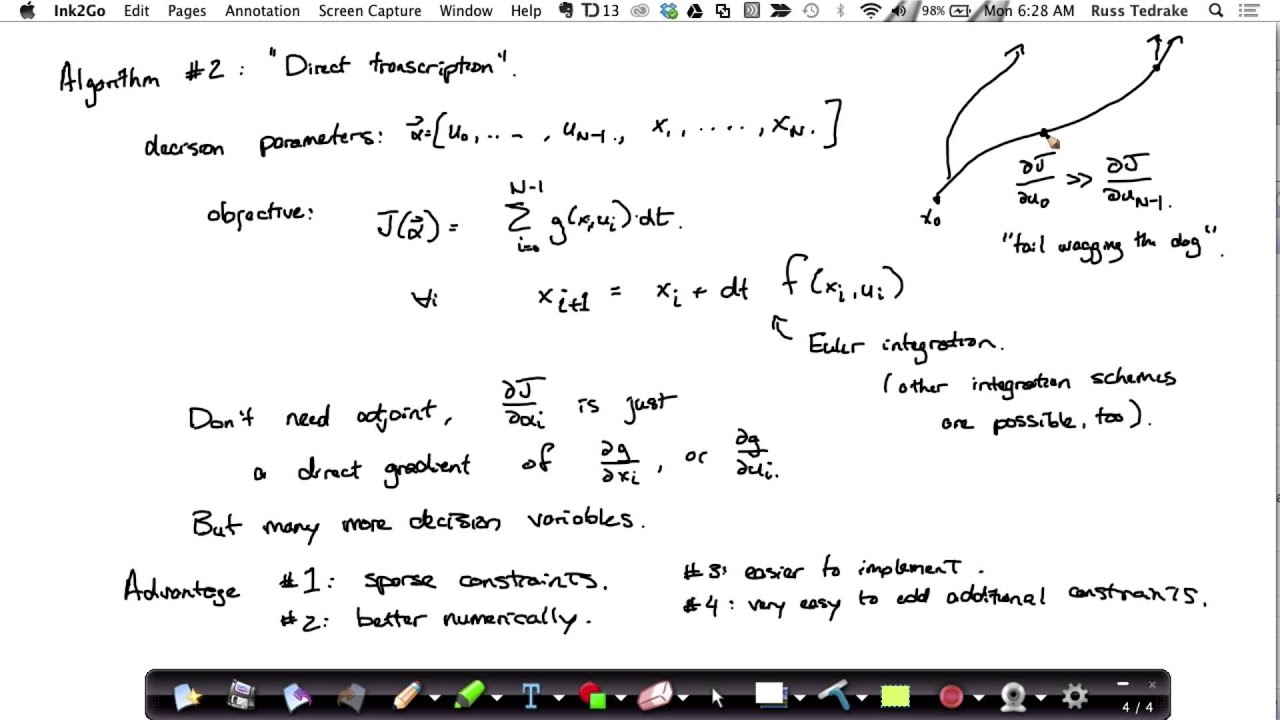
The lecture provides a clear and rigorous introduction to direct transcription and direct collocation methods for trajectory optimization. The instructor, presumably a professor at MIT, demonstrates deep expertise in the subject. The argumentation is solid: he logically motivates the need for these methods by pointing out the drawbacks of shooting methods, such as poor numerical conditioning and difficulty in handling state constraints. He then explains the mathematical formulation of each method, emphasizing the sparsity of gradients and the ease of adding constraints. The explanation of direct collocation is particularly insightful, as he clarifies the role of cubic splines and collocation points in enforcing dynamics. The lecture is well-structured, with a natural progression from one method to the next. However, the presentation is concise and assumes prior knowledge of nonlinear optimization and sequential quadratic programming, which may be challenging for beginners. The sources cited are primarily the course notes and problem sets, which are authoritative but not explicitly referenced in the video. The title accurately reflects the content, and the lecture fulfills its educational purpose. Overall, the content is highly valuable for students and practitioners in robotics and control, offering practical insights into numerical optimization techniques.
195 words
Title / Content Match
The title accurately describes the content: a lecture clip on underactuated robotics focusing on trajectory optimization methods.
Quality & Reliability
8/10
The lecture is part of MIT OpenCourseWare, presented by an expert in robotics, and covers established numerical optimization methods with clear mathematical explanations. The content is consistent with standard literature on trajectory optimization.
Key Moments
Markers derived by PSI from the transcript: the creator did not define chapters.
- Introduction to direct transcription as an alternative to shooting methods.
- Formulation of direct transcription with decision variables for state and control.
- Discussion of advantages: sparse gradients and better numerical conditioning.
- Explanation of ease of adding constraints in direct transcription.
- Introduction to direct collocation and its parameterization of trajectories.
- Details on collocation constraints and their algebraic simplicity.
- Comparison of direct collocation with direct transcription and its advantages.
Cited Sources
- MIT 6.832 Underactuated Robotics Course Notes — Referenced as the primary source for the lecture content and further reading.
Concurring Sources
- MIT 6.832 Underactuated Robotics Course Notes — The course notes provide detailed derivations and additional examples consistent with the lecture.
Contribution & Novelties
The lecture provides a clear pedagogical explanation of direct transcription and direct collocation methods, emphasizing their practical advantages over shooting methods in trajectory optimization. It highlights the importance of sparse gradients and the ease of incorporating constraints, which are crucial for real-world robotics applications.
Pour aller plus loin :
- Direct transcription — Overview of the method and its applications.
- Collocation method — General mathematical background on collocation.
- Sequential quadratic programming — The underlying optimization technique used in these methods.
79 words
Radar Profile
The radar profile shows high scores across all dimensions, indicating a well-rounded and reliable educational resource. The lecture excels in technical depth and clarity, making it a valuable reference for advanced students.