Lecture 8 | MIT 6.881 (Robotic Manipulation), Fall 2020 | Geometric Perception (part 3)
Keywords
Summary
135 words
Critical Evaluation
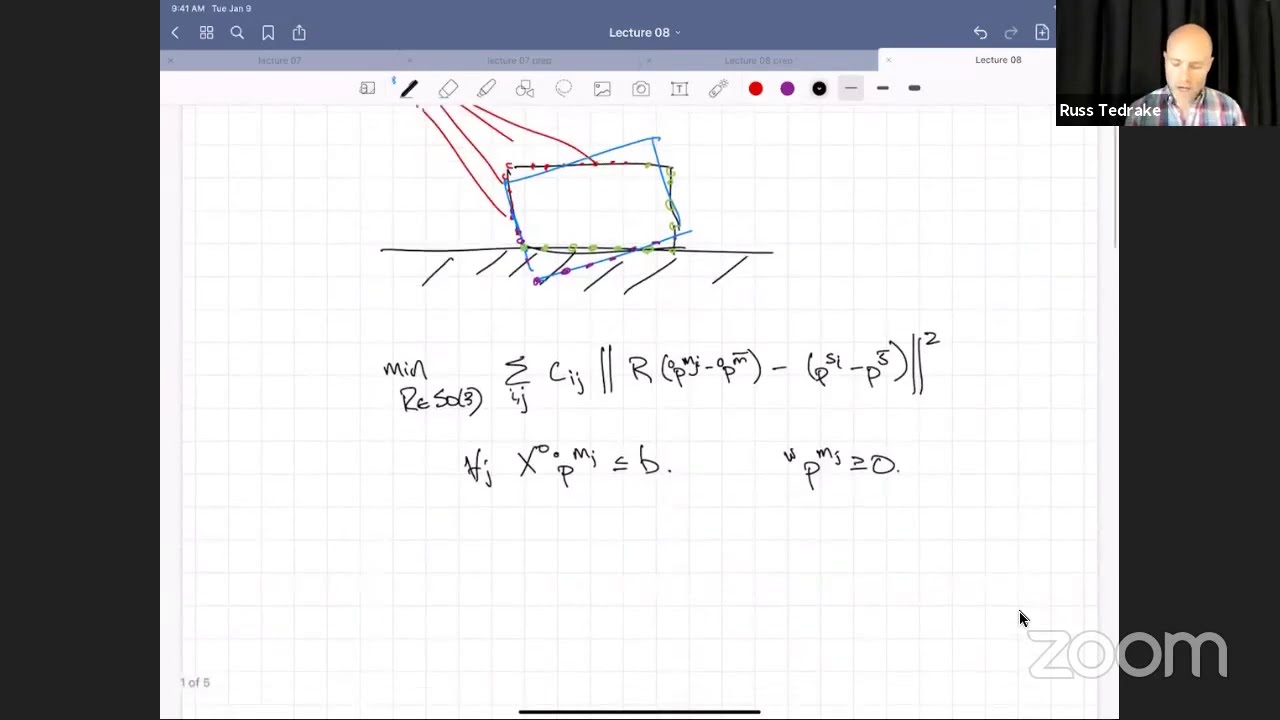
This lecture provides a rigorous and insightful exploration of geometric perception in robotic manipulation, focusing on the integration of physical constraints into point cloud registration. The instructor, Russ Tedrake, is a renowned expert in robotics, and his expertise is evident in the clarity and depth of the presentation. The lecture builds logically on previous sessions, first reviewing the limitations of ICP and then introducing convex relaxation as a principled method to handle non-convex constraints. The use of concrete examples, such as the box on a table scenario, effectively illustrates the practical importance of non-penetration constraints. The mathematical derivations are thorough, and the connection to optimization theory is well-explained, making the content accessible to advanced students. The lecture also highlights the role of software tools like Drake, which is valuable for practical implementation. The sources cited, including the textbook and slides, are reliable and directly relevant. The title accurately reflects the content, and the lecture meets its educational objectives. Overall, this is an excellent resource for those studying robotic manipulation and perception.
171 words
Title / Content Match
The title accurately describes the content: a lecture on geometric perception, part 3, from MIT's robotic manipulation course.
Quality & Reliability
9/10
Lecture from MIT OpenCourseWare by a leading expert in robotics, with rigorous mathematical derivations and references to a textbook and slides. The content is well-structured and technically accurate.
Key Moments
Markers derived by PSI from the transcript: the creator did not define chapters.
- Introduction and overview of the lecture series on geometric perception.
- Review of previous lectures: clean point clouds and ICP, messy point clouds and robust methods.
- Introduction to non-penetration and free space constraints.
- Formulation of the optimization problem with constraints.
- Explanation of convex relaxation for rotation matrices.
- Example of 2D rotation relaxation and its implementation.
- Discussion of second-order cone constraints and SOCP.
- Demonstration of using Drake's MathematicalProgram for pose estimation.
- Conclusion and summary of key takeaways.
Cited Sources
- Robotic Manipulation Textbook — The textbook for the course, providing detailed background on manipulation and perception.
- Lecture Slides — Live slides used during the lecture, containing figures and equations.
Concurring Sources
- Robotic Manipulation Textbook — The textbook aligns with the lecture content, providing additional details and exercises.
Contribution & Novelties
This lecture provides a novel approach to incorporating physical constraints into point cloud registration, moving beyond traditional ICP. The use of convex relaxation to handle rotation constraints is a key contribution, enabling the use of efficient convex optimization solvers. The lecture also demonstrates the practical implementation using Drake’s MathematicalProgram, making the concepts accessible to practitioners.
Pour aller plus loin :
- Convex Optimization — A comprehensive textbook on convex optimization, relevant to the relaxation techniques discussed.
- Second-order cone programming — Overview of SOCP, a class of convex optimization problems mentioned in the lecture.
- Iterative closest point — Background on the ICP algorithm, which is the starting point of the lecture.
109 words
Radar Profile
The radar profile shows high scores across all dimensions, indicating a well-rounded and reliable lecture. The strong scores in information quantity and quality reflect the depth and accuracy of the content, while the high technical level and reliability underscore its value for advanced learners.