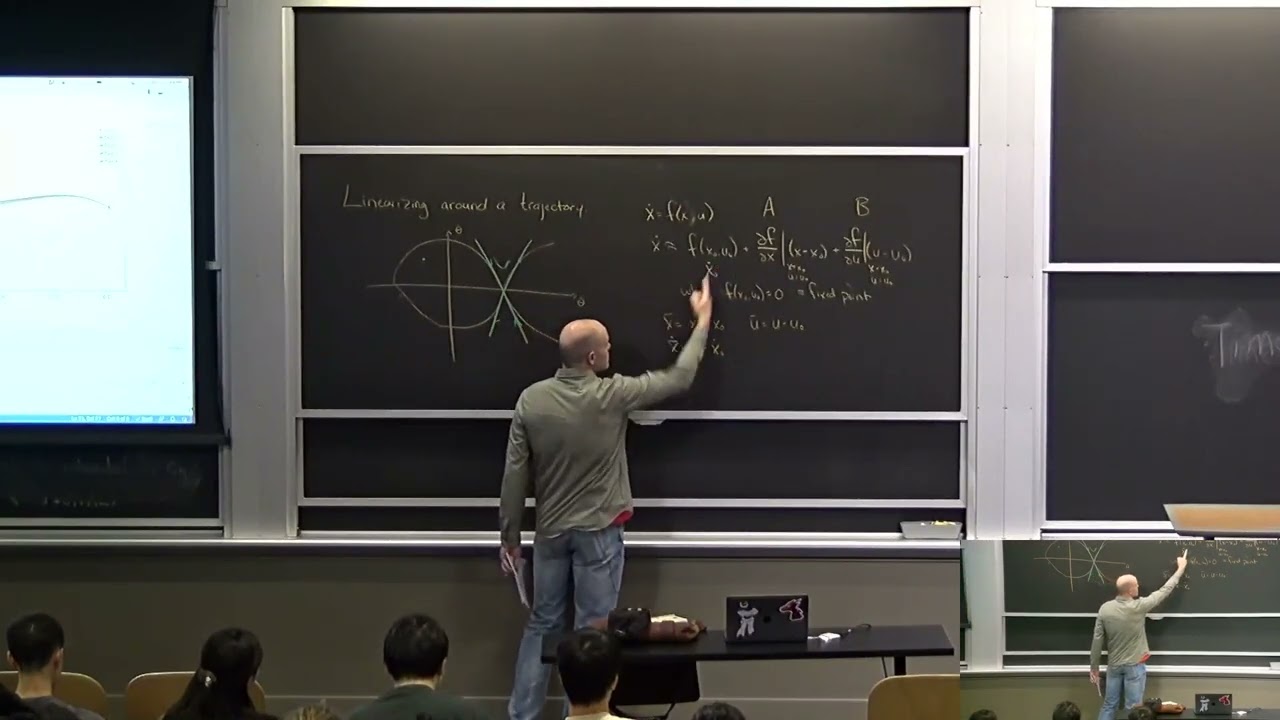
6 8210 Spring 2023 Lecture 13: Trajectory Stabilization
Keywords
Summary
139 words
Critical Evaluation
The lecture provides a clear and rigorous introduction to trajectory stabilization using time-varying LQR. The instructor effectively motivates the topic with the perching example, illustrating the failure of open-loop control and the need for feedback. The explanation of time-varying linearization is thorough, addressing the mathematical derivation and its practical implications. The lecture builds on previously covered material, such as LQR and trajectory optimization, and connects them coherently. The instructor also addresses student questions, clarifying potential misconceptions about the time-dependence of the linearization and the robustness of the approach. The content is well-structured, with a logical flow from problem statement to solution. However, the lecture lacks formal citations to specific sources, relying instead on general knowledge of control theory. Additionally, the presentation is somewhat informal, which may be less suitable for viewers seeking a more formal treatment. Overall, the lecture is valuable for students and practitioners interested in control of underactuated systems, offering both theoretical insights and practical examples.
158 words
Title / Content Match
The title accurately reflects the content, which focuses on trajectory stabilization using time-varying LQR.
Quality & Reliability
8/10
Lecture from MIT OpenCourseWare, presented by an expert in the field, with clear explanations and references to established control theory concepts. The content is technically sound and well-structured, though it lacks formal citations and is based on a single lecture.
Key Moments
Markers derived by PSI from the transcript: the creator did not define chapters.
- Introduction and motivation for trajectory stabilization using the perching example.
- Discussion on why open-loop control fails and the need for feedback.
- Introduction to time-varying linearization along a trajectory.
- Derivation of the time-varying linear system and its implications.
- Application of LQR to the time-varying linear system.
- Discussion on the robustness of the approach and its limitations.
- Example of perching stabilization and demonstration of the controller's effectiveness.
- Q&A session addressing student questions about time-dependence and robustness.
Contribution & Novelties
The lecture provides a clear pedagogical explanation of time-varying LQR for trajectory stabilization, a fundamental technique in control of underactuated systems. It bridges the gap between trajectory optimization and feedback control, showing how to linearize along a trajectory and apply LQR to achieve robust stabilization. The perching example serves as a compelling case study, demonstrating the practical utility of the method.
Pour aller plus loin :
- Time-varying LQR — Provides a formal definition and derivation of time-varying LQR.
- Underactuated Robotics — The course website with lecture notes and additional resources.
- Model Predictive Control — A related technique that addresses some limitations of time-based linearization.
104 words
Radar Profile
The radar profile shows high scores across all dimensions, indicating a well-balanced and comprehensive lecture. The content is technically deep, reliable, and provides substantial information, making it a valuable resource for learners.