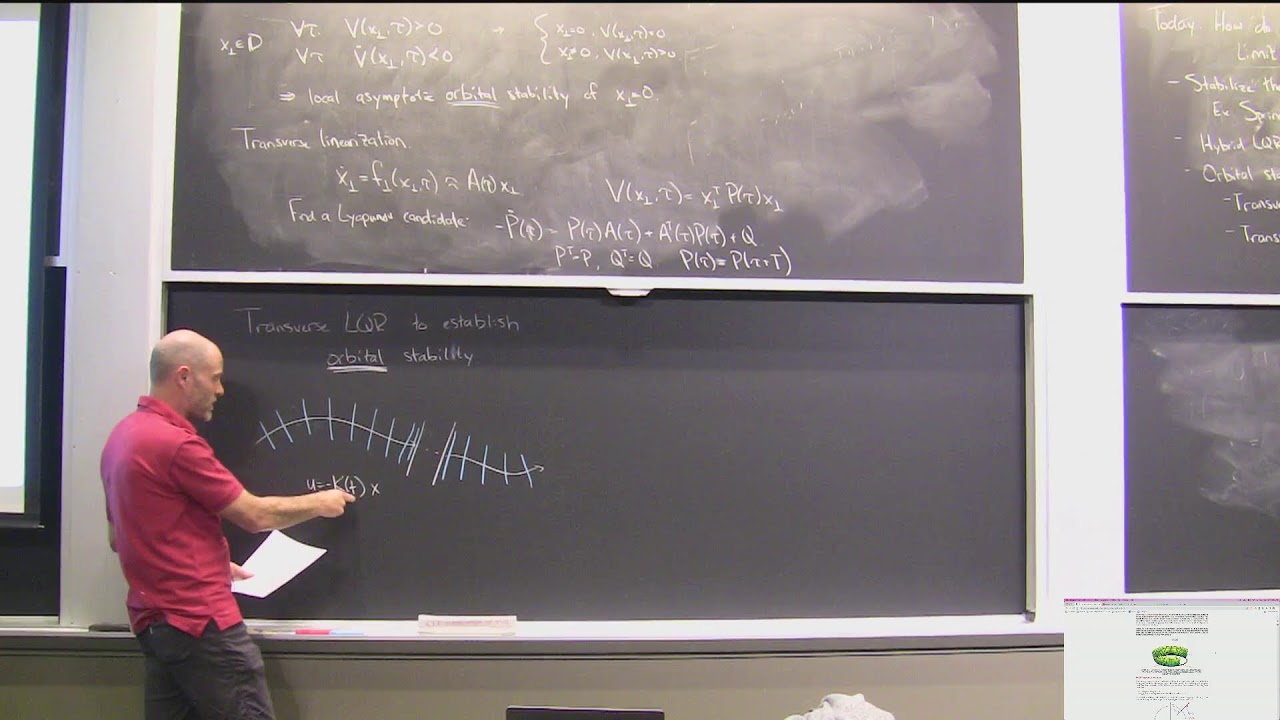
Lecture 17: MIT 6.832 Underactuated Robotics (Spring 2022) | "Hybrid Stabilization, Simple Running"
Keywords
Summary
154 words
Critical Evaluation
The lecture provides a rigorous and insightful introduction to the stabilization of hybrid systems in legged robotics. The instructor’s use of the SLIP model effectively illustrates key concepts such as Poincaré maps and the role of energy in stability. The mathematical derivations are clear and well-paced, making complex ideas accessible to an advanced audience. The lecture builds on previous material, creating a coherent narrative that emphasizes the importance of hybrid dynamics in robotic locomotion. One notable strength is the explicit discussion of the assumptions behind the SLIP model, such as massless legs and perfectly elastic collisions, which helps viewers understand the model’s limitations. The instructor also connects the material to historical developments, such as the early success of running robots over walking robots, providing valuable context. However, the lecture could benefit from more explicit references to specific research papers or sources, as the current presentation relies heavily on the instructor’s expertise. Additionally, while the Poincaré map analysis is well-explained, the lecture does not delve deeply into the practical implementation of controllers based on these principles. Overall, the lecture is of high quality, offering both theoretical depth and practical insights, making it a valuable resource for students and researchers in robotics.
200 words
Title / Content Match
The title accurately reflects the lecture's focus on hybrid stabilization and simple running models.
Quality & Reliability
8/10
Lecture from MIT OpenCourseWare, presented by a recognized expert in robotics, with rigorous mathematical derivations and references to established models. The content is well-structured and based on peer-reviewed concepts, though it lacks explicit citations to specific papers.
Key Moments
Markers derived by PSI from the transcript: the creator did not define chapters.
- Introduction and recap of hybrid systems framework
- Introduction to the Spring-Loaded Inverted Pendulum (SLIP) model
- Discussion on the history of running robots and the SLIP model's relevance
- Derivation of the SLIP model dynamics and assumptions
- Explanation of the Poincaré map for the SLIP model
- Analysis of stability and fixed points in the Poincaré map
- Discussion on energy conservation and its implications for stability
- Introduction to control strategies for hybrid systems
- Preview of future topics: trajectory optimization and feedback control
Contribution & Novelties
The lecture provides a clear and accessible explanation of hybrid stabilization for running robots, using the SLIP model as a case study. It emphasizes the use of Poincaré maps to reduce dimensionality and analyze stability, which is a fundamental technique in underactuated robotics. The lecture also highlights the historical context and practical considerations, making it a valuable educational resource.
Pour aller plus loin :
- Spring-loaded inverted pendulum — Overview of the SLIP model and its applications.
- Poincaré map — Mathematical background on Poincaré maps and their use in dynamical systems.
- Hybrid system — General concept of hybrid systems and their applications.
101 words
Radar Profile
The radar profile shows high scores in technical level and information quality, indicating a rigorous and detailed lecture. The lower score in information quantity suggests a focused scope, while the moderate score in reliability reflects the lack of explicit citations.