Lecture 5 | MIT 6.881 (Robotic Manipulation), Fall 2020 | Basic Pick and Place Part 3
Keywords
Summary
149 words
Critical Evaluation
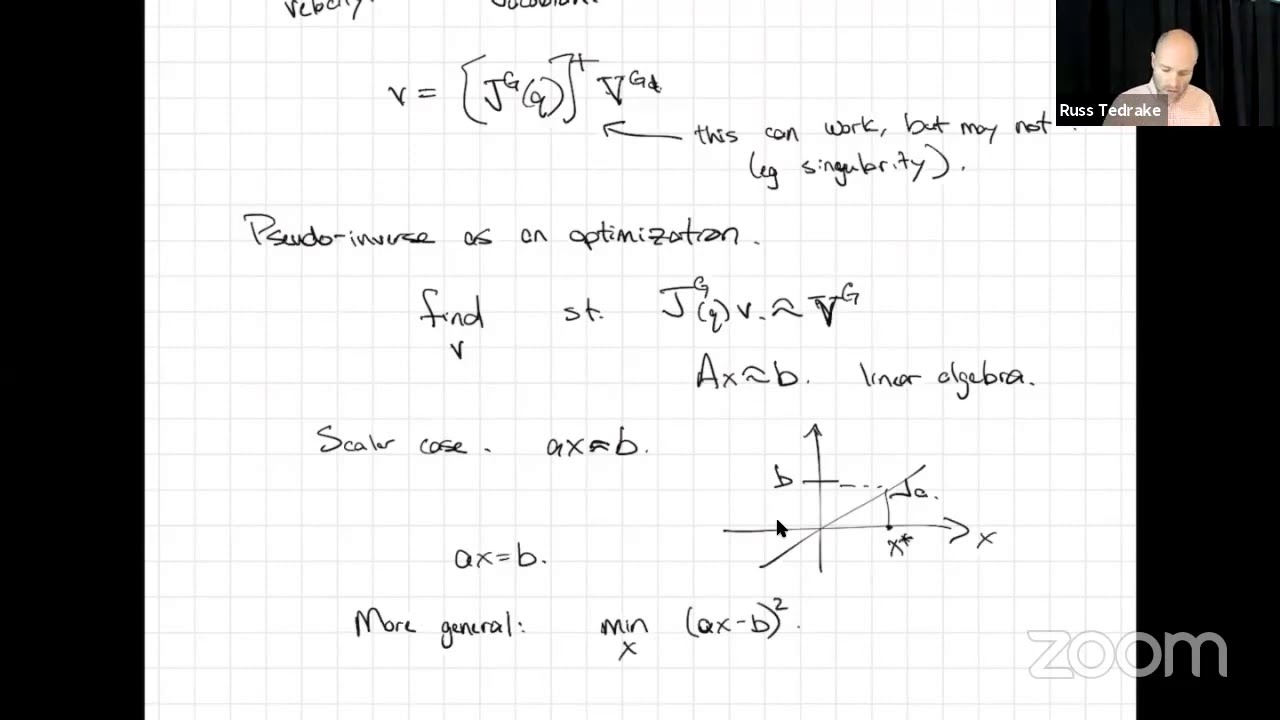
This lecture is a masterclass in pedagogical clarity and technical depth. Tedrake excels at building intuition from simple examples and then scaling to the full robotic problem. The mathematical treatment is rigorous: he carefully derives the optimization problem, explains the gradient conditions, and connects the pseudo-inverse to a least-squares problem. The use of the scalar case to illustrate the concept of constraints is particularly effective, making the abstract idea of regularization tangible. The lecture’s strength lies in its logical progression: it identifies a real problem (singularity-induced instability), explains why the previous approach fails, and then introduces a principled solution (constrained optimization). The connection to the course’s broader goals is clear, and the emphasis on robustness is practically relevant. The sources cited are the course textbook and slides, which are authoritative and directly support the content. The lecture is part of a well-structured course, and the instructor’s expertise is evident. The only minor weakness is that the lecture assumes prior knowledge of linear algebra and basic optimization, but this is appropriate for an advanced undergraduate or graduate course. Overall, this is an excellent lecture that provides a solid foundation for understanding optimization-based control in robotics.
194 words
Title / Content Match
The title accurately reflects the content: a lecture on basic pick and place, focusing on optimization-based control for robustness.
Quality & Reliability
9/10
Lecture by MIT professor Russ Tedrake, part of an official MIT course. Content is rigorous, mathematically grounded, and based on established robotics principles. The lecture is part of a structured curriculum with accompanying textbook and slides.
Key Moments
Markers derived by PSI from the transcript: the creator did not define chapters.
- Introduction and recap of previous lecture on differential kinematics
- Discussion of Jacobian singularity and its implications
- Introduction to optimization as a robust alternative
- Scalar example of least-squares optimization with constraints
- Matrix generalization and gradient derivation
- Emphasis on the benefits of optimization over direct inversion
- Preview of future applications of optimization in perception
Cited Sources
- Robotic Manipulation: Perception, Planning, and Control (course textbook) — The course textbook, which contains the lecture notes and additional material on manipulation.
- Live slides for Lecture 5 — The slides used during the lecture, providing visual aids and additional details.
Concurring Sources
- MIT OpenCourseWare: Underactuated Robotics — Another course by Russ Tedrake that covers similar topics in robotics and control.
Contribution & Novelties
The lecture provides a clear and rigorous introduction to optimization-based control for robotic manipulation, specifically addressing the issue of singularity robustness. It bridges the gap between theoretical kinematics and practical control by framing the pseudo-inverse as an optimization problem with constraints. This approach is not entirely novel but is presented in an accessible and pedagogically effective manner, making it a valuable resource for students and practitioners.
Pour aller plus loin :
- Optimization-based control — Provides background on optimization in control systems.
- Quadratic programming — The optimization problem discussed is a quadratic program; this page explains the general formulation.
- Singular value decomposition — Related to the pseudo-inverse and conditioning of the Jacobian.
111 words
Radar Profile
The radar profile shows high scores across all dimensions, indicating a well-balanced and high-quality lecture. The strongest aspects are the quantity and quality of information, while the technical level is also high, making it suitable for an advanced audience.