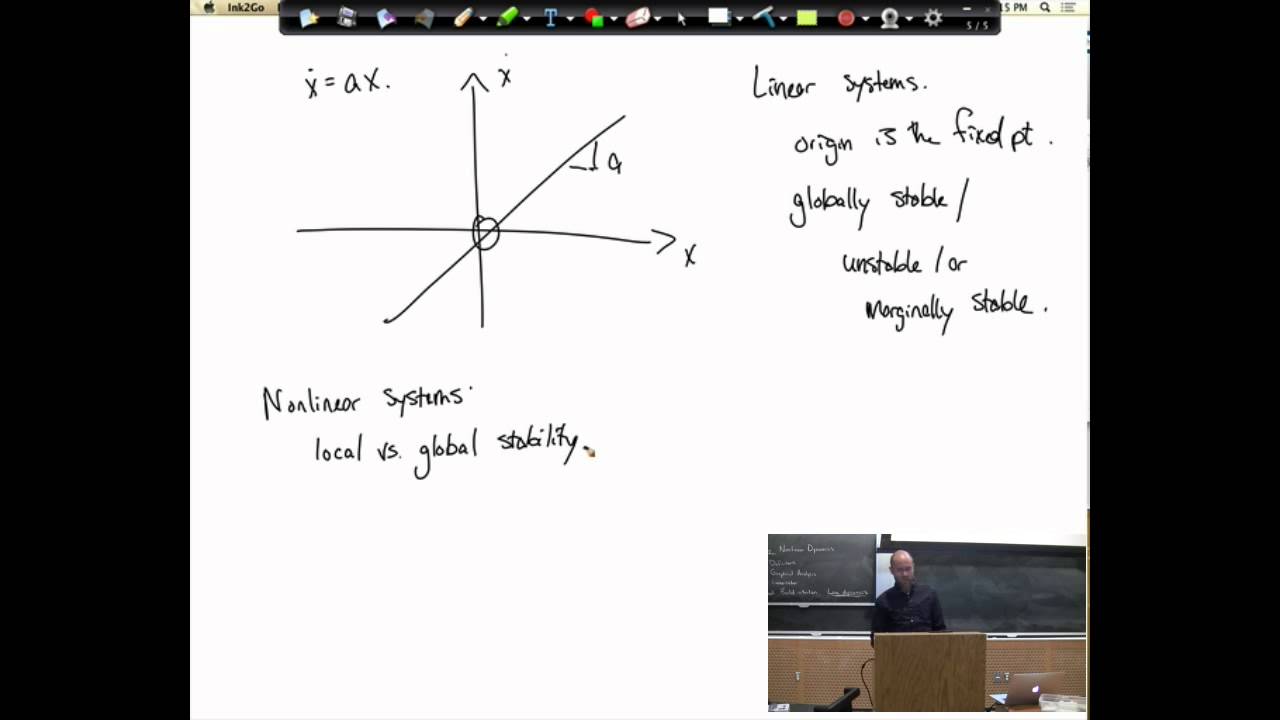
Lecture 02 for MIT 6.832 (Underactuated Robotics)
Keywords
Summary
114 words
Critical Evaluation
The lecture provides a solid introduction to nonlinear dynamics, tailored for students with diverse backgrounds. The instructor’s pedagogical approach is effective: he starts with a simple pendulum, derives the equations of motion, and then shows why traditional solving methods fail, motivating the need for qualitative tools. The explanation of linearization is clear, though it is presented as a local analysis tool with limitations. The graphical analysis section, inspired by Strogatz’s book, is particularly well-executed, using phase portraits to illustrate fixed points and stability. The content is mathematically rigorous, with derivations shown step-by-step. However, the lecture assumes some prior knowledge of differential equations and Lagrangian mechanics, which may be challenging for absolute beginners. The sources are not explicitly cited within the lecture, but the instructor references Strogatz’s book as recommended reading. The title accurately reflects the content, and the lecture fulfills its goal of building intuition. The main weakness is that it is an introductory lecture and does not delve deeply into advanced topics, but it serves as a strong foundation. Overall, the lecture is of high quality, well-structured, and valuable for students of robotics and control.
186 words
Title / Content Match
The title accurately reflects the content: a lecture on underactuated robotics focusing on nonlinear dynamics of simple systems.
Quality & Reliability
8/10
Lecture from MIT OpenCourseWare by a recognized expert in robotics, presenting foundational nonlinear dynamics concepts with mathematical rigor. The content is well-structured and pedagogically sound, though it is an introductory lecture and not a peer-reviewed source.
Key Moments
Markers derived by PSI from the transcript: the creator did not define chapters.
- Introduction and course goals
- Derivation of pendulum equations of motion
- Discussion of nonlinearity and limitations of closed-form solutions
- Introduction to linearization as a local analysis tool
- Graphical analysis of overdamped pendulum
- Phase portraits and fixed points
- Regions of attraction and stability analysis
Cited Sources
- Nonlinear Dynamics and Chaos by Steven Strogatz — Recommended reading for graphical analysis methods
Concurring Sources
- Underactuated Robotics course materials — The course website provides additional lecture notes and resources.
Contribution & Novelties
This lecture provides a clear and intuitive introduction to nonlinear dynamics, emphasizing qualitative analysis over closed-form solutions. It bridges the gap between traditional differential equations courses and the needs of robotics, where nonlinearity is ubiquitous. The use of the pendulum as a canonical example makes the concepts accessible.
Pour aller plus loin :
- Nonlinear Dynamics and Chaos — A comprehensive textbook by Steven Strogatz covering the topics discussed.
- Phase portrait — Visual representation of dynamical systems.
- Lyapunov stability — A key concept for analyzing stability of nonlinear systems.
88 words
Radar Profile
The radar profile shows high scores in information quantity, quality, and reliability, with a slightly lower technical level, indicating a well-balanced introductory lecture that is both informative and accessible.