6.8210 Spring 2024 Lecture 23: Feedback motion planning
Keywords
Summary
157 words
Critical Evaluation
The lecture provides a comprehensive and rigorous introduction to feedback motion planning, a key concept in robotics. The instructor, Russ Tedrake, is a leading expert in the field, and his presentation is both technically deep and pedagogically clear. The content is well-structured, starting with motivation, then building on classical AI planning, and finally detailing the mathematical framework of funnels and Lyapunov functions. The use of the juggling example is effective in illustrating the concepts, and the derivation of the dynamics and the funnel composition is thorough. The lecture also touches on modern developments, such as the use of LLMs for task planning, which adds relevance. The sources cited, including the seminal work by Burridge, Rizzi, and Koditschek, are appropriate and credible. The lecture does not include any commercial bias or advertising. The title accurately reflects the content. Overall, this is a high-quality lecture that would be valuable for students and practitioners in robotics and control.
155 words
Title / Content Match
The title accurately reflects the lecture's focus on feedback motion planning, a core topic in robotics.
Quality & Reliability
8/10
Lecture from MIT's Underactuated Robotics course, presented by a leading expert. Content is technically rigorous, builds on established theory (Lyapunov, funnels), and includes references to classical and recent work. No commercial bias detected.
Key Moments
Markers derived by PSI from the transcript: the creator did not define chapters.
- Introduction and logistics for final project
- Motivation: high-level planning in robotics, dishwasher example
- Action primitives and software abstraction
- Historical context: STRIPS and PDDL
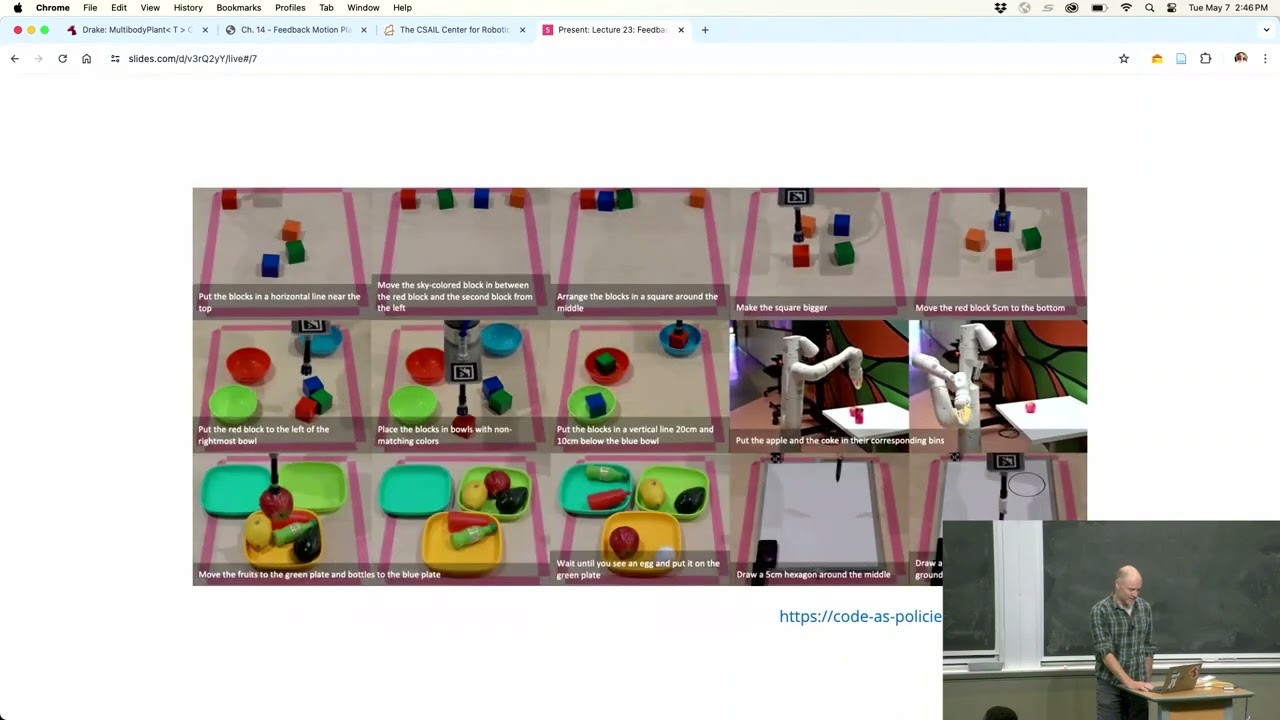
- Using LLMs for task planning (code as policies)
- Core idea: feedback motion planning, funnels and Lyapunov functions
- Juggling robot example: dynamics and control
- Sequential composition of funnels
- Verification of funnels using sums-of-squares
- Extensions to stochastic systems and robustness
Cited Sources
- Sequential Composition of Dynamically Dexterous Robot Behaviors — Referenced as the foundational paper on sequential composition of funnels.
- PDDL - The Planning Domain Definition Language — Mentioned as a standard language for task planning.
- Code as Policies: Language Model Programs for Embodied Control — Referenced as a recent approach using LLMs for robot control.
Concurring Sources
- Underactuated Robotics — Course website with lecture notes and additional materials.
Contribution & Novelties
This lecture provides a clear and accessible introduction to feedback motion planning, emphasizing the composition of controllers via Lyapunov functions and funnels. It bridges classical AI planning with modern control theory, and highlights recent developments such as LLM-based task planning. The lecture is valuable for its pedagogical clarity and practical insights.
Pour aller plus loin :
- Sequential Composition of Dynamically Dexterous Robot Behaviors — The seminal paper on funnels and sequential composition.
- Planning Domain Definition Language (PDDL) — Standard language for task planning.
- Code as Policies — Recent work on using LLMs for robot control.
- Underactuated Robotics — Course website with additional resources.
103 words
Radar Profile
The radar profile shows high scores in information quality and technical depth, with slightly lower scores in quantity and reliability, reflecting the lecture's focused scope and reliance on established theory.