6.8210 Spring 2023 Lecture 3 Part 2
Keywords
Summary
123 words
Critical Evaluation
The lecture provides a clear and insightful exposition of dynamic programming for continuous state spaces, using the pendulum as a canonical example. The instructor’s explanations are technically sound and pedagogically effective, bridging theory and practical implementation. He correctly emphasizes the importance of understanding the system’s dynamics and the role of discretization, acknowledging the limitations of grid-based methods and the potential for numerical artifacts. The discussion of robustness to perturbations is nuanced, distinguishing between instantaneous state perturbations and parameter changes. The comparison between dynamic programming and reinforcement learning is valuable, highlighting the scalability challenges of exhaustive state-space methods. The Q&A session addresses important questions about discretization accuracy and the uniqueness of solutions, reinforcing key concepts. The lecture does not cite external sources, but the content is consistent with standard optimal control literature. The title accurately reflects the content, and the technical level is appropriate for an advanced undergraduate or graduate course. Overall, the lecture is rigorous, well-structured, and offers valuable insights for students and practitioners.
164 words
Title / Content Match
The title accurately reflects the content: a lecture segment on dynamic programming for underactuated systems.
Quality & Reliability
8/10
Lecture from MIT's Underactuated Robotics course, presented by an expert (likely Russ Tedrake). Content is technically rigorous, with clear explanations and interactive Q&A. No external sources cited, but the material is based on established dynamic programming and optimal control theory.
Key Moments
Markers derived by PSI from the transcript: the creator did not define chapters.
- Introduction to dynamic programming for pendulum swing-up with minimum-time cost.
- Discussion on robustness to perturbations, distinguishing state vs. parameter changes.
- Introduction of quadratic cost function and its effect on the policy and cost-to-go.
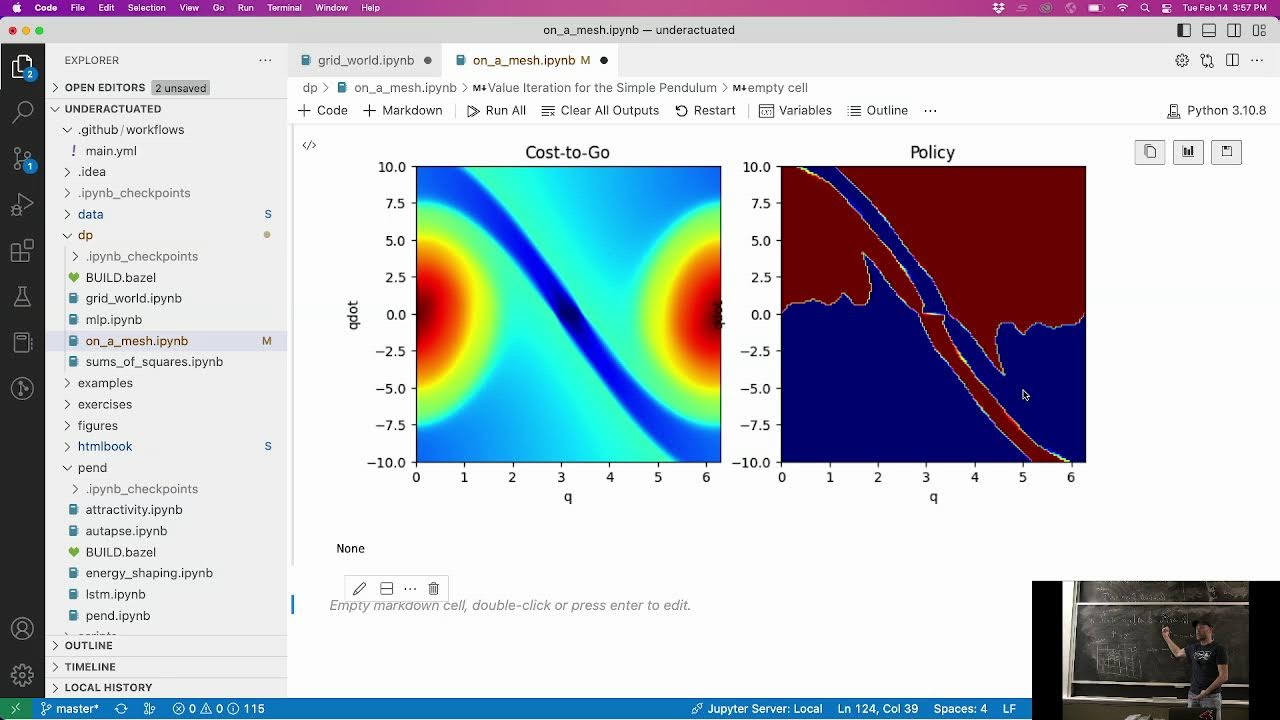
- Visualization of cost-to-go and policy for the quadratic cost, highlighting the 'eyeball' shape.
- Question on discretization resolution and convergence; instructor discusses slow convergence and upwind discretization.
- Clarification that the method is a batch update over all states, akin to value iteration.
- Explanation of the policy as bang-bang due to minimum-time, with decision boundaries.
- Demonstration of more spirals with reduced torque limits and increased resolution.
- Discussion on non-uniqueness of optimal policies vs. uniqueness of value function.
- Implications for imitation learning and conclusion of lecture.
Contribution & Novelties
The lecture provides a clear demonstration of dynamic programming for a continuous underactuated system, emphasizing the importance of understanding passive dynamics and the trade-offs of discretization. It offers practical insights into the relationship between dynamic programming and reinforcement learning, and highlights the non-uniqueness of optimal policies versus the uniqueness of value functions.
Pour aller plus loin :
- Dynamic Programming — Foundational concept.
- Hamilton-Jacobi-Bellman equation — Theoretical basis for optimal control.
- Reinforcement Learning — Related field with scalability challenges.
78 words
Radar Profile
The radar profile shows high scores in information quantity, quality, and technical level, with a slightly lower but still strong reliability score. This indicates a technically rich and reliable lecture, with minor limitations in source citation.