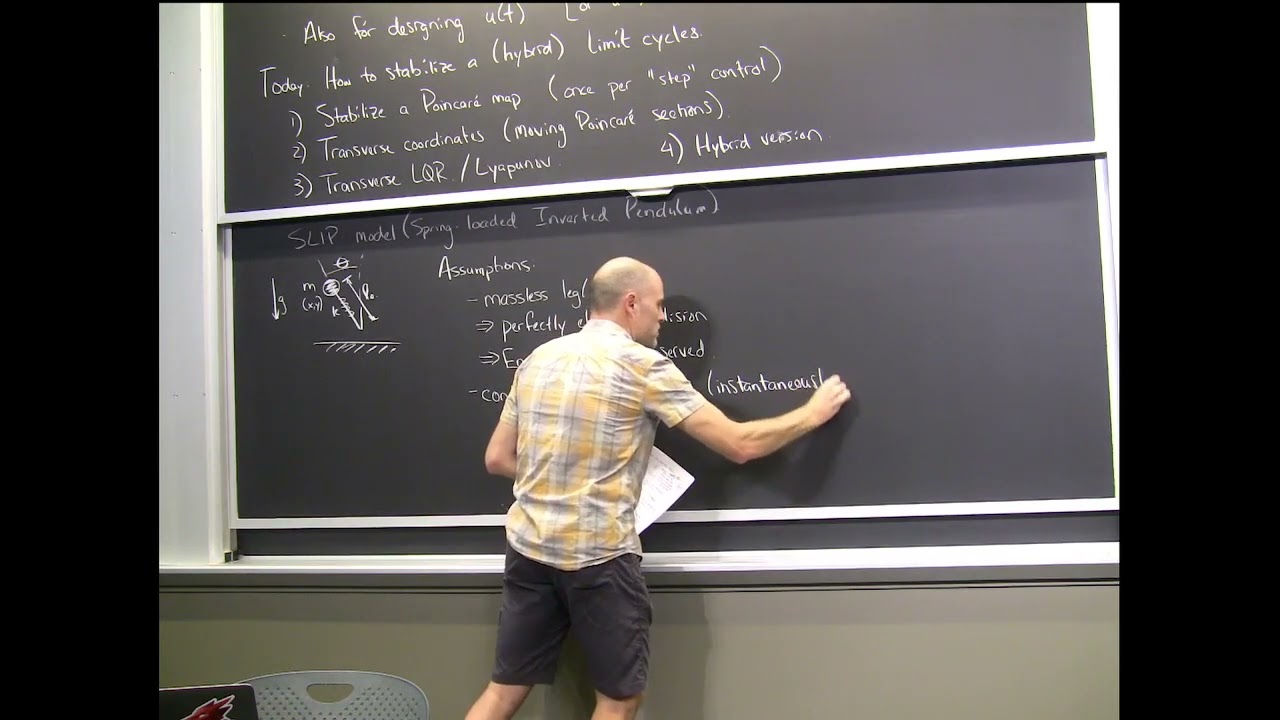
6.8210 Spring 2023 Lecture 16: Planning + control through contact
Keywords
Summary
128 words
Critical Evaluation
The lecture provides a rigorous and insightful treatment of control for hybrid systems, particularly in the context of legged locomotion. The instructor effectively builds on previous material, clearly explaining the challenges of stabilizing limit cycles in systems with impacts. The use of the SLIP model as a running example is excellent, as it is simple yet rich enough to illustrate key concepts. The mathematical derivations are thorough, and the instructor takes care to explain the physical intuition behind the equations. The discussion of the Poincaré map and transverse coordinates is particularly valuable, as these are fundamental tools in the analysis of periodic orbits. The lecture also benefits from references to real-world research, such as the work by Bob Full on animal locomotion, which grounds the theoretical concepts in empirical observations. However, the lecture assumes a strong background in dynamics and control, and some viewers may find the pace challenging. The lack of visual aids for some of the mathematical manipulations could also be a drawback. Overall, the content is of high quality and provides a solid foundation for understanding control of hybrid systems, with clear connections to both biological and robotic applications. The adéquation between title and content is excellent, as the lecture indeed covers planning and control through contact. The presentation is well-structured, and the instructor’s enthusiasm for the subject is evident, making the material engaging despite its complexity.
230 words
Title / Content Match
The title accurately reflects the content: the lecture covers planning and control for hybrid systems with contact, focusing on stabilization of limit cycles.
Quality & Reliability
8/10
Lecture from MIT OpenCourseWare, presented by a professor in robotics, with rigorous mathematical derivations and references to established research (e.g., Full's work on SLIP). The content is technical and well-structured, though it is a lecture and not peer-reviewed.
Key Moments
Markers derived by PSI from the transcript: the creator did not define chapters.
- Introduction and recap of previous lectures on limit cycles and hybrid dynamics.
- Discussion of the SLIP model and its relevance to running gaits.
- Derivation of the SLIP dynamics and the Poincaré map.
- Introduction to stabilizing a Poincaré map using once-per-step control.
- Explanation of transverse coordinates and their use in linearization.
- Application of transverse LQR to stabilize limit cycles.
- Discussion of hybrid versions of the control methods.
- Examples from animal locomotion, including cockroach experiments.
- Templates and anchors concept in biological and robotic locomotion.
- Conclusion and outlook on extending these ideas to more complex robots.
Cited Sources
- Underactuated Robotics course materials — Course website with lecture notes and additional resources.
Concurring Sources
- Underactuated Robotics course materials — Course website with lecture notes and additional resources.
Contribution & Novelties
The lecture provides a clear and comprehensive framework for stabilizing limit cycles in hybrid systems, using the SLIP model as a concrete example. It bridges theoretical concepts with practical applications in legged robotics and biomechanics.
Pour aller plus loin :
- Spring-loaded inverted pendulum — Overview of the SLIP model and its applications.
- Poincaré map — Mathematical tool for analyzing periodic orbits.
- Hybrid system — General concept of systems with continuous and discrete dynamics.
73 words
Radar Profile
The radar profile shows high scores in technical level and information quality, indicating a dense and rigorous lecture. The lower score in quantity of information relative to the others suggests that while the content is deep, it may not cover a wide breadth of topics, focusing instead on specific methods.