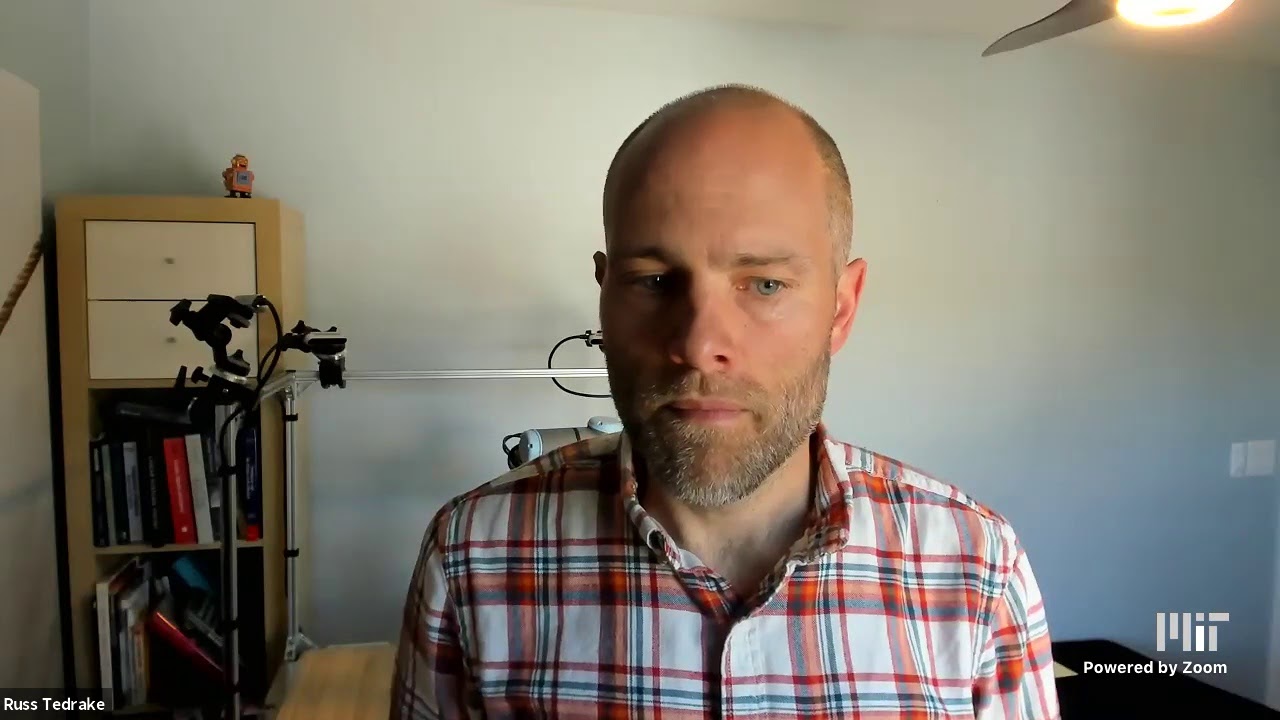
Lecture 11 (Policy Search) | MIT 6.832 (Underactuated Robotics), Spring 2021
Keywords
Summary
135 words
Critical Evaluation
The lecture provides a solid introduction to policy search, a key topic in reinforcement learning and optimal control. The instructor, Russ Tedrake, is a leading expert in the field, and the content is well-structured and rigorous. The motivation for policy search is clearly articulated: for many real-world systems, the dynamics and cost-to-go functions are too complex to model accurately, yet simple controllers can perform well. The LQR case is analyzed in detail, demonstrating that even though the optimization problem is non-convex, gradient descent can be used effectively because there are no local minima. This is a valuable theoretical result that justifies the use of gradient-based methods. The lecture also highlights the importance of specifying a distribution over initial conditions, which is a crucial practical consideration. The algorithm presented, which adapts trajectory optimization techniques to optimize controller parameters, is a useful tool for practitioners. The lecture is well-paced and includes intuitive explanations, though some parts assume prior knowledge of control theory and linear algebra. The lack of external references is a minor weakness, but the lecture is part of a comprehensive course with extensive notes. Overall, this is a high-quality educational resource that effectively bridges theory and practice.
197 words
Title / Content Match
The title accurately reflects the content: a lecture on policy search methods in the context of underactuated robotics.
Quality & Reliability
8/10
Lecture from MIT OpenCourseWare by a recognized expert in robotics and control. Content is rigorous, with theoretical foundations and practical algorithms. No external sources cited, but the lecture is part of a well-established course.
Key Moments
Markers derived by PSI from the transcript: the creator did not define chapters.
- Introduction and motivation for policy search
- Formulation of the policy search problem and the need for a distribution over initial conditions
- LQR as a special case: computing the expected cost with Gaussian initial conditions
- Derivation of the gradient of the cost with respect to controller parameters
- Discussion of non-convexity and the absence of local minima in LQR policy search
- Counterexamples where gradient descent may fail
- Practical algorithm: using trajectory optimization to update policy parameters
- Summary and outlook for future lectures
Contribution & Novelties
The lecture provides a clear and accessible introduction to policy search, a fundamental concept in reinforcement learning and optimal control. It highlights the advantages of searching directly in policy space, especially for systems with complex dynamics. The analysis of LQR policy search, including the non-convexity and the absence of local minima, is a key insight. The lecture also offers a practical algorithm that combines trajectory optimization with policy parameter updates.
Pour aller plus loin :
- Policy gradient methods — Overview of a class of policy search algorithms.
- REINFORCE algorithm — A classic policy gradient method.
- Trust region policy optimization — A more advanced policy search method.
106 words
Radar Profile
The radar profile shows high scores across all dimensions, indicating a well-balanced lecture with strong information content, technical depth, and reliability. The lecture excels in providing both theoretical foundations and practical algorithms.