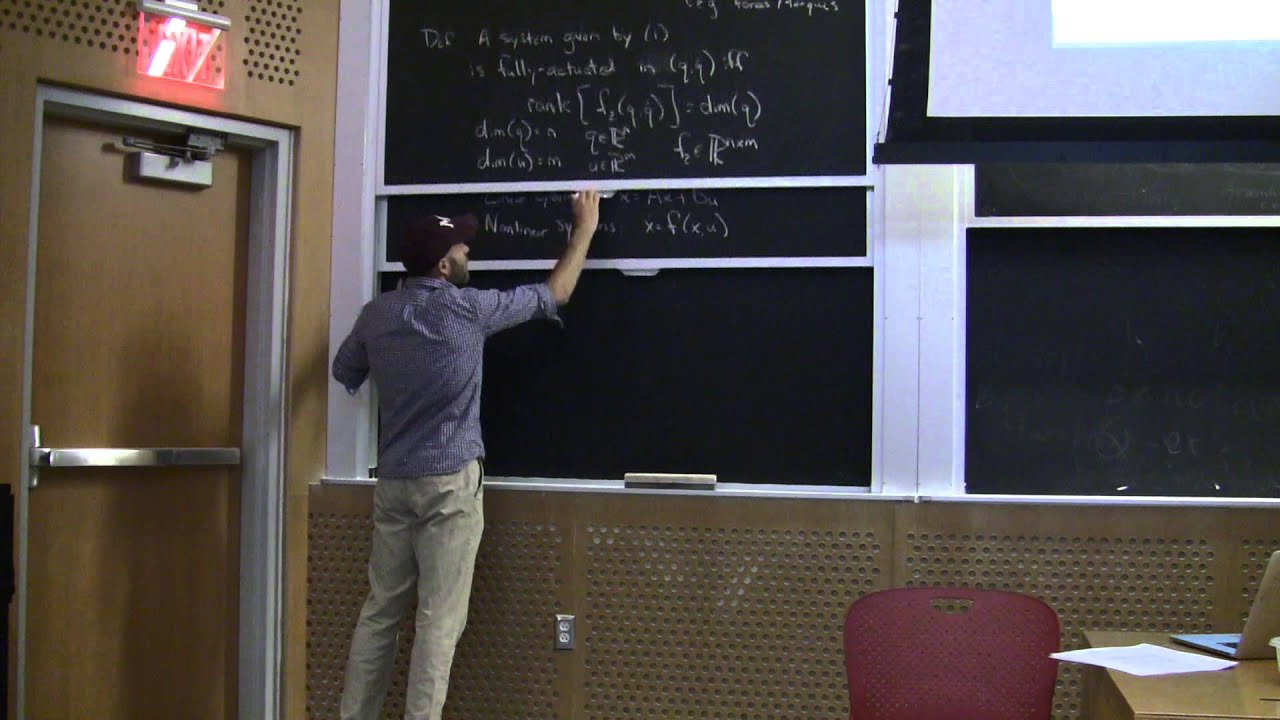
Lecture 1 for MIT 6.832 (Underactuated Robotics) 2015
Keywords
Summary
150 words
Critical Evaluation
The lecture is a compelling introduction to underactuated robotics, delivered by a leading expert in the field. Tedrake effectively uses historical examples and demonstrations to illustrate the importance of dynamics in robotics. The argument that high-gain, stiff control is not the only approach is well-supported by the passive walker example, which shows that natural dynamics can lead to more efficient and human-like locomotion. The lecture also highlights the fragility of current robots, as seen in the DARPA Challenge, and sets the stage for a course that aims to address these challenges. The content is scientifically sound, drawing on established research and the instructor’s extensive experience. The sources cited are primarily the instructor’s own course materials and well-known robotics projects (e.g., Boston Dynamics, Honda’s ASIMO). The lecture is well-structured and accessible, though it assumes some background in robotics and control. The title accurately reflects the content, and the lecture successfully fulfills its goal of motivating the study of dynamics. The main limitation is that it is an introductory lecture, so it does not delve deeply into technical details, but it provides a solid foundation for the course.
186 words
Title / Content Match
The title accurately reflects the content: a first lecture in an underactuated robotics course.
Quality & Reliability
8/10
Lecture by a leading MIT professor, based on established research and course materials, but not peer-reviewed.
Key Moments
Markers derived by PSI from the transcript: the creator did not define chapters.
- Introduction and course logistics
- History of dynamic robots at MIT, Marc Raibert's hopping robots
- Honda's ASIMO and the contrast with passive walkers
- DARPA Robotics Challenge and the fragility of robots
- Definition of underactuated systems and examples
- Importance of dynamics in aircraft and other systems
- Course overview and topics to be covered
Cited Sources
- MIT 6.832 Course Website — Course materials, notes, and schedule
Concurring Sources
- Passive Dynamic Walking — Supports the idea that passive dynamics can lead to efficient locomotion.
Contribution & Novelties
The lecture provides a unique perspective on underactuated robotics, emphasizing the importance of dynamics and the potential of passive dynamics. It challenges traditional high-gain control approaches and encourages a shift towards letting physics do the work. The historical context and examples from MIT’s robotics program add depth to the discussion.
Pour aller plus loin :
- Underactuated Robotics — The course textbook and notes by Russ Tedrake.
- Passive Dynamic Walking — Concept of robots that walk without actuation, using gravity and inertia.
- DARPA Robotics Challenge — Competition that highlighted the capabilities and fragility of humanoid robots.
95 words
Radar Profile
The radar profile shows high scores in information quantity and quality, reflecting the lecture's rich content and authoritative source. The technical level is high, indicating a specialized audience. The overall reliability is strong, consistent with the instructor's expertise.