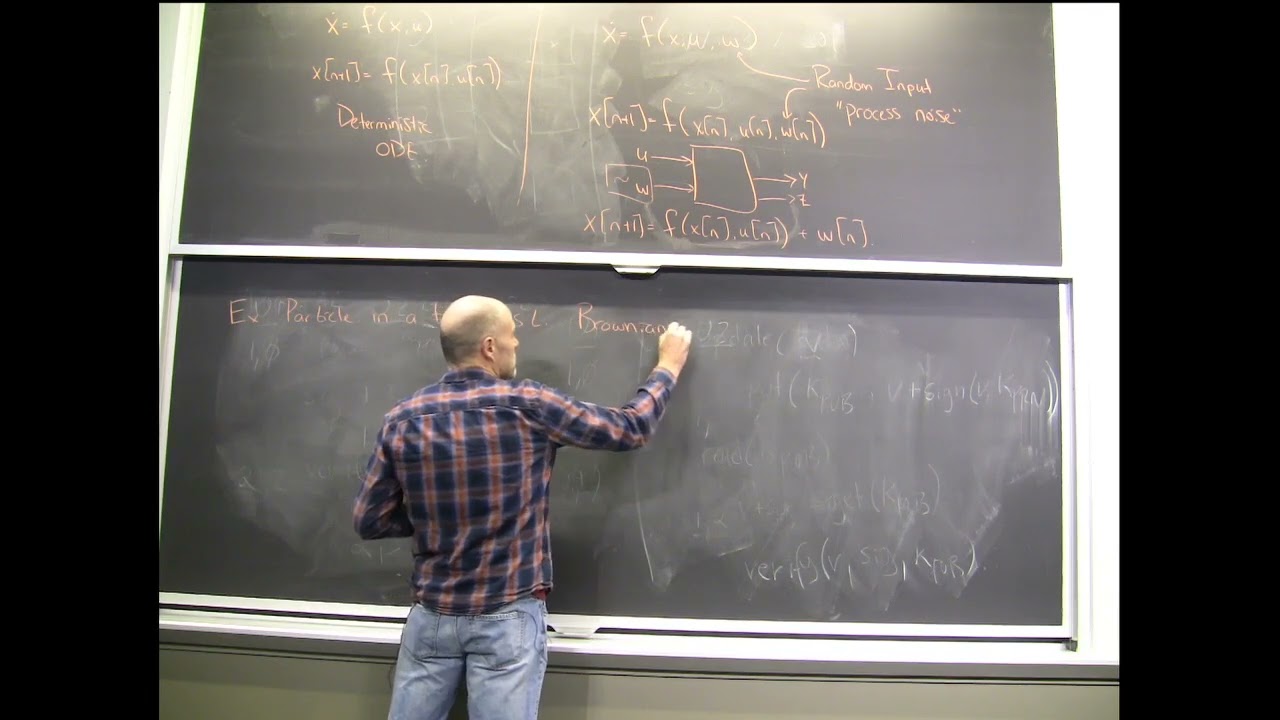
6.8210 Spring 2023 Lecture 20: Stochastic dynamics
Keywords
Summary
144 words
Critical Evaluation
The lecture provides a solid introduction to stochastic dynamics, focusing on the evolution of probability distributions in nonlinear systems. The instructor’s approach is rigorous, building on deterministic concepts and extending them with minimal notation changes. He clearly explains the difference between individual trajectories and the distribution, using the example of a particle in a bowl to illustrate how the distribution can converge even when individual paths do not. The mathematical derivations are clear, and the connection to the master equation and Fokker-Planck equation is well-motivated. The lecture is well-structured, with a logical flow from motivation to theory to examples. The use of visualizations (histograms) helps intuition. However, the lecture is part of a course and assumes prior knowledge of control theory and basic probability, which may limit accessibility to a broader audience. The sources cited are not explicitly mentioned, but the content aligns with standard textbooks on stochastic processes and control. The title accurately reflects the content. Overall, the lecture is of high quality, providing valuable insights into stochastic dynamics for those with a background in control or dynamical systems.
180 words
Title / Content Match
The title accurately reflects the content: the lecture focuses on stochastic dynamics in the context of underactuated systems.
Quality & Reliability
8/10
The lecture is part of a formal MIT course (6.8210) on underactuated robotics, presented by an expert in the field. The content is mathematically rigorous, with clear derivations and references to standard concepts in stochastic dynamics. The presentation is well-structured and the explanations are precise, though the video is a lecture recording and not peer-reviewed.
Key Moments
Markers derived by PSI from the transcript: the creator did not define chapters.
- Introduction: motivation for stochastic dynamics, robustness to disturbances.
- General framework: adding random inputs to state equations, process vs measurement noise.
- Example: particle in a bowl with Brownian motion, discrete-time approximation.
- Illustration of probability distribution evolution for a cubic potential, finite-time escape.
- Introduction of the master equation for probability dynamics, relation to Fokker-Planck.
- Discussion of stability of distributions vs individual trajectories.
- Further examples and implications for control.
Contribution & Novelties
The lecture provides a clear pedagogical introduction to stochastic dynamics, emphasizing the evolution of probability distributions. It bridges deterministic control theory and stochastic processes, offering intuition for how randomness affects nonlinear systems. The use of simple examples and visualizations makes the concepts accessible.
Pour aller plus loin :
- Fokker-Planck equation — Relevant for the continuous-time limit of the master equation.
- Markov chain — Foundational concept for discrete-time stochastic processes.
- Stochastic differential equation — Extends the framework to continuous-time noise.
79 words
Radar Profile
The radar profile shows high scores across all dimensions, indicating a well-balanced lecture with strong information content, technical depth, and reliability. The lecture is particularly strong in technical level and information quality, making it a valuable resource for advanced students.