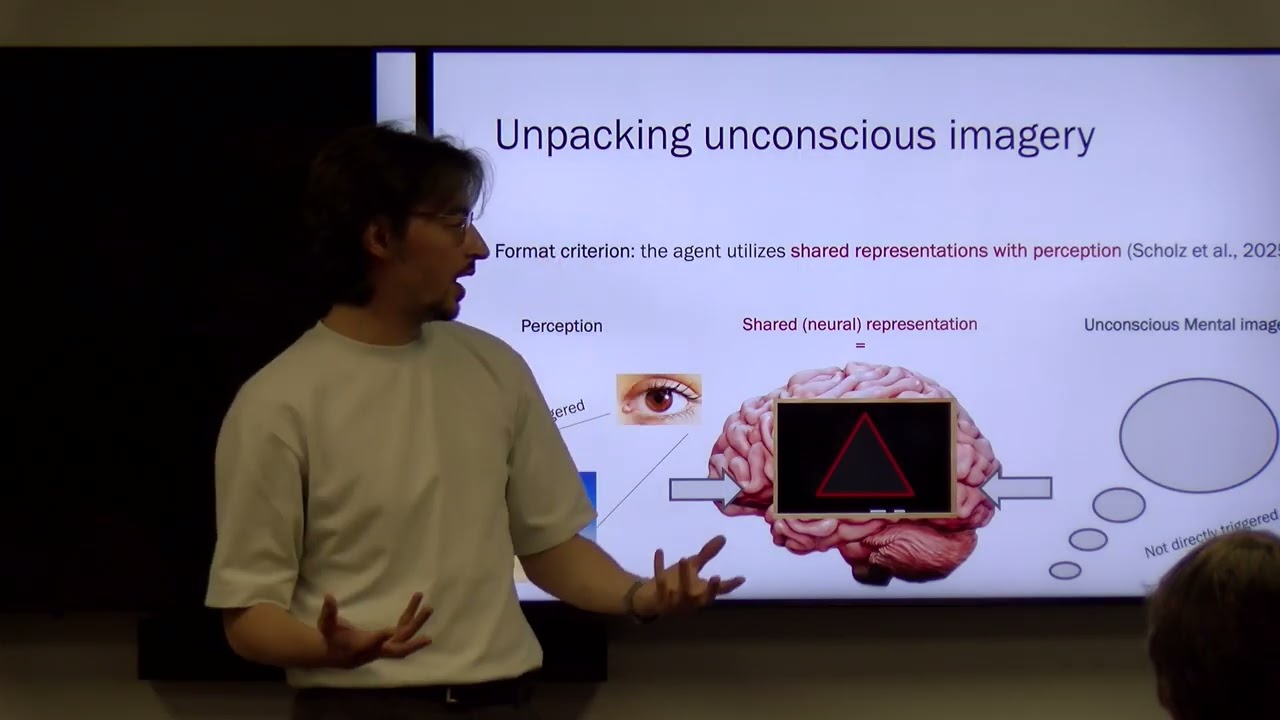
Bochum - In Person Talk (No Q&A) - Scholz: Aphantasia and the Unconscious Imagery Debate
Keywords
Summary
188 words
Critical Evaluation
Value of the Information & Strength of the Argument
The talk provides a valuable critical analysis of the unconscious imagery debate, offering clear criteria and evaluating evidence. The argumentation is solid, systematically addressing each criterion and citing relevant studies. The speaker acknowledges counterarguments and limitations, such as the possibility of distorted representations or the necessity of shared representations. The proposal of ‘sensory precursors’ and the integration model is speculative but well-motivated, providing a novel framework for understanding aphantasia.
Scientific Rigor, Source Quality, Title Accuracy
The talk demonstrates scientific rigor by grounding arguments in published literature, including works by Nanay, Pearson, and others. The speaker clearly distinguishes between empirical findings and theoretical interpretations. The title accurately reflects the content, focusing on the debate over unconscious imagery. The talk is an expert opinion, not a systematic review, but it is well-referenced and critically engages with the literature.
145 words
Title / Content Match
The title accurately reflects the content: a focused talk on aphantasia and the debate over unconscious imagery.
Quality & Reliability
8/10
The talk presents a well-structured argument based on recent literature, but it is an expert opinion with speculative elements, and the speaker's own model is in preprint.
Key Moments
Markers derived by PSI from the transcript: the creator did not define chapters.
- Introduction to aphantasia and the spectrum of imagery vividness.
- Historical importance of mental imagery and the puzzle of aphantasia competency.
- Introduction to the unconscious imagery debate and key proponents.
- Definition of unconscious imagery based on Nanay and unpacking into three criteria.
- Discussion of the formal criterion and evidence on shared representations.
- Discussion of the function criterion, including priming and physiological correlates.
- Proposal of sensory precursors as an alternative to unconscious imagery.
- Presentation of the integration model of aphantasia.
- Summary of subtypes and conclusion.
Cited Sources
- Unconscious mental imagery — Nanay's 2021 paper defining unconscious imagery.
- Mental Imagery: Philosophy, Psychology, Neuroscience — Nanay's book providing the definition of mental imagery.
- Aphantasia and the unconscious imagery debate — Scholz's own letter arguing against unconscious imagery.
- Aphantasia and the unconscious imagery debate — Response by Chung et al. to Scholz's letter.
- Aphantasia and the unconscious imagery debate — Paper by Ian Phillips on aphantasia.
Concurring Sources
- Unconscious mental imagery — Nanay's paper proposing the concept of unconscious imagery.
- Aphantasia and the unconscious imagery debate — Scholz's letter arguing against unconscious imagery.
Dissenting Sources
- Aphantasia and the unconscious imagery debate — Chung et al. argue that aphantasics might have distorted perceptual representations, which would still count as unconscious imagery.
Contribution & Novelties
The talk offers a novel contribution by proposing ‘sensory precursors’ as an alternative to unconscious imagery in aphantasia, and by introducing an integration model that specifies the cognitive and neural processes involved. It provides clear criteria for evaluating unconscious imagery and systematically applies them to existing evidence.
Pour aller plus loin :
- Aphantasia - Wikipedia — Overview of aphantasia and its research.
- Mental imagery - Wikipedia — Background on mental imagery.
- Global workspace theory - Wikipedia — Relevant to the amplification step in the model.
85 words
Radar Profile
The radar profile shows high scores in information quantity and quality, and moderate to high technical level, with a slightly lower reliability due to the speculative nature of the proposed model. This suggests a well-informed but somewhat theoretical talk.