Sequences, Affordances, and the Evolution of Complexity
Keywords
Summary
133 words
Critical Evaluation
Value of the Information & Strength of the Argument
The talk offers a valuable interdisciplinary perspective, synthesizing ideas from biology, linguistics, and computer science to propose a unified framework for understanding sequences. The argumentation is logically structured, building from the properties of sequences to their role in affordances and complexity. Waters effectively uses analogies and examples to illustrate abstract concepts, making the argument accessible. However, the framework is largely theoretical and speculative, with limited empirical evidence presented. The claim that sequences and affordances are central to the evolution of complexity is intriguing but not rigorously tested. The argument would benefit from more concrete examples and potential falsifiable predictions.
Scientific Rigor, Source Quality, Title Accuracy
The talk demonstrates scientific rigor by grounding its arguments in established concepts and citing influential researchers such as Ada Lovelace, Howard Pattee, James Gibson, and others. The sources mentioned are credible and relevant, though the talk does not provide a systematic literature review. The title accurately reflects the content, which focuses on sequences, affordances, and complexity. The talk does not present original empirical research but rather a novel synthesis of existing ideas. The lack of detailed citations for some claims and the speculative nature of the framework slightly reduce its scientific rigor.
206 words
Title / Content Match
The title accurately reflects the content, which explores the role of sequences and affordances in the evolution of complexity across biological, cultural, and technological domains.
Quality & Reliability
8/10
The talk presents a coherent theoretical framework drawing on established concepts from biology, linguistics, and computer science, with references to notable researchers. However, it is largely a synthesis of existing ideas rather than original empirical research, and some claims are speculative.
Key Moments
Markers derived by PSI from the transcript: the creator did not define chapters.
- Introduction by Ryan, highlighting Dennis Waters' background and the book 'Behavior and Culture in One Dimension'.
- Waters begins his talk, introducing the concept of sequences and quoting Ada Lovelace.
- Discussion of DNA, language, and code as examples of one-dimensional patterns.
- Introduction of Howard Pattee's work on the physics of symbols and the symbol-matter problem.
- Explanation of rate independence vs. rate dependence using examples like driving tests and treaties.
- Discussion of the energetic properties of sequences, using the Pentagon levitation story to illustrate that sequences lack direct energetic power.
- Exploration of spatial properties of sequences, contrasting physical distance with adjacency.
- Discussion of matter and the economic concept of public goods, explaining that sequences are non-rival and non-excludable.
- Introduction of the concept of affordances from Gibson and its extension to sequences.
- Conclusion and Q&A session, where Waters elaborates on the implications of his framework.
Cited Sources
- Ada Lovelace's Notes on the Analytical Engine — Quoted in the talk to illustrate the idea of sequences as general symbols.
- Howard Pattee's 'How Does a Molecule Become a Message?' — Recommended for understanding the physics of symbols.
- Howard Pattee's 'Cell Psychology: An Evolutionary Approach to the Symbol-Matter Problem' — Recommended for cognitive scientists.
- James Gibson's 'The Ecological Approach to Visual Perception' — Source of the concept of affordances.
- C.H. Waddington's work on evolutionary biology — Quoted on the analogy between DNA and language.
- Clifford Geertz's work on cultural anthropology — Quoted on the comparison of gene and symbol.
- Roman Jakobson and Linda Waugh's work on linguistics — Quoted on the correspondence between language and genetics.
- David Baltimore's comments on DNA and Turing machines — Mentioned in the talk.
- Charles Bennett and Rolf Landauer's work on computation — Mentioned in the talk.
- David Gifford's work on biological computation — Mentioned in the talk.
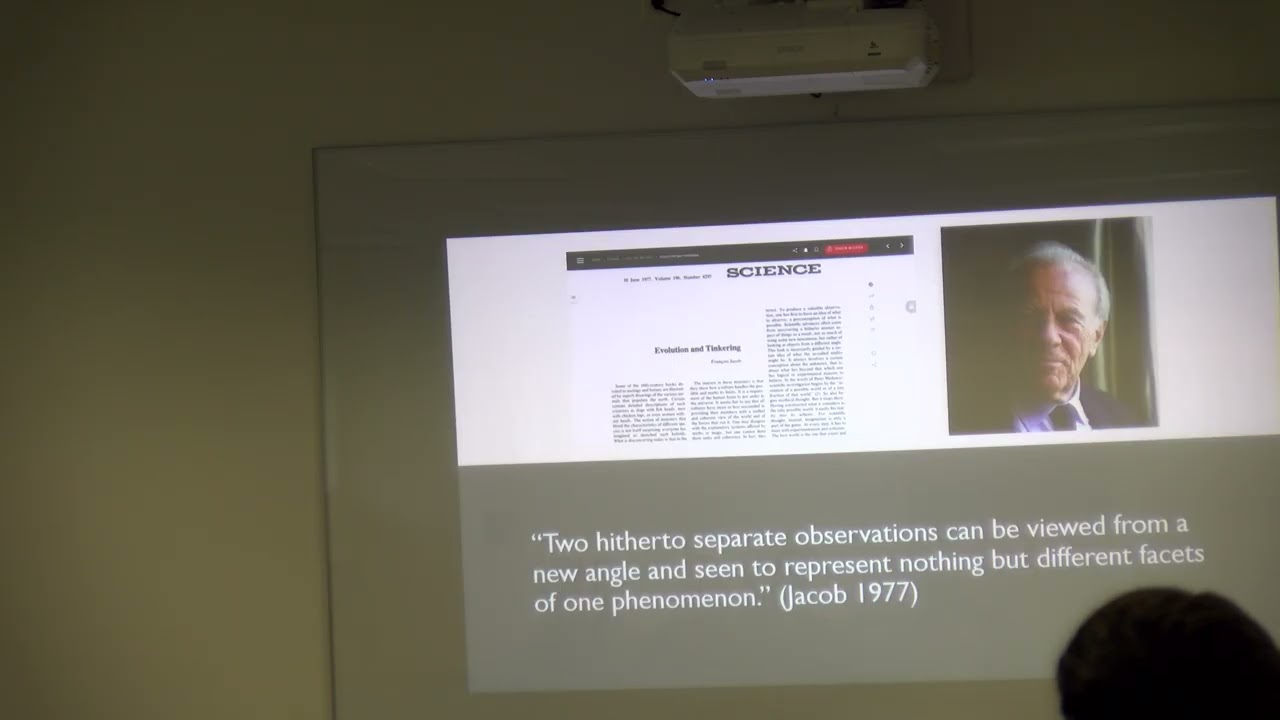
- François Jacob's 'The Linguistic Model in Biology' — Referenced for the linguistic model in biology.
Concurring Sources
- The Extended Phenotype by Richard Dawkins — Supports the idea that sequences can have effects beyond the organism.
- Symbol grounding problem — Related to the challenge of connecting symbols to physical reality.
Dissenting Sources
- Critiques of the genetic code as a language — Some biologists argue that the analogy between DNA and language is misleading, as DNA is not symbolic in the same way as human language.
Contribution & Novelties
The talk offers a novel interdisciplinary framework that unifies DNA, language, and code as sequences, and proposes that affordances are the key link between sequences and the physical world. This perspective could inspire new research directions in cognitive science, biology, and computer science. However, the framework is largely theoretical and would benefit from empirical validation.
Pour aller plus loin :
- Extended Phenotype — Richard Dawkins’ concept, relevant to how sequences extend beyond the organism.
- Symbol grounding problem — Related to how symbols acquire meaning, relevant to the symbol-matter problem.
- Universal Turing machine — Relevant to the idea of sequences as computational substrates.
- Information theory — Provides mathematical foundations for understanding sequences and information.
113 words
Radar Profile
The radar profile shows high scores in quantity and quality of information, and moderate to high technical level and reliability. This indicates a well-structured and informative talk, though it may be more accessible to those with some background in the relevant fields.