RuCCS - Dr. Sean Trott - In Person Talk - Tuesday, February 10, 2026
Keywords
Summary
174 words
Critical Evaluation
Value of the Information & Strength of the Argument
The talk provides valuable insights into the potential and limitations of using LLMs to study human cognition. The argumentation is solid: the speaker carefully designs experiments, controls for confounds, and compares model behavior to human behavior. He acknowledges the limitations of his approach and discusses alternative explanations. The use of log odds as a metric is well-explained, and the statistical modeling approach is appropriate. The talk also raises important epistemological questions about the validity of using LLMs as model organisms, which adds depth to the discussion.
Scientific Rigor, Source Quality, Title Accuracy
The talk demonstrates scientific rigor through careful experimental design, pre-registered attention checks, and transparent reporting of results. The speaker cites relevant literature on theory of mind and language models, and he acknowledges the limitations of his own work. The title accurately reflects the content, and the talk is well-structured. The speaker also discusses the importance of reproducibility and the need for open-weight models, which is a strength.
168 words
Title / Content Match
The title accurately reflects the content: a talk by Dr. Sean Trott at RuCCS on using language models to study false belief reasoning.
Quality & Reliability
8/10
The talk presents original research with clear methodology, including controlled stimuli, human comparison, and statistical analyses. The speaker acknowledges limitations and discusses epistemological challenges. However, the talk is a presentation of ongoing work, not a peer-reviewed publication, and some details are simplified.
Key Moments
Markers derived by PSI from the transcript: the creator did not define chapters.
- Introduction to the talk and the research program 'LLMology'.
- Discussion of competing hypotheses for the origin of theory of mind.
- Explanation of large language models and their training.
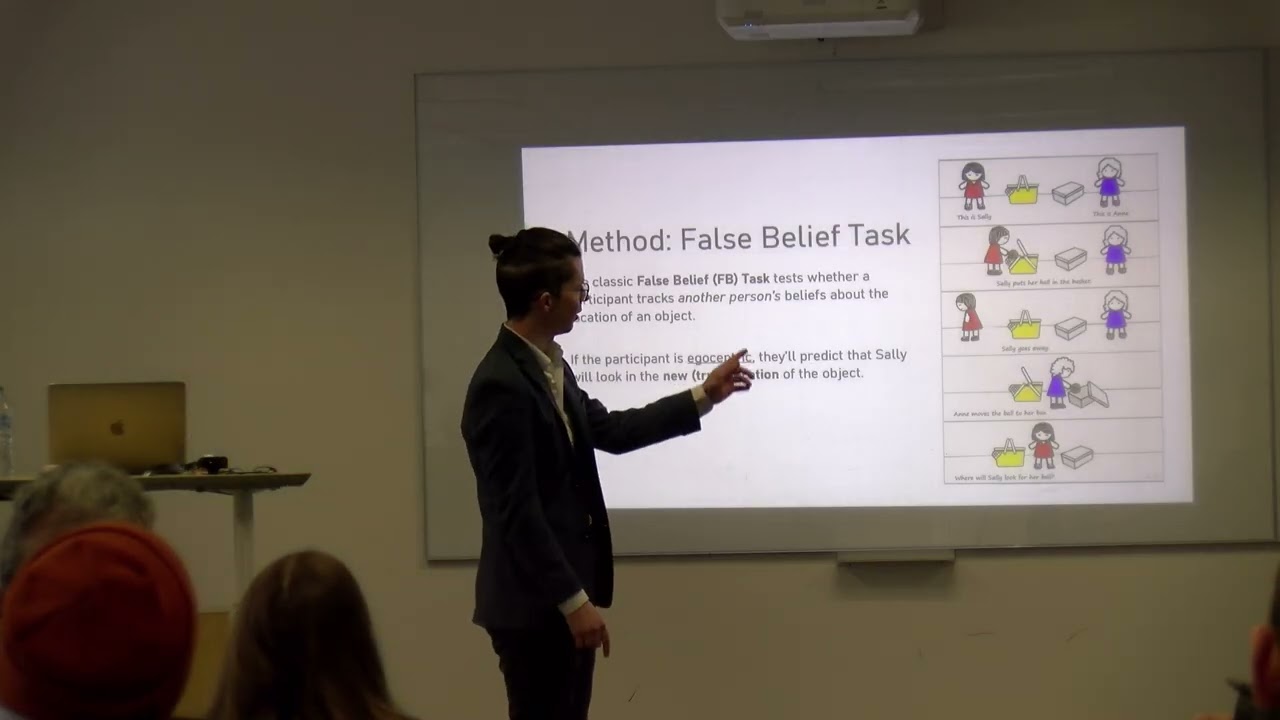
- Introduction to the false belief task and its adaptation for language models.
- Description of the custom false belief task design and stimuli.
- Presentation of GPT-3 results showing sensitivity to false beliefs.
- Human comparison study results and comparison with GPT-3.
- Discussion of limitations of closed-source models and the need for open-weight models.
- Replication with 41 open-weight LMs and findings on model size.
- Epistemological challenges in using LLMs as model organisms.
Cited Sources
- Trott, S., et al. (2023). Do Large Language Models Know What Humans Know? — The speaker references his own published work from 2023, which is the basis of the first study presented.
Concurring Sources
- Trott, S., et al. (2023). Do Large Language Models Know What Humans Know? — The speaker's own published work, which is the primary source for the first study.
Contribution & Novelties
The talk provides a novel approach to testing the role of language exposure in theory of mind by using LLMs as distributional baselines. It offers empirical evidence that LLMs can develop some sensitivity to false beliefs from language statistics alone, but not to human levels. The discussion of epistemological challenges, such as differential construct validity, is a valuable contribution to the field.
Pour aller plus loin :
- Theory of mind — Overview of the concept and its research.
- False belief task — Description of the classic task used to assess theory of mind.
- Large language model — Background on LLMs and their capabilities.
103 words
Radar Profile
The radar profile shows high scores in quantity and quality of information, with slightly lower technical level and reliability, reflecting the talk's balance between detailed methodology and accessible presentation.