RuCCS - Dr. Ida Momennejad - In Person Talk - Tuesday, November 4, 2025
Keywords
Summary
133 words
Critical Evaluation
Value of the Information & Strength of the Argument
The talk provides a high-value synthesis of computational neuroscience and AI, clearly explaining complex concepts like successor representation and its neural correlates. The argumentation is solid, building from foundational studies to original experiments, and carefully distinguishes between model-free, model-based, and SR-based approaches. The speaker’s interdisciplinary background enriches the perspective, and she explicitly avoids overclaiming equivalence between brains and AI.
Scientific Rigor, Source Quality, Title Accuracy
The talk demonstrates scientific rigor by grounding claims in seminal papers (Tolman 1948, O’Keefe & Nadel, Mosers) and her own published work. She references a book chapter in ‘Space, Time and Memory’ (Oxford University Press). The title accurately reflects the content. No public comments were provided for analysis.
122 words
Title / Content Match
The title accurately reflects the content: a research talk by Dr. Ida Momennejad at RuCCS, covering her work on memory, planning, and AI.
Quality & Reliability
8/10
The talk presents a coherent synthesis of established computational neuroscience concepts (Tolman, O'Keefe, Mosers) and original research, with clear methodological explanations. The speaker is a principal researcher at Microsoft Research with a strong interdisciplinary background. Claims are grounded in referenced literature, though the talk format limits detailed verification.
Key Moments
Markers derived by PSI from the transcript: the creator did not define chapters.
- Introduction of speaker and her interdisciplinary background.
- Overview of research question: how brains structure past experience for prediction and planning.
- Historical context: Tolman's 1948 experiment and cognitive maps.
- Introduction to successor representation and its mathematical formulation.
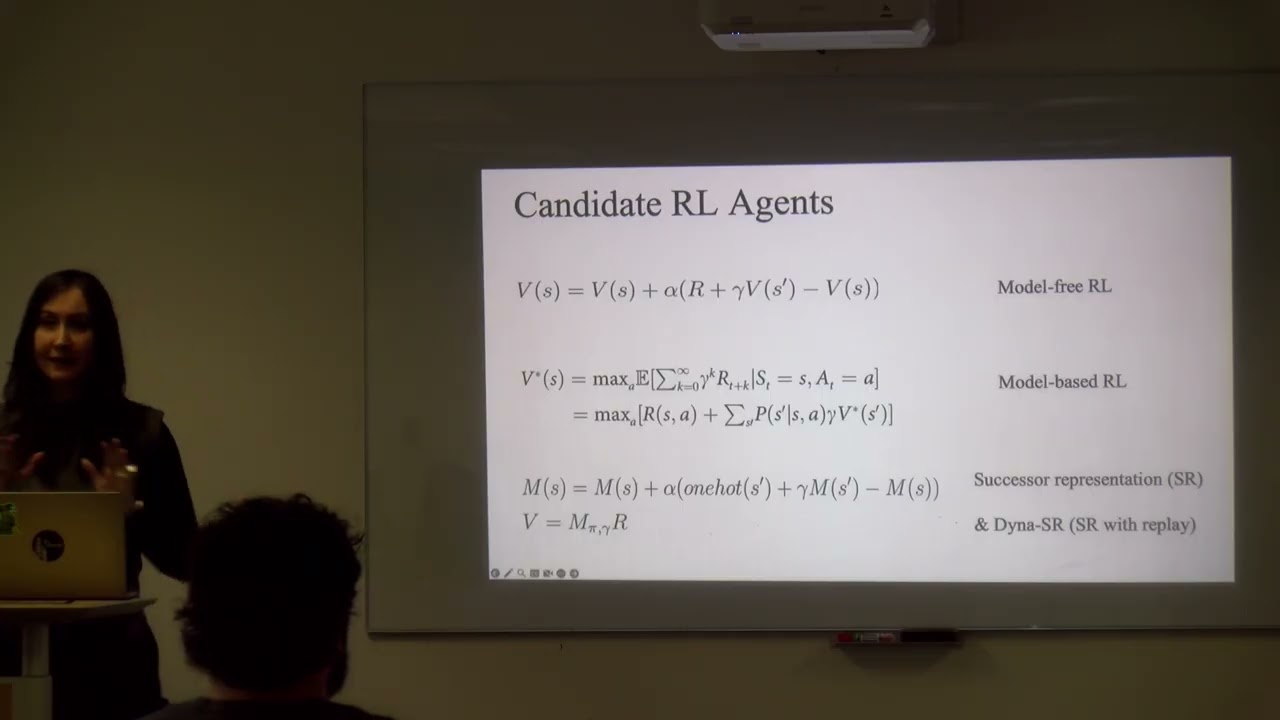
- Comparison of model-free, model-based, and successor representation agents.
- Experiments on reward changes and transition changes, showing SR predicts human behavior.
- Neural correlates: SR and hippocampal place fields, grid cells.
- Implications for AI and collective intelligence.
- Conclusion and Q&A.
Cited Sources
- Tolman, E.C. (1948). Cognitive maps in rats and men. — Cited as foundational work on cognitive maps.
- O'Keefe, J., & Nadel, L. (1978). The Hippocampus as a Cognitive Map. — Cited for place cells and cognitive maps.
- Moser, E.I., et al. (2014). Grid cells and the brain's GPS. — Cited for grid cells in entorhinal cortex.
- Momennejad, I., et al. (2017). The successor representation in human reinforcement learning. — Cited as the speaker's own work on successor representation.
- Space, Time and Memory (Oxford University Press) — Book with a chapter by the speaker summarizing her research.
Concurring Sources
- Momennejad, I., et al. (2017). The successor representation in human reinforcement learning. — Directly supports the talk's claims about SR in human behavior.
- Russek, E.M., et al. (2017). Predictive representations can link model-based reinforcement learning to model-free mechanisms. — Supports the idea of SR as a bridge between model-free and model-based.
Contribution & Novelties
The talk offers an original perspective by unifying computational models (successor representation) with neural data and AI, emphasizing common mathematical principles without equating brains and AI. It provides a clear framework for understanding how multi-step dependencies are cached in memory.
Pour aller plus loin :
- Successor representation — Overview of the concept and its applications.
- Reinforcement learning — Foundational framework for the discussed models.
- Place cell — Neural basis of spatial representation.
- Grid cell — Neural basis of metric representation.
80 words
Radar Profile
The radar profile shows high scores across all dimensions, indicating a well-rounded talk with strong information content, technical depth, and reliability. The lowest score is in 'quantite_information' relative to others, but still high, reflecting the talk's focused scope.