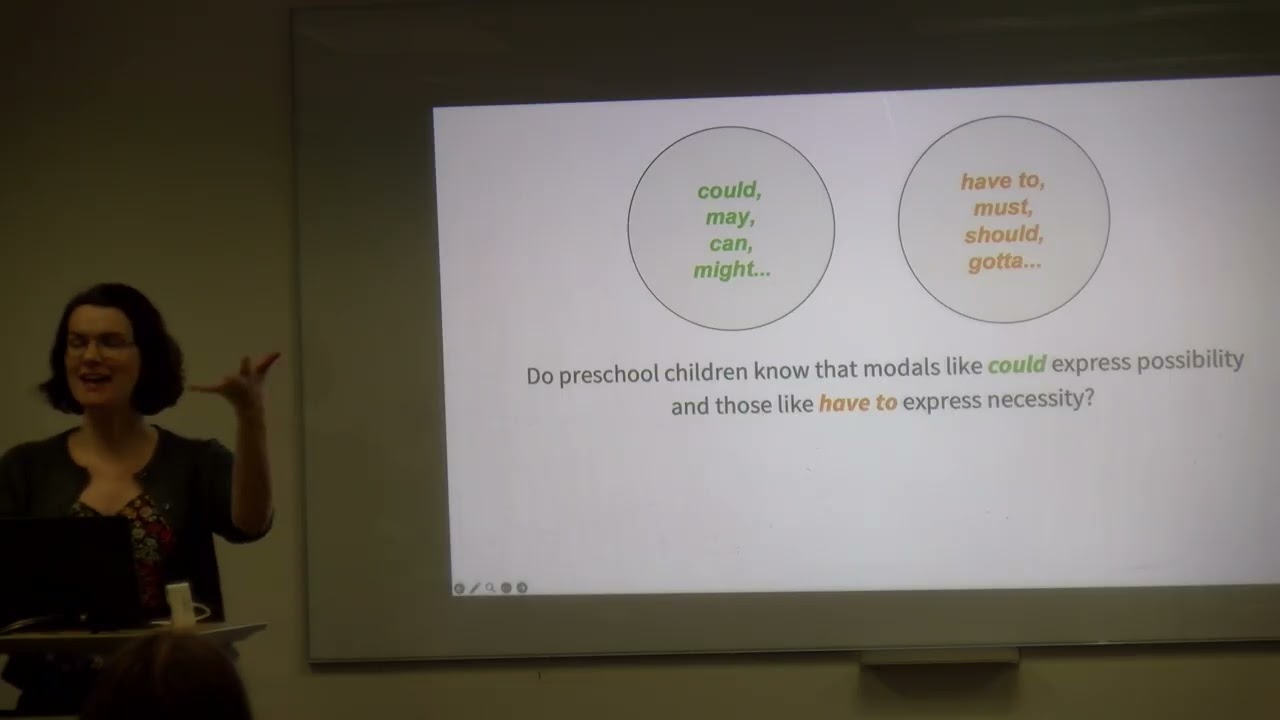
RuCCS - Dr. Ailis Cournane - In Person Talk - Tuesday, November 18, 2025
Keywords
Summary
185 words
Critical Evaluation
Value of the Information & Strength of the Argument
The talk provides valuable insights into the acquisition of modal semantics, challenging the dominant conceptual explanation for children’s errors. The argumentation is well-structured, moving from prior findings to new experimental evidence. The speaker carefully considers alternative explanations and supports her claims with data from multiple studies, including cross-linguistic comparisons. The presentation is clear and accessible, with helpful visual aids.
Scientific Rigor, Source Quality, Title Accuracy
The talk demonstrates scientific rigor through the use of controlled experiments, appropriate statistical analyses, and consideration of alternative hypotheses. The speaker cites relevant literature, including studies by Papafragou & Ozturk, Moscati et al., and others. The title accurately reflects the content, and the talk is well-organized. The speaker is a credible researcher in the field.
129 words
Title / Content Match
The title accurately reflects the content: a talk by Dr. Cournane at RuCCS on child acquisition of modal force.
Quality & Reliability
8/10
The talk presents original experimental research with rigorous methodology, including controlled tasks and cross-linguistic comparisons. The speaker is a recognized expert in child language acquisition. However, the presentation is a colloquium talk, not a peer-reviewed publication, and some details are simplified for the audience.
Key Moments
Markers derived by PSI from the transcript: the creator did not define chapters.
- Introduction of the speaker and topic
- Overview of prior findings on modal comprehension
- Explanation of the two key results from literature
- Discussion of conceptual explanations for overacceptance
- Introduction of the linguistic explanation
- Presentation of corpus studies on child modal production
- Elicited production experiment results
- Design of new comprehension experiments
- Results of the new experiments
- Discussion and conclusions
Cited Sources
- Papafragou & Ozturk (2014) — Cited as prior study showing children's overacceptance of necessity modals in possibility contexts.
- Moscati et al. (2017) — Cited as prior study on modal force comprehension.
- Bleotu et al. (2021) — Cited as prior study on modal force comprehension.
- van Dooren et al. (2022) — Cited for frequency of root vs. epistemic uses in child input.
- Phillips & Kratzer (2023) — Cited for metacognitive demands in epistemic reasoning tasks.
- Cournane, Dieuleveut, Repetti-Ludlow & Hacquard (2025) — Cited as the source of the new experiments presented.
- Lungu, Dieuleveut, Cournane & Hacquard (in prep) — Cited as related work in progress.
- Leahy & Zalnieriunas (2021) — Cited for a conceptual account of children's modal behavior.
- Dieuleveut et al. (2021) — Cited for word-learning challenges with necessity modals.
- Redshaw & Suddendorf (2006) — Cited for non-linguistic task patterns with possibility reasoning.
- Leahy & Carey (2020) — Cited for non-linguistic task patterns with possibility reasoning.
- Robinson et al. (2006) — Cited for epistemic reasoning in children.
Concurring Sources
- Papafragou & Ozturk (2014) — Their findings align with the overacceptance pattern reported.
- Moscati et al. (2017) — Their findings align with the overacceptance pattern reported.
Dissenting Sources
- Leahy & Zalnieriunas (2021) — They offer a conceptual account, contrasting with the speaker's linguistic explanation.
Contribution & Novelties
The talk contributes to the understanding of modal acquisition by proposing a novel linguistic explanation for children’s errors, challenging the dominant conceptual account. It provides new experimental evidence from teleological contexts and cross-linguistic data, suggesting that children’s difficulty with necessity modals stems from lexical semantics rather than conceptual limitations.
Pour aller plus loin :
- Modal logic — Foundational concepts of possibility and necessity.
- Language acquisition — Overview of how children learn language.
- Semantics — Study of meaning in language.
79 words
Radar Profile
The radar profile shows high scores across all dimensions, indicating a well-rounded presentation with strong information content, technical depth, and reliability.