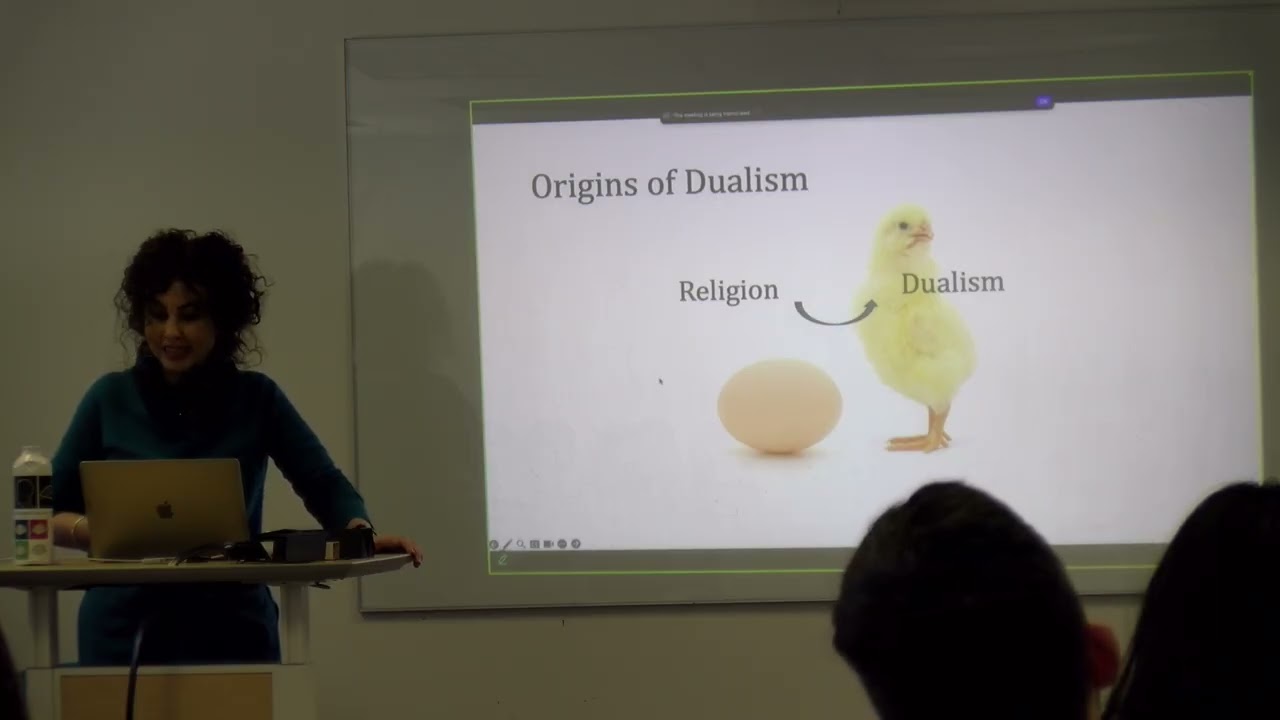
RuCCS - Dr.Iris Berent - In Person Talk - Tuesday, February 3, 2026
Keywords
Summary
158 words
Critical Evaluation
Value of the Information & Strength of the Argument
The talk provides a compelling synthesis of empirical research and theoretical arguments. Berent systematically builds her case, starting with the origins of dualism in core knowledge, then presenting experimental evidence for its existence and its attenuation in certain populations. She then demonstrates its pervasive influence on reasoning about innateness and consciousness. The argumentation is solid, with clear logical progression and appropriate caveats about correlation vs. causation. The value lies in offering a unified framework linking dualism to fundamental questions in cognitive science, backed by original data.
Scientific Rigor, Source Quality, Title Accuracy
Berent references her own published studies and those of others (e.g., Paul Bloom, Elizabeth Spelke, Susan Carey) without providing specific citations in the talk. The title is accurate, and the content is scientifically rigorous, with clear distinctions between empirical findings and speculative interpretations. The talk is well-structured and appropriate for an academic audience.
154 words
Title / Content Match
The title accurately reflects the content: a recorded talk by Dr. Iris Berent at RuCCS.
Quality & Reliability
8/10
The talk is given by a recognized researcher in cognitive science, presenting empirical evidence from her lab and referencing established theories. The arguments are structured and supported by data, though some speculative claims are clearly labeled as such.
Key Moments
Markers derived by PSI from the transcript: the creator did not define chapters.
- Introduction: dualism as a tacit belief and its bad reputation in cognitive science.
- Proposal: dualism arises from tension between intuitive physics and theory of mind.
- Evidence from body replication and afterlife thought experiments showing weaker dualism in autistic individuals and males.
- Implicit association task reveals implicit dualism even in self-proclaimed physicalists.
- Dualism's toll on cognition: links to supernatural beliefs, free will, and stigma.
- Dualism promotes empiricism: people deny innate knowledge because it is not in the body.
- Dualism fuels the hard problem of consciousness by positing mind as ethereal.
- Speculative adaptive role of dualism in affective processing and psychopathology.
Cited Sources
- Paul Bloom's work on natural dualism — Berent references Paul Bloom's proposal that dualism emerges from core knowledge systems.
- Elizabeth Spelke's core knowledge research — Mentioned as foundational for understanding innate systems of core knowledge.
- Susan Carey's work on core cognition — Referenced in the context of core knowledge systems.
Concurring Sources
- Bloom, P. (2004). Descartes' Baby — Supports the idea that dualism is natural and emerges from core knowledge.
- Spelke, E. S., & Kinzler, K. D. (2007). Core knowledge — Provides evidence for innate core knowledge systems.
Dissenting Sources
- Embodied cognition perspectives — Some researchers argue that the mind is fundamentally embodied, challenging the dualist separation.
Contribution & Novelties
The talk offers a novel integration of dualism with core knowledge theory, providing empirical evidence for its natural origins and its impact on reasoning about innateness and consciousness. It also suggests a potential adaptive role for dualism, linking it to psychopathology.
Pour aller plus loin :
- Core knowledge systems — Overview of the theory of core knowledge.
- Theory of mind — Background on the cognitive ability to attribute mental states.
- Hard problem of consciousness — David Chalmers’ formulation of the problem.
81 words
Radar Profile
The radar profile shows high scores in information quantity, quality, and reliability, with a slightly lower technical level, indicating a talk that is rich in content and well-supported but accessible to a broader academic audience.
💬 No comments were provided for analysis.