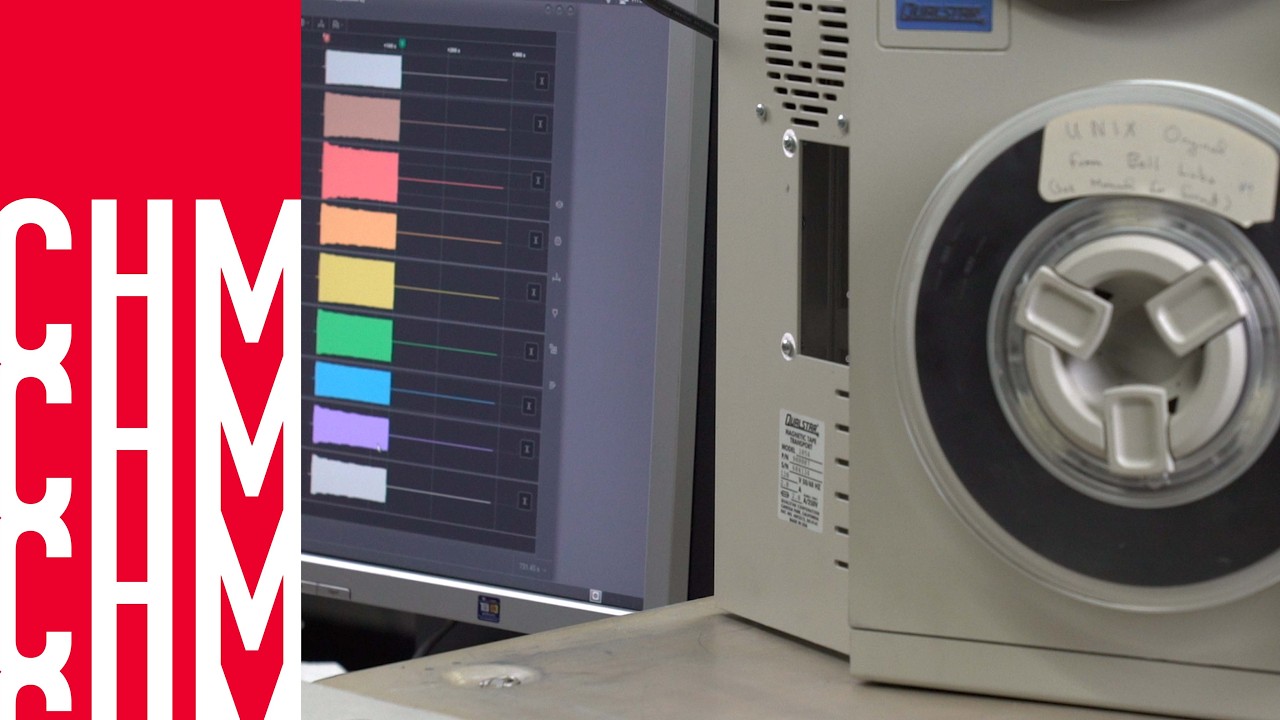
Computer History Museum Recovers Rare UNIX History
Keywords
Summary
162 words
Critical Evaluation
The video provides a compelling and informative account of the recovery of a historically significant UNIX source code tape. The production quality is high, with clear explanations from experts directly involved in the process. The technical details are accurate and well-presented, making the content accessible to a general audience while still being of interest to specialists. The narrative is well-structured, moving from the discovery of the tape to the technical challenges of data recovery and finally to the historical context and significance. The sources cited are credible, including the Computer History Museum’s own catalog and the Unix Heritage Society. The video does not oversell the achievement; it acknowledges the uncertainty of the tape’s contents until the recovery was successful. The adéquation between the title and content is excellent, as the video indeed focuses on the recovery of rare UNIX history. The only minor criticism is that the video could have provided more detail on the flux mapping technique, but this is a minor omission given the overall quality. The public comments reflect a positive reception, with viewers expressing appreciation for the preservation work and the technical insights. Overall, this is an excellent video that combines technical depth with historical significance, making it a valuable resource for anyone interested in computing history.
211 words
Title / Content Match
The title accurately reflects the content, which focuses on the recovery of a rare UNIX source code tape.
Quality & Reliability
9/10
The video is produced by the Computer History Museum, a reputable institution, and features direct interviews with the curator and other experts involved in the recovery. The technical details are consistent with known practices in magnetic tape data recovery, and the narrative is corroborated by the museum's catalog number and the Unix Heritage Society's involvement.
Key Moments
Markers derived by PSI from the transcript: the creator did not define chapters.
- Introduction to Al Kossow and his role as software curator.
- Explanation of the challenges of magnetic tape recovery.
- Len Shustek describes his failed attempt to recover his PL/1 tape and his innovative analog approach.
- Talia Archeald recounts discovering the tape's significance and the excitement at the University of Utah.
- John Durig explains the tape's discovery in Jay Lepreau's storage room.
- Warren Toomey discusses the historical importance of UNIX V4 and the Unix Heritage Society.
- Al Kossow details the recovery process, including tape conditioning and digitization.
- The team prepares to read the tape and the successful recovery is anticipated.
- Conclusion and reflections on the significance of preserving computing history.
Cited Sources
- Computer History Museum — The museum's website, where the video is hosted and where the recovered software may be made available.
- Unix Heritage Society — Mentioned by Warren Toomey as the organization he founded and runs, which tracks UNIX history.
Concurring Sources
- Unix Heritage Society — The society's archives and mailing list discussions corroborate the existence and significance of the UNIX V4 tape.
Contribution & Novelties
The video provides a unique behind-the-scenes look at the recovery of a historically significant UNIX source code tape, highlighting the technical challenges and the innovative analog recovery technique. It underscores the importance of software preservation and the collaborative efforts of institutions and individuals.
Pour aller plus loin :
- UNIX V4 source code — The actual recovered source code, available for study.
- Flux mapping — The technique used to recover data from magnetic media by analyzing analog signals.
- Computer History Museum Software Preservation — The museum’s software preservation efforts and resources.
90 words
Radar Profile
The radar profile shows high scores in information quality and reliability, with slightly lower but still strong scores in quantity and technical level. This indicates a well-balanced video that is both informative and technically sound, suitable for a broad audience interested in computing history.
💬 Très positif. Sur les 30 commentaires analysés, les spectateurs expriment une grande admiration pour le travail de préservation et la technique de récupération, avec des remerciements appuyés à Al Kossow et à l'équipe.