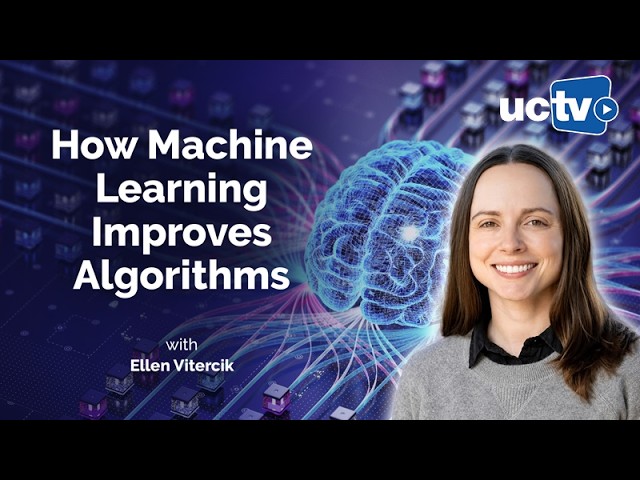
How Machine Learning Improves Algorithms with Ellen Vitercik
Keywords
Summary
162 words
Critical Evaluation
The video provides a valuable overview of Ellen Vitercik’s research at the intersection of machine learning and algorithm design. The discussion is well-structured, moving from foundational concepts like beyond worst-case analysis to specific applications in optimization and LLM reasoning. Vitercik’s explanations are clear and accessible, making complex topics understandable without oversimplifying. The argumentation is solid, grounded in her expertise and experience as a Stanford professor. She effectively highlights the gap between theoretical worst-case analysis and practical performance, a key motivation for her work. The discussion of using machine learning to improve solvers while preserving optimality guarantees is particularly insightful, addressing a critical challenge in the field. Her work on LLM reasoning is innovative, using data structure tasks to probe reasoning abilities in a verifiable manner. The examples of out-of-distribution failures provide concrete evidence of limitations in current models. The video does not delve into specific technical details or provide citations, but it serves as an excellent introduction to these research areas. The title accurately reflects the content, and the conversation is engaging and informative. Overall, the video offers a high-quality expert perspective on important topics in computer science.
188 words
Title / Content Match
The title accurately reflects the content, focusing on how machine learning can improve algorithm design, with a clear emphasis on Ellen Vitercik's research.
Quality & Reliability
8/10
The speaker is a Stanford professor with a PhD and multiple awards, providing expert insights. The content is well-structured and references established concepts, but lacks detailed citations or peer-reviewed sources in the video itself.
Chapters
- Machine Learning and Algorithm Design
- What Beyond Worst-Case Analysis Means
- Why NP-Hard Problems Differ in Practice
- Problem-Specific Heuristics and Solvers
- Using Machine Learning Without Losing Guarantees
- Testing LLM Reasoning With Algorithms
- When Pattern Matching Breaks Down
- From Math and Music to Computer Science
Cited Sources
- UCTV — Main platform for the video.
- Data Science Channel — Channel where the video is featured.
- UCTV Science & Technology — Related science content.
- Audio description version — Alternate version with audio description.
Concurring Sources
- Beyond Worst-Case Analysis — Supports the concept discussed.
- AlphaDev — Example of ML improving algorithms.
Contribution & Novelties
The video provides an expert overview of using machine learning to improve algorithm design, highlighting the potential of LLMs to generate problem-specific heuristics while maintaining formal guarantees. It also introduces a novel approach to evaluating LLM reasoning through data structure tasks, which are verifiable and can reveal pattern matching failures.
Pour aller plus loin :
- Beyond Worst-Case Analysis — Overview of the field.
- NP-hardness — Definition and implications.
- Integer programming — Key optimization framework discussed.
- AlphaDev — Example of ML-generated heuristics.
- LLM reasoning — Context on reasoning abilities.
88 words
Radar Profile
The radar profile shows high scores in information quantity, quality, and reliability, with a slightly lower technical level, indicating a well-balanced presentation suitable for a broad audience.