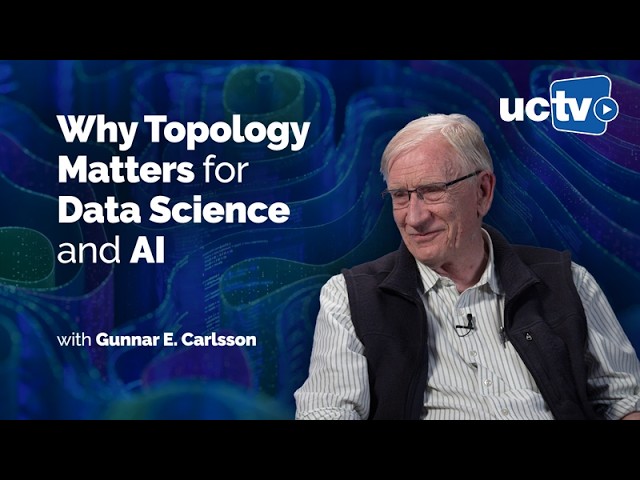
Why Topology Matters for Data Science and AI
Keywords
Summary
146 words
Critical Evaluation
The video provides a valuable high-level introduction to topological data analysis and its relevance to AI, delivered by two leading experts in the field. Gunnar Carlsson’s explanations are clear and accessible, using analogies like the game Connections to illustrate how topology helps identify groups in data. The discussion successfully conveys the conceptual power of TDA without delving into technical complexities, making it suitable for a broad audience interested in the intersection of mathematics and AI.
The argumentation is solid, grounded in Carlsson’s extensive experience and his pioneering work in TDA. He effectively makes the case that algebraic topology, despite its abstract nature, offers practical tools for organizing and interpreting complex data. The emphasis on examples and accessible tools is a practical takeaway, highlighting the need for user-friendly implementations to bridge the gap between theory and application.
However, the video lacks depth in explaining the specific mathematical techniques (e.g., persistent homology) and their computational aspects. For viewers seeking a more technical understanding, this may be insufficient. The discussion also touches on AI interpretability but does not provide concrete examples of how topology enhances interpretability in current AI systems.
The sources cited are primarily institutional links to UCTV and related channels, which are credible but not directly linked to the research discussed. The video does not reference specific papers or external sources, limiting the ability to verify claims independently.
The title accurately reflects the content, and the video fulfills its promise of explaining why topology matters for data science and AI. The production quality is professional, with clear audio and visuals.
Overall, the video is a valuable resource for those seeking an expert perspective on the role of topology in AI, but it is more of an overview than a detailed technical exposition.
291 words
Title / Content Match
The title accurately reflects the content, which focuses on the relevance of topology to data science and AI.
Quality & Reliability
8/10
The video features two established researchers in topological data analysis, providing credible expert perspectives. The discussion is largely conceptual, with limited technical depth, but the speakers' credentials and the institutional context (UC system) support reliability.
Chapters
Cited Sources
- UCTV — Main platform hosting the video
- Data Science Channel — Channel featuring related content
- Science Like Me + — Series to which this video belongs
- UCTV Donation Page — Support page for UCTV
- Science & Technology on UCTV — Related science content
- Audio Description Version — Alternative version with audio description
Concurring Sources
- Topological Data Analysis — General reference on TDA, consistent with the video's claims.
Contribution & Novelties
The video provides an accessible expert perspective on how topology, particularly algebraic topology, can be applied to data science and AI. It emphasizes the concept of ‘shape of data’ as a way to organize and interpret complex datasets, and discusses the importance of interpretability in AI. The discussion also highlights the need for interdisciplinary collaboration and the development of user-friendly tools to make topological methods more accessible.
Pour aller plus loin :
- Topological data analysis - Wikipedia — Provides a comprehensive overview of TDA, including persistent homology and applications.
- Persistent homology - Wikipedia — Key technique in TDA, useful for understanding the mathematical foundations.
- Mapper (topology) - Wikipedia — A specific TDA method mentioned in the video for clustering and visualization.
121 words
Radar Profile
The radar profile shows strong scores in quality and reliability, reflecting the expertise of the speakers, while quantity and technical level are moderate, indicating a conceptual rather than detailed technical discussion.