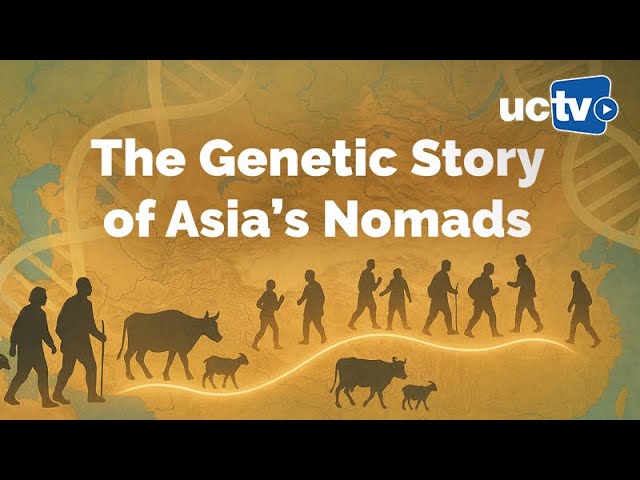
CARTA: Human Population History in North and East Asia with Choongwon Jeong
Keywords
Summary
114 words
Critical Evaluation
The presentation is a high-quality synthesis of recent archaeogenetic research on the Eurasian Steppe. Choongwon Jeong, a prominent researcher in the field, provides a clear and well-structured narrative, supported by PCA plots that visually demonstrate genetic relationships. The talk is scientifically rigorous, referencing multiple studies and acknowledging collaborative efforts. The argumentation is solid, with logical progression from hunter-gatherers to the Xiongnu Empire, and the interpretation of genetic data is cautious, noting uncertainties. The sources are primarily the speaker’s own published work and that of collaborators, which lends authority but also potential bias. The talk does not delve into methodological details, which is appropriate for a general audience but limits critical assessment. The adéquation between title and content is excellent. Overall, this is a valuable resource for understanding the genetic history of North and East Asia, though it assumes some familiarity with genetic concepts.
143 words
Title / Content Match
The title accurately reflects the content: a CARTA presentation on human population history in North and East Asia, focusing on the Kazakh and Mongolian Steppes.
Quality & Reliability
8/10
Presentation by a leading researcher in archaeogenetics, summarizing peer-reviewed studies. The talk is well-structured, uses PCA plots, and cites specific ancient DNA findings. However, it is a conference talk without detailed methodological exposition, and some claims rely on unpublished or recent studies.
Key Moments
Markers derived by PSI from the transcript: the creator did not define chapters.
- Introduction to the Eurasian Steppe and its significance.
- Explanation of PCA and genetic maps.
- Discussion of pre-Bronze Age hunter-gatherers and their genetic structure.
- Arrival of Afanasievo herders and their genetic legacy.
- Spread of Andronovo horse pastoralists and the halt at Altai.
- Iron Age genetic groups and the rise of the Xiongnu Empire.
- Summary and conclusions.
Cited Sources
- CARTA website — Mentioned as the organizing body for the talk.
- UCTV — Platform hosting the video.
- CARTA: Ancient DNA - New Revelations — Series containing this talk.
- UCTV Science & Technology — General science content from UCTV.
Concurring Sources
- Jeong et al. (2020) - The genetic history of admixture across inner Eurasia — Key study on the genetic history of Inner Eurasia, likely referenced in the talk.
- Damgaard et al. (2018) - 137 ancient human genomes from across the Eurasian steppes — Major study on ancient Eurasian steppe genomes.
Dissenting Sources
- Narasimhan et al. (2019) - The formation of human populations in South and Central Asia — This study suggests a more complex picture of gene flow into South Asia, which may contrast with the simplified narrative of steppe expansions presented in the talk.
Contribution & Novelties
This talk provides a concise synthesis of recent archaeogenetic findings on the Kazakh and Mongolian Steppes, highlighting the distinct genetic histories of these regions and the role of the Xiongnu in their integration. It emphasizes the importance of river geography in structuring hunter-gatherer populations and the differential impact of pastoralist expansions.
Pour aller plus loin :
- Ancient North Eurasian — Relevant to the ANE ancestry discussed.
- Yamnaya culture — Context for early pastoralist expansions.
- Xiongnu — The first steppe empire mentioned.
- Principal component analysis — Method used for genetic visualization.
90 words
Radar Profile
The radar chart shows high scores in information quantity, quality, and reliability, with a slightly lower technical level, reflecting the talk's accessibility. The overall profile indicates a well-balanced, informative presentation suitable for a scientifically literate audience.
💬 No comments were provided for analysis.