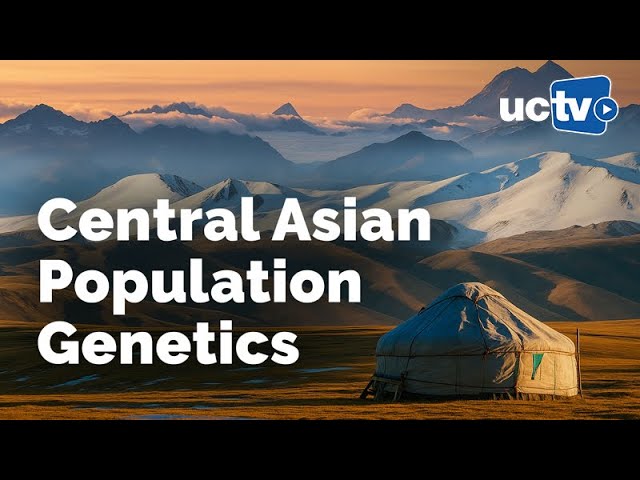
CARTA: Central Asian Population Genetics and Natural Selection with Ainash Childebayeva
Keywords
Summary
163 words
Critical Evaluation
The presentation offers a valuable synthesis of current knowledge on Central Asian population genetics, integrating evidence from ancient DNA, archaeology, and linguistics. The speaker, a professor at the University of Texas at Austin, demonstrates expertise in the field, and the content is scientifically sound, referencing established methods like PCA and admixture analysis. The argumentation is coherent, moving from a broad introduction of the region to specific examples of natural selection. However, the talk is a conference presentation and lacks detailed citations, which limits its utility for verification. The speaker acknowledges the underrepresentation of Central Asia in ancient DNA studies, which is an important caveat. The discussion of natural selection is insightful, particularly the distinction between standing variation and novel mutations, but it remains at an introductory level. The admixture analysis is well-explained, but the presentation could benefit from more concrete data or figures. Overall, the talk is informative and rigorous, but it is not a peer-reviewed publication and should be considered as an expert opinion. The title accurately reflects the content, and the presentation is well-structured. The lack of specific sources is a minor weakness, but the content is consistent with established scientific knowledge.
194 words
Title / Content Match
The title accurately reflects the content, which focuses on population genetics and natural selection in Central Asia.
Quality & Reliability
8/10
The presentation is given by a professor at the University of Texas at Austin, specializing in population genetics and ancient DNA. It is part of the CARTA symposium, which is known for high-quality scientific content. The talk is well-structured, referencing established methods (PCA, admixture analysis) and known genetic markers (SLC24A5, OCA2). However, it is a conference talk without peer review, and specific citations are not provided in the video.
Key Moments
Markers derived by PSI from the transcript: the creator did not define chapters.
- Introduction to Central Asia and its ecological diversity.
- Discussion of the migration corridor and ancient hominins in Central Asia.
- PCA and admixture analysis of modern Central Asian populations.
- Overview of ancient DNA studies and the underrepresentation of Central Asia.
- Population history from Neolithic to Iron Age, including horse domestication and nomadic pastoralism.
- How ancient DNA can reveal natural selection in action.
- Examples of adaptation: skin color and high-altitude adaptation in Central Asia.
- Challenges in differentiating admixture effects from post-admixture selection.
Cited Sources
- CARTA website — The talk is part of the CARTA symposium, and the website provides information about the event and related resources.
- UCTV - CARTA: Ancient DNA - New Revelations — The video is part of this series, which includes related talks on ancient DNA.
- UCTV Science & Technology — The video is hosted on UCTV's science channel, which features scientific content.
Concurring Sources
- The genetic history of the Southern Arc: A bridge between West Asia and Europe — This study provides insights into ancient DNA from West Asia, which is relevant to understanding Central Asian admixture.
- Ancient human genomes suggest three ancestral populations for present-day Europeans — This paper discusses the admixture of ancestral populations in Europe, which parallels the admixture patterns in Central Asia.
Dissenting Sources
- No specific discordant sources found — The talk is consistent with current scientific understanding; no conflicting sources were identified.
External References
Contribution & Novelties
The talk provides a concise overview of Central Asian population genetics, highlighting the region’s underrepresentation in ancient DNA studies and the potential for future research. It emphasizes the importance of ancient DNA in distinguishing between standing variation and novel mutations in natural selection, and discusses specific adaptations like skin color and high-altitude adaptation in Central Asian populations.
Pour aller plus loin :
- Ancient DNA and human history — Provides background on ancient DNA methods and applications.
- Admixture mapping — Explains the method used to infer ancestry mixtures.
- High-altitude adaptation in humans — Discusses genetic adaptations to high altitude, relevant to the talk’s discussion of Tajik and Kyrgyz populations.
108 words
Radar Profile
The radar profile shows high scores in quality of information and reliability, reflecting the expert presentation and scientific rigor. The quantity of information is moderate, as the talk is a concise overview. The technical level is also moderate, suitable for a general scientific audience.
💬 No comments were provided for analysis.