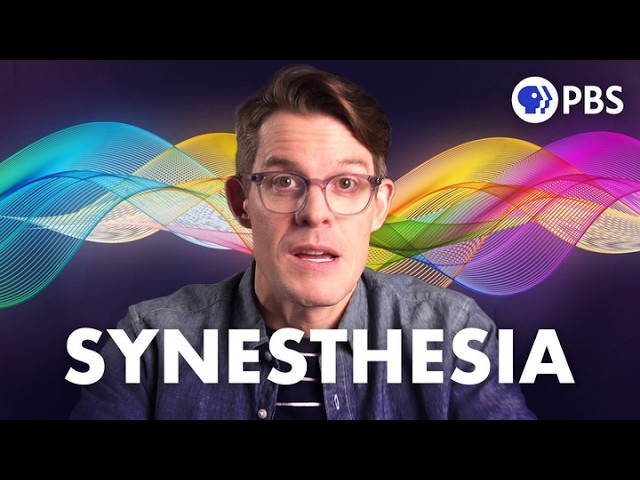
The Weird Reason Some People Can Taste Colors
Keywords
Summary
141 words
Critical Evaluation
Value of the Information & Strength of the Argument
The video provides valuable information by clearly explaining the neurological basis of synesthesia, using accessible analogies and real-world examples. It effectively argues that synesthesia is a genuine perceptual phenomenon, not just learned associations, by outlining criteria like simultaneity, involuntariness, and consistency. The inclusion of a personal interview adds credibility and human interest. The argumentation is solid, referencing specific studies and expert opinions, though it could delve deeper into the genetic and neural mechanisms.
Scientific Rigor, Source Quality, Title Accuracy
The video maintains scientific rigor by citing specific studies (e.g., the 2013 letter-color study, 2018 UK training study) and mentioning researchers. It distinguishes synesthesia from mere associations and sound symbolism, showing careful attention to definitions. The title accurately reflects the content, focusing on the ‘weird reason’ behind synesthesia. The sources are not explicitly listed in the description, but the video references credible research and includes an interview with a person with synesthesia, enhancing its reliability.
163 words
Title / Content Match
The title accurately reflects the content, which explores the neurological basis of synesthesia and why some people experience it.
Quality & Reliability
8/10
The video presents established scientific concepts (synesthesia types, synaptic pruning, bouba/kiki effect) with references to specific studies (2013 letter-color study, 2018 UK training study) and includes expert interviews. While it simplifies some nuances, it accurately distinguishes synesthesia from mere associations and sound symbolism.
Key Moments
Markers derived by PSI from the transcript: the creator did not define chapters.
- Introduction to the question: what color is the letter A?
- Explanation of grapheme-color synesthesia and its prevalence.
- Discussion of exuberant synaptogenesis and synaptic pruning.
- Interview with P.W. Shelton about lexical-gustatory synesthesia.
- Benefits of synesthesia, including enhanced memory and creativity.
- The bouba/kiki effect as an example of sound symbolism.
- Conclusion on the importance of studying synesthesia for understanding brain connectivity.
Cited Sources
- Patreon page — Support page mentioned in description.
- YouTube subscription link — Link to subscribe to the channel.
- Instagram profile — Host's Instagram.
- Instagram profile — Channel's Instagram.
- Facebook page — Channel's Facebook page.
Concurring Sources
- Synesthesia - Wikipedia — General information on synesthesia aligns with video content.
- Synaptic pruning - Wikipedia — Supports the explanation of how synesthesia may develop.
Contribution & Novelties
The video offers a clear and engaging explanation of synesthesia, synthesizing current scientific understanding for a general audience. It uniquely combines personal testimony with scientific evidence, making the phenomenon relatable. The discussion of the 2013 letter-color study and the bouba/kiki effect provides concrete examples that illustrate the concepts.
Pour aller plus loin :
- Synesthesia - Wikipedia — Comprehensive overview of synesthesia types and research.
- Synaptic pruning - Wikipedia — Explanation of the neural process that may underlie synesthesia.
- Bouba/kiki effect - Wikipedia — Details on the sound symbolism phenomenon mentioned in the video.
93 words
Radar Profile
The radar profile shows high scores in information quantity, quality, and reliability, with a slightly lower technical level, indicating a well-balanced, accessible science communication piece. The video excels in providing accurate and engaging content without overwhelming the audience with jargon.
💬 Très positif. Sur les 30 commentaires analysés, la grande majorité exprime de l'enthousiasme et de la gratitude pour l'explication claire, avec de nombreux partages d'expériences personnelles de synesthésie.