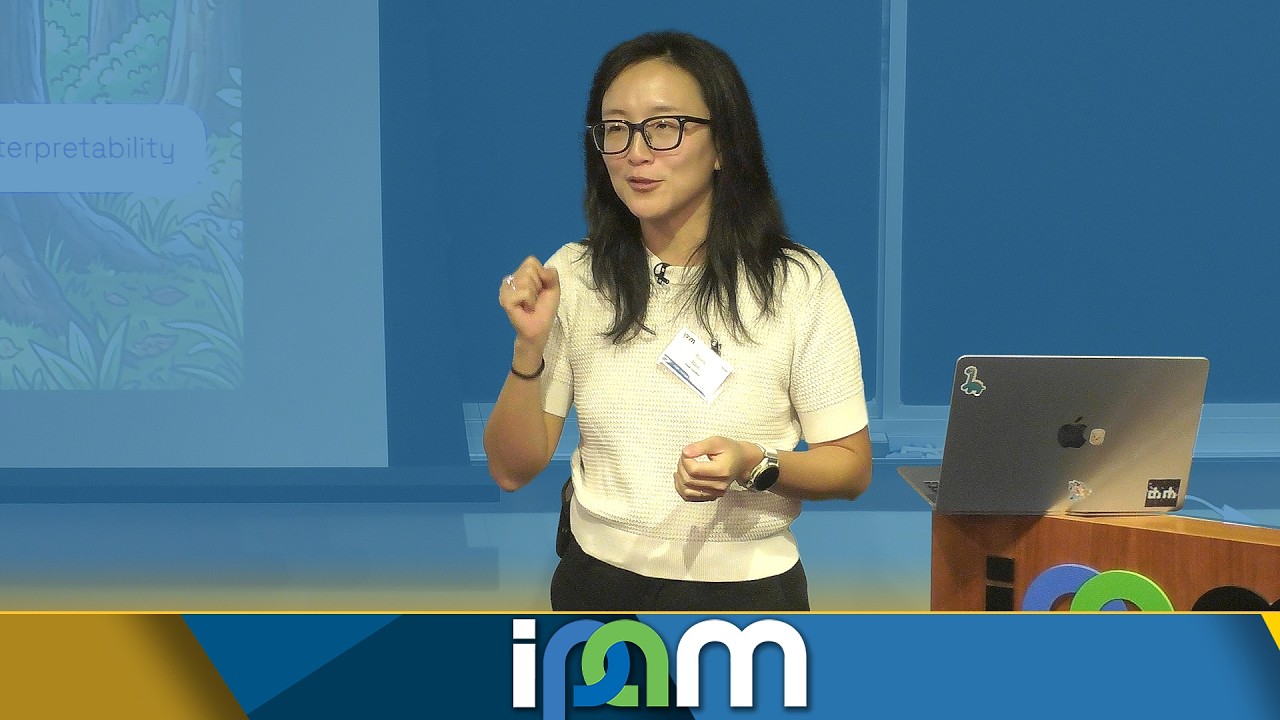
Changing Shapes: Interpretability, AI, and the Future of Human Agency
Keywords
Summary
197 words
Critical Evaluation
Value of the Information & Strength of the Argument
The talk provides valuable insights into the current state and future directions of interpretability. Kim’s argument is well-structured, moving from a historical review to a proposed new paradigm. She effectively uses the chess grandmaster study as evidence that AI can augment human understanding. The discussion of the limitations of feature attribution, including the mathematical impossibility result, is particularly strong. However, the proposal for ‘agentic interpretability’ is somewhat speculative, and the speaker acknowledges that the general implementation is not yet known. The argumentation is persuasive but relies on a personal perspective and a single case study.
Scientific Rigor, Source Quality, Title Accuracy
The talk is scientifically rigorous, referencing published work and the speaker’s own research. The speaker is a leading expert in the field, which adds to the credibility. The sources are not explicitly cited in the video, but the content is consistent with known literature. The title accurately reflects the content, which discusses the changing nature of interpretability and the need to focus on human agency. The talk is well-structured and the arguments are presented clearly.
185 words
Title / Content Match
The title accurately reflects the content, which discusses the evolution of interpretability and the need for a new 'agentic' approach to maintain human agency.
Quality & Reliability
8/10
High credibility due to the speaker's position at Google DeepMind and the academic context (IPAM workshop). The talk presents a personal perspective but is grounded in published research and includes concrete examples. However, some claims are speculative and lack detailed evidence.
Key Moments
Markers derived by PSI from the transcript: the creator did not define chapters.
- Introduction and motivation: concern about AI development and the need for interpretability.
- Discussion of the increasing complexity of AI systems and the decreasing coverage of human understanding.
- Historical review of interpretability: from inherently interpretable models to feature attribution and concept-based explanations.
- Presentation of the mathematical impossibility result for feature attribution.
- Introduction of micro and macro interpretability, and the concept of agentic interpretability.
- Case study: teaching superhuman chess concepts from AlphaZero to grandmasters.
- Discussion of future directions, including the use of neologisms and the need for new ideas.
Cited Sources
- Foundations of Interpretability Workshop — The talk was presented at this workshop, and the link provides context and related materials.
Concurring Sources
- Interpretability (Wikipedia) — Provides background on interpretability, including feature attribution and mechanistic interpretability.
Contribution & Novelties
The talk contributes a novel perspective on interpretability by proposing ‘agentic interpretability’ as a new paradigm focused on proactive AI assistance in human understanding. It also provides a critical review of existing methods and highlights the need to shift from exhaustive understanding to practical usefulness. The chess grandmaster study is a concrete example of AI augmenting human capabilities.
Pour aller plus loin :
- Mechanistic Interpretability — Overview of interpretability, including mechanistic approaches.
- Zone of Proximal Development — Educational theory referenced in the talk.
- AlphaZero — The AI system used in the chess study.
93 words
Radar Profile
The radar profile shows high scores in quality of information and reliability, reflecting the speaker's expertise and the academic context. The quantity of information is moderate, as the talk is a perspective piece rather than a comprehensive review. The technical level is high, but accessible to a knowledgeable audience.