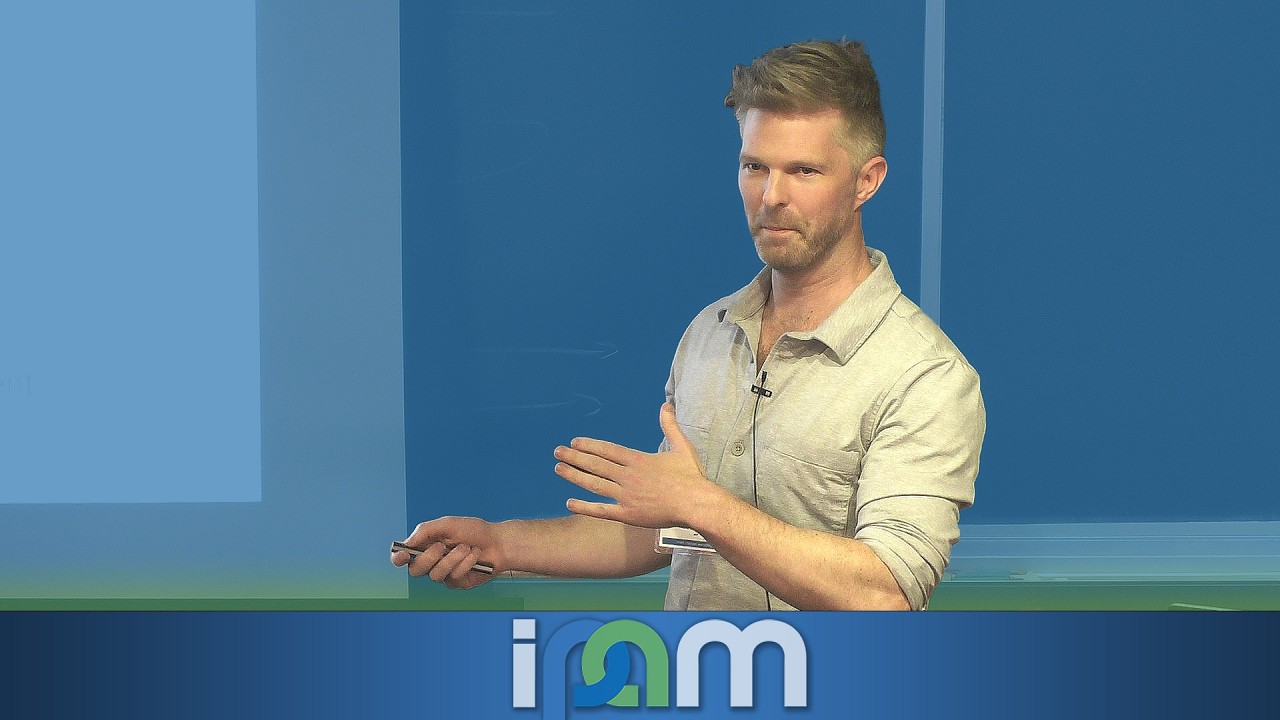
Michael Beverland - Real-time decoding for fault-tolerant quantum computers - IPAM at UCLA
Keywords
Summary
195 words
Critical Evaluation
Value of the Information & Strength of the Argument
The talk provides valuable insights into the practical challenges of decoding for fault-tolerant quantum computers, especially for quantum LDPC codes. The speaker clearly explains the decoding problem and its mathematical formulation, and he makes a strong case for the need for real-time decoding and the potential of message-passing decoders like Relay-BP. The argumentation is well-structured, moving from the big picture to specific algorithmic considerations. He also addresses the backlog problem, which is often overlooked, and provides conditions for bounded slowdown. The discussion is grounded in the context of IBM’s research and the broader field, and the speaker is open to questions, which enriches the content. However, the talk is more of an overview and position statement than a detailed presentation of results, and some claims are presented without full evidence, as expected in a workshop talk.
Scientific Rigor, Source Quality, Title Accuracy
The talk demonstrates scientific rigor in its formulation of the decoding problem and its consideration of hardware constraints. The speaker does not cite specific sources during the talk, but the description provides a link to the workshop page, which may contain further references. The title accurately reflects the content, focusing on real-time decoding for fault-tolerant quantum computers. The talk is aimed at a specialized audience, and the technical level is high. The speaker acknowledges limitations and open questions, which adds to the credibility. However, as a conference talk, it does not provide a full literature review or detailed experimental data, so the quality of sources is not explicitly demonstrated. The audience questions and responses indicate a healthy scientific exchange.
270 words
Title / Content Match
The title accurately reflects the content: the talk focuses on real-time decoding for fault-tolerant quantum computers, with emphasis on the challenges and potential solutions.
Quality & Reliability
8/10
The talk is given by an IBM researcher with deep expertise in quantum error correction and decoding. The content is technically rigorous, with clear mathematical formulation of the decoding problem and practical constraints. The speaker acknowledges limitations and open questions, and the presentation is grounded in the context of a specialized workshop. However, as a conference talk, it does not provide full experimental details or peer-reviewed references, and some claims are presented as opinions or work in progress.
Key Moments
Markers derived by PSI from the transcript: the creator did not define chapters.
- Introduction and overview of the talk's goals.
- Discussion of the trade-off between physical qubits and algorithmic capability without fault tolerance.
- Explanation of the conceptual stack of quantum computing and the role of decoding.
- Definition of the decoding problem as a classical algorithm with check and action matrices.
- Illustration of the size of decoding problems for practical systems.
- Discussion of the time constraints for real-time decoding and the need for specialized hardware.
- Introduction of message-passing decoders and Relay-BP as a promising approach.
- Analysis of the backlog problem and conditions for bounded slowdown.
- Discussion of current progress and remaining challenges.
- Conclusion and final remarks.
Cited Sources
- Bridging the Gap Between NISQ and FTQC Workshop — The talk was recorded at this workshop, and the link provides access to the workshop program and possibly further materials.
Concurring Sources
- Bridging the Gap Between NISQ and FTQC Workshop — The talk is part of this workshop, which brings together experts in the field, providing a platform for the ideas presented.
Contribution & Novelties
The talk provides a clear and accessible overview of the decoding problem for fault-tolerant quantum computers, with a focus on real-time constraints. It highlights the importance of specialized classical hardware and argues for the potential of message-passing decoders like Relay-BP. The discussion of the backlog problem and conditions for bounded slowdown is a valuable contribution, as it addresses a practical issue that is often overlooked. The talk also emphasizes the need for hardware-aware algorithm design, which is a key insight for the field.
Pour aller plus loin :
- Quantum error correction — Provides background on the fundamental concepts.
- Belief propagation — The basis for message-passing decoders.
- Quantum LDPC codes — The class of codes discussed in the talk.
- FPGA — The hardware platform mentioned for real-time decoding.
127 words
Radar Profile
The radar profile shows high scores in technical level and information quality, reflecting the specialized and rigorous nature of the talk. The quantity of information is also high, but the global reliability is slightly lower due to the lack of explicit citations and the presentation of work in progress. The overall note of 4/5 indicates a strong contribution to the field.
💬 No comments were provided for analysis.