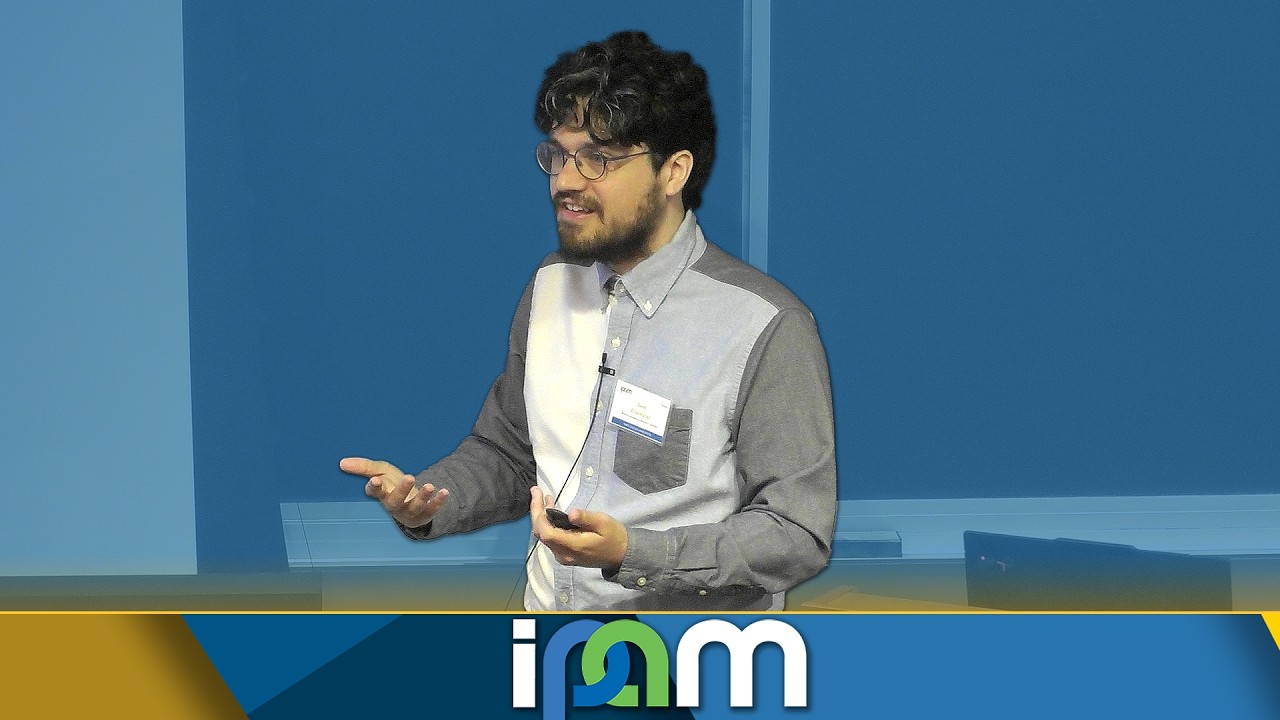
Sam Eisenstat - Concepts, information, and objectivity - IPAM at UCLA
Keywords
Summary
168 words
Critical Evaluation
Value of the Information & Strength of the Argument
The talk provides a novel theoretical contribution by formalizing the notion of shared concepts through latent variable models and information-theoretic uniqueness. The argumentation is rigorous: the speaker carefully defines the model, states conditions, and sketches the proof of the main theorem. He also addresses potential objections and clarifies technical points in response to audience questions. The value lies in offering a principled framework that could complement empirical interpretability research, though the practical applicability to real neural networks remains an open question.
Scientific Rigor, Source Quality, Title Accuracy
The talk is based on a paper by the speaker and subsequent work, though no specific references are given in the video. The presentation is mathematically rigorous, with clear definitions and a theorem. The title accurately reflects the content. The description provides a link to the IPAM workshop page, which is the primary source. No external sources are cited in the video itself.
159 words
Title / Content Match
The title accurately reflects the content: the talk introduces a theoretical model for concepts using latent variables and information theory, aiming to establish a form of objectivity (uniqueness) in representation.
Quality & Reliability
8/10
The talk presents a formal mathematical framework with a theorem and proof sketch, grounded in probability theory and information theory. The approach is rigorous, with clear definitions and conditions, though the presentation is at a research seminar level and the theorem's applicability to real-world interpretability remains to be validated empirically.
Key Moments
Markers derived by PSI from the transcript: the creator did not define chapters.
- Introduction: motivation for shared understanding and concepts.
- Informal example: texts as observed variables, latent concepts like Golden Gate Bridge.
- Definition of random variable model and latent variable model.
- Example: coin with unknown bias as a latent variable model.
- Connection to Bayesian networks and contribution relation.
- Statement of the main theorem: approximate uniqueness of latent variable models.
- Explanation of the reconstruction condition and its role.
- Discussion of the Markov condition and other technical assumptions.
- Sketch of the proof and the role of the number of latent variables (m).
- Implications for interpretability and future work.
Cited Sources
- Foundations of Interpretability Workshop - IPAM — Workshop page where the talk was recorded, providing context and related materials.
Concurring Sources
- Foundations of Interpretability Workshop - IPAM — The workshop context aligns with the talk's focus on theoretical foundations for interpretability.
Contribution & Novelties
The talk offers a novel theoretical framework for understanding concept sharing and objectivity in representations, using latent variable models and information theory. It provides a formal uniqueness theorem that could underpin interpretability research. The approach is original in its combination of ideas from Bayesian networks, algorithmic information theory, and statistical learning.
Pour aller plus loin :
- Latent variable model — Background on latent variables and their use in statistics.
- Information theory — Foundational concepts like entropy and mutual information used in the talk.
- Bayesian network — Related graphical models and conditional independence.
- Algorithmic information theory — Connection to Kolmogorov complexity mentioned by the speaker.
- Interpretability (machine learning) — Context for the application of the theory.
115 words
Radar Profile
The radar profile shows high scores in technical level and information quality, reflecting the formal mathematical nature of the talk. The quantity of information is moderate, as the talk is focused on a specific theoretical result. The global reliability is high due to the rigorous presentation, but the practical applicability remains uncertain.