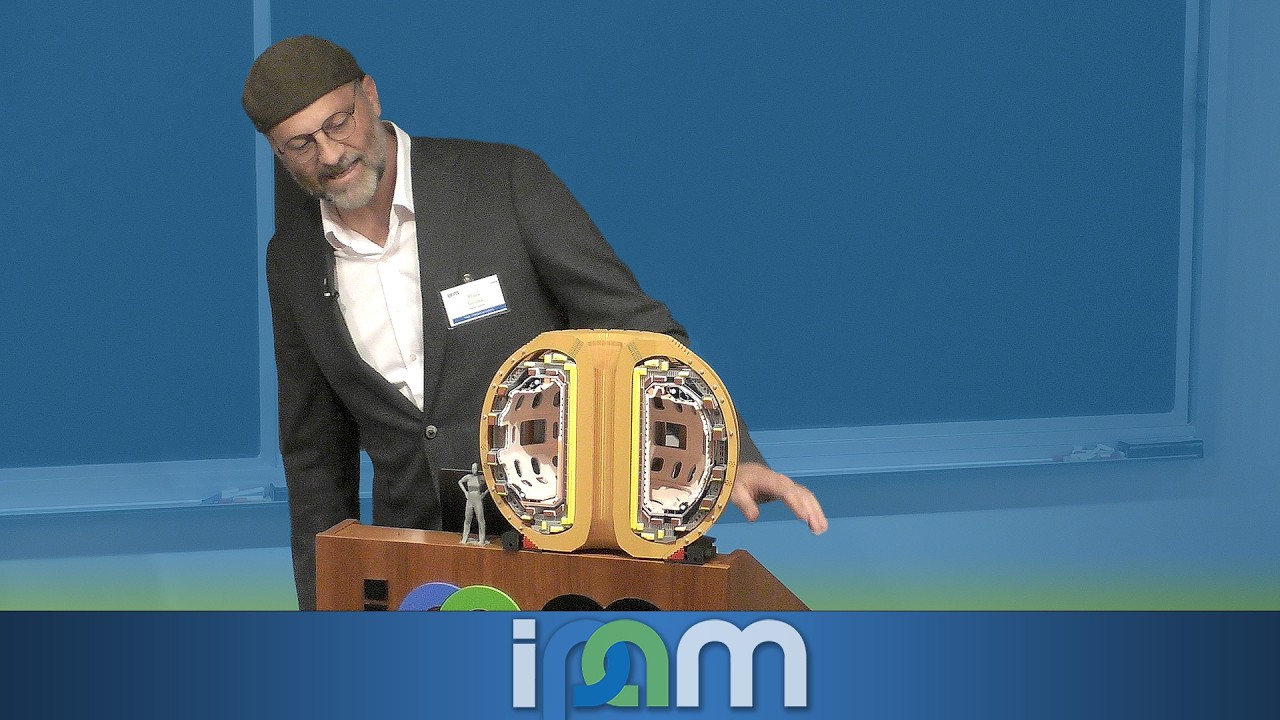
Mark Kostuk - Mixed-Fidelity, Multi-Model Optimization within the DIII-D Digital Twin - IPAM at UCLA
Keywords
Summary
102 words
Critical Evaluation
Value of the Information & Strength of the Argument
The talk provides valuable insights into the practical challenges of implementing a digital twin for fusion devices. Kostuk argues convincingly for the need to integrate models with experimental data in a closed loop, illustrating with examples from DIII-D. He addresses potential pitfalls, such as the risk of overfitting to historical data, and explains how mathematical techniques help navigate these issues. The argumentation is solid, grounded in real-world experience and specific technical details.
Scientific Rigor, Source Quality, Title Accuracy
The presentation is scientifically rigorous, with clear references to mathematical methods and acknowledgment of funding sources. The title accurately describes the content. The talk is based on ongoing work at a national facility, lending credibility. However, as a workshop talk, it lacks formal peer review, and some results are preliminary. The description provides a link to the workshop page for further context.
149 words
Title / Content Match
The title accurately reflects the content, focusing on mixed-fidelity, multi-model optimization within the DIII-D digital twin.
Quality & Reliability
8/10
The talk is given by an expert from General Atomics, presenting ongoing work on the DIII-D digital twin. It includes specific technical details, references to mathematical methods, and acknowledges funding sources. However, it is a workshop presentation with limited peer review, and some claims are based on ongoing research.
Key Moments
Markers derived by PSI from the transcript: the creator did not define chapters.
- Introduction and overview of the talk.
- Discussion of the digital twin's role in connecting high-fidelity models with experiments.
- Explanation of the DIII-D plasma control system and its integration into the digital twin.
- Challenges of closed-loop optimization and the risk of overfitting to historical data.
- Mathematical guideposts: Hamiltonian Monte Carlo, Tikhonov regularization, Takens' embedding theorem.
- Application of Takens' theorem to extract plasma profiles from magnetic data.
- Demonstration of the digital twin in conjunction with control room operations.
- Future directions and potential for real-time control.
Cited Sources
- IPAM Workshop: Multi-Fidelity Methods to Enable Robust Optimization and Real-Time Control of Fusion Processes — Workshop page where the talk was presented.
Concurring Sources
- IPAM Workshop: Multi-Fidelity Methods to Enable Robust Optimization and Real-Time Control of Fusion Processes — Workshop page providing context for the talk.
Contribution & Novelties
The talk provides a unique perspective on applying mixed-fidelity optimization to a real fusion device’s digital twin. It highlights practical challenges and solutions, such as using regularization to handle chaotic dynamics. The demonstration of extracting plasma profiles from magnetic data alone is a notable novelty.
Pour aller plus loin :
- Takens’ theorem — Relevant to the use of embedding for state reconstruction.
- Hamiltonian Monte Carlo — Discussed as a method for optimization without gradients.
- Tikhonov regularization — Used to regularize the optimization surface.
83 words
Radar Profile
The radar profile shows high scores across all dimensions, indicating a well-rounded presentation with substantial information, technical depth, and reliability. The talk is particularly strong in quantitative information and technical level, reflecting its expert audience.