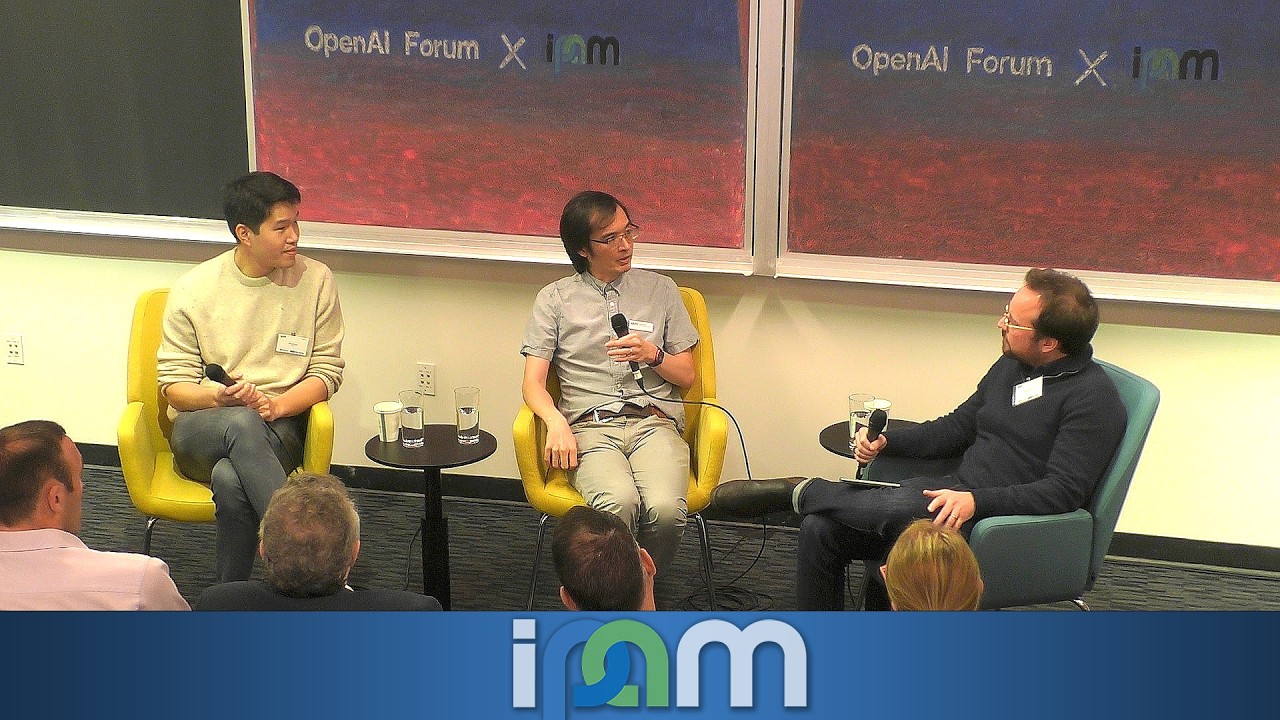
Terence Tao and Mark Chen - Fireside Chat with James Donovan - IPAM at UCLA
Keywords
Summary
185 words
Critical Evaluation
Value of the Information & Strength of the Argument
The value of the information is high, as it provides direct insights from leading figures in mathematics and AI. The argumentation is solid, with both Tao and Chen offering concrete examples and thoughtful perspectives. Tao’s distinction between problems amenable to AI (like Erdős problems) and those requiring deep theoretical insight is particularly valuable. Chen’s explanation of OpenAI’s ‘meter plot’ and the importance of scaling autonomous work is also compelling. The discussion is well-structured and avoids hype, acknowledging current limitations while highlighting promising directions.
Scientific Rigor, Source Quality, Title Accuracy
The scientific rigor is high, given the expertise of the speakers. The sources cited are primarily the speakers’ own experiences and projects, such as the Erdős problems and the First Proof competition. The title accurately reflects the content, and the discussion stays on topic. No external sources are cited beyond the IPAM workshop link, but the credibility of the speakers compensates for this. The adéquation between title and content is excellent.
169 words
Title / Content Match
The title accurately reflects the content: a fireside chat between Terence Tao, Mark Chen, and James Donovan, hosted at IPAM.
Quality & Reliability
8/10
The discussion features two leading experts in mathematics and AI, providing credible insights into current AI capabilities and future directions. The content is largely anecdotal and forward-looking, but grounded in recent concrete examples like the Erdős problems and the First Proof competition. No formal peer-reviewed evidence is presented, but the expertise of the speakers lends high reliability.
Key Moments
Markers derived by PSI from the transcript: the creator did not define chapters.
- Introduction and context of the fireside chat.
- Tao discusses how AI has changed his approach to mathematics.
- Chen talks about the transition from bronze to gold medal performance in competitions.
- Tao highlights the success of AI on Erdős problems and the long tail of problems.
- Discussion on division of labor in mathematics and the role of AI.
- Chen explains the 'meter plot' and the importance of scaling autonomous work.
- Tao discusses the verification bottleneck and the need for precise goal specification.
- Chen talks about the potential for AI to serve as a central repository of mathematical knowledge.
- Discussion on the future of AI in mathematics and whether it will dominate or complement human efforts.
- Concluding thoughts on community engagement and the acceleration of scientific discovery.
Cited Sources
- IPAM Workshop: Accelerating Math and Theoretical Physics with AI — The workshop where this fireside chat took place, providing context and related resources.
Concurring Sources
- IPAM Workshop: Accelerating Math and Theoretical Physics with AI — The workshop itself, which focuses on the intersection of AI and mathematics, aligns with the discussion's themes.
Contribution & Novelties
This discussion provides a unique, real-time perspective on the state of AI in mathematics from two of the most influential figures in the field. The main novelty is the candid assessment of AI’s current capabilities and limitations, particularly the success on Erdős problems and the challenges of verification. The conversation also introduces the concept of ‘division of labor’ in mathematics, enabled by AI, which is a fresh idea. The ‘meter plot’ concept from OpenAI is also a novel way to think about AI progress.
Pour aller plus loin :
- Erdős problems — A collection of mathematical problems posed by Paul Erdős, many of which have been tackled by AI.
- First Proof competition — A competition organized by OpenAI to encourage AI-generated proofs of mathematical theorems.
- IMO problems — The International Mathematical Olympiad, used as a benchmark for AI performance in mathematics.
141 words
Radar Profile
The radar profile shows high scores across all dimensions, indicating a well-rounded and reliable discussion. The slightly lower score in 'niveau_technique' reflects the accessible nature of the conversation, which avoids deep technical details. Overall, this is a high-quality resource for understanding the current state and future of AI in mathematics.
💬 No comments were provided for analysis.