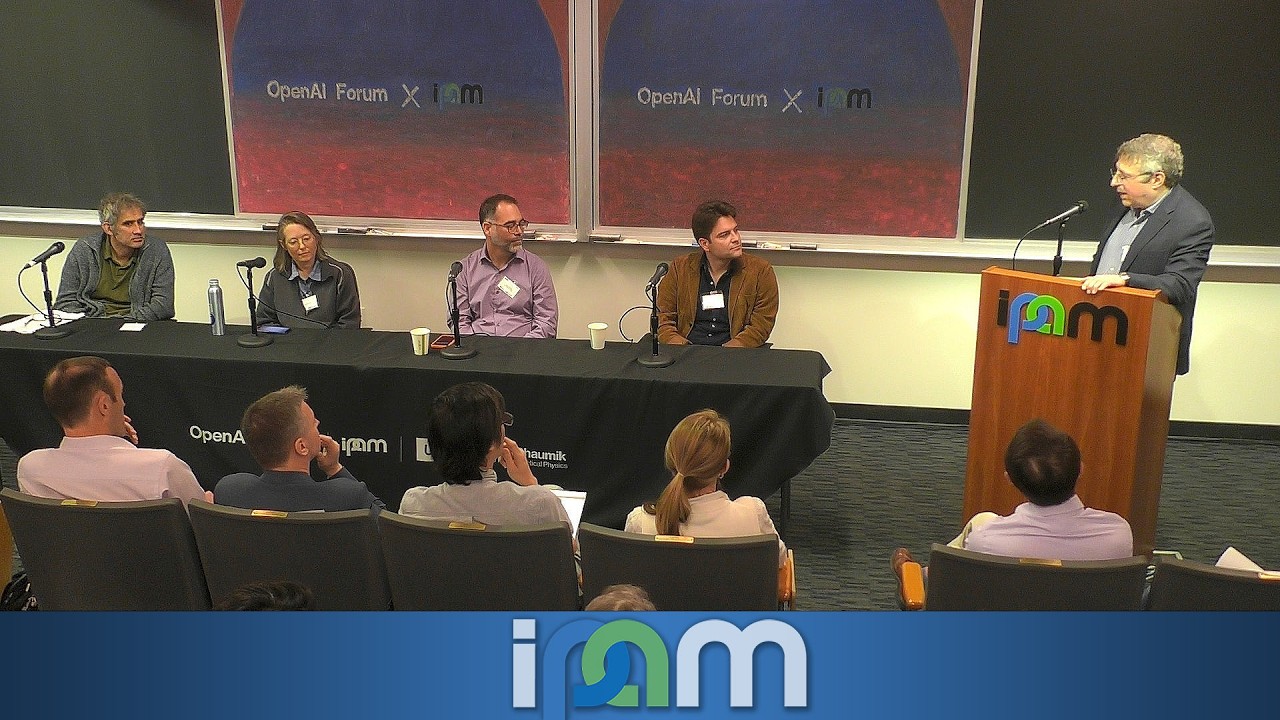
Physics Panel - Accelerating Math and Theoretical Physics with AI - IPAM at UCLA
Keywords
Summary
155 words
Critical Evaluation
Value of the Information & Strength of the Argument
The discussion provides valuable insights into the practical applications of AI in theoretical physics, with concrete examples from the panelists’ own research. The arguments are well-reasoned and grounded in recent experiences, such as Alex Lupsasca’s papers on gluons and gravitons. The panelists present a balanced view, acknowledging both the potential and the challenges, such as the need for productionizing AI and the sociological aspects of adoption. The argumentation is solid, though some claims are speculative and forward-looking.
Scientific Rigor, Source Quality, Title Accuracy
The panelists are highly credible researchers from prestigious institutions. The discussion references specific projects (e.g., ForecastNet, Genesis) and recent papers, but specific citations are not provided in the video. The title accurately reflects the content. The description provides a link to the workshop schedule, which may contain further resources. Overall, the scientific rigor is high, but the lack of explicit citations limits verifiability.
155 words
Title / Content Match
The title accurately reflects the content: a panel discussion on accelerating math and theoretical physics with AI.
Quality & Reliability
8/10
Panel of leading physicists and AI experts from top institutions (UCLA, Stanford, OpenAI, LBNL/NERSC) discussing current applications of AI in theoretical physics. High expertise, but discussion is forward-looking and includes speculative claims.
Key Moments
Markers derived by PSI from the transcript: the creator did not define chapters.
- Introduction of panelists by Zvi Bern.
- Alex Lupsasca discusses how AI reduces confusion and enables rapid exploration.
- Kyle Cranmer provides a taxonomy of AI applications in science.
- Eva Silverstein discusses symmetries in transformer models and Noether's theorem.
- Wahid Bhimji discusses the Genesis project and productionizing AI.
- Alex Lupsasca claims 2026 is an inflection year for AI in science.
- Discussion on AI's role in making bold leaps and complex discoveries.
Cited Sources
- IPAM Workshop: Accelerating Math and Theoretical Physics with AI — Official workshop page with schedule and resources.
Concurring Sources
- IPAM Workshop: Accelerating Math and Theoretical Physics with AI — Workshop page providing context and additional resources.
Contribution & Novelties
The panel provides a unique cross-section of perspectives on AI in theoretical physics, from academic research to national lab infrastructure. It highlights concrete recent advances, such as AI-derived results in gluon and graviton scattering, and discusses novel ideas like using symmetries in transformers. The discussion also addresses the sociological and philosophical implications of AI-driven discovery.
Pour aller plus loin :
- Noether’s theorem — Relevant to Eva Silverstein’s discussion of symmetries in transformers.
- Transformer models — Core architecture discussed in the context of AI for science.
- Lattice QCD — Mentioned by Kyle Cranmer as an area where AI is improving sampling algorithms.
101 words
Radar Profile
The radar profile shows high scores across all dimensions, indicating a well-rounded and reliable discussion. The highest scores are in information quality and reliability, reflecting the expertise of the panelists. The technical level is also high, but accessible to a knowledgeable audience.
💬 No comments were provided for analysis.