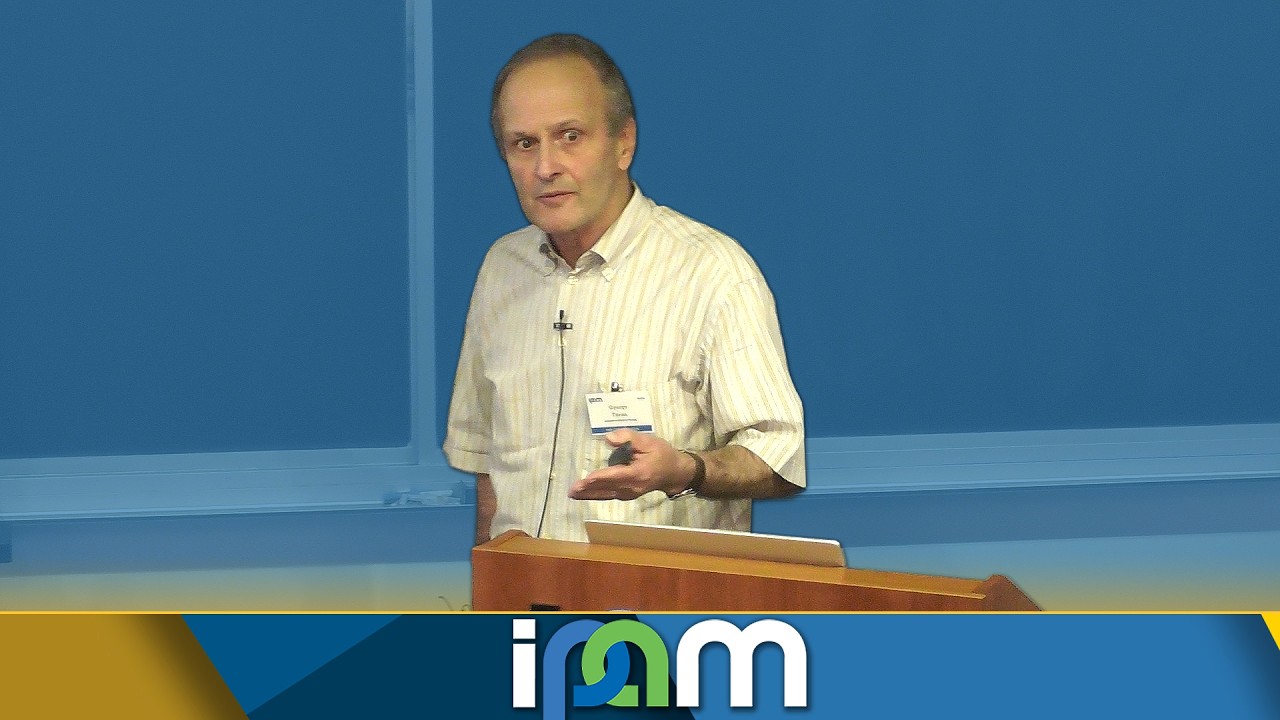
Gyorgy Turan - Error-correcting codes: a sandbox for learning, interpretability and optimization
Keywords
Summary
139 words
Critical Evaluation
Value of the Information & Strength of the Argument
The talk provides valuable insights into the interpretability of learned error-correcting codes, a relatively underexplored area. The argumentation is solid, based on experimental evidence and theoretical reasoning. The speaker clearly explains the motivation and the challenges, and the results are presented in a coherent manner. The discussion of the optimization landscape and the role of symmetries is particularly insightful, offering a new perspective on the problem.
Scientific Rigor, Source Quality, Title Accuracy
The talk demonstrates scientific rigor by referencing classical coding theory and recent deep learning work. The speaker mentions joint work with colleagues and cites specific papers, such as the Turbo-AE paper by Gangr (2019) and a 2005 paper on information geometric interpretation of turbo decoding. The title accurately reflects the content. The talk is a workshop presentation, so it is not peer-reviewed, but the methodology and results appear sound.
150 words
Title / Content Match
The title accurately reflects the content, which focuses on using error-correcting codes as a testbed for learning, interpretability, and optimization.
Quality & Reliability
8/10
The talk is given by a university professor, presents experimental results and theoretical analysis, and references classical coding theory and recent deep learning work. The claims are plausible and grounded in the presented experiments, though the talk is a workshop presentation rather than a peer-reviewed publication.
Key Moments
Markers derived by PSI from the transcript: the creator did not define chapters.
- Introduction to error-correcting codes and the communication model.
- Overview of classical codes: linear, convolutional, turbo, and Reed-Muller.
- Introduction to the channel autoencoder architecture for learning codes.
- Discussion of interpretability challenges and the three possibilities for learned codes.
- Experimental results: influence analysis of Turbo-AE shows near-parity functions.
- Fourier coefficient analysis reveals dominant parity terms and training dynamics.
- Optimization landscape experiments: linear codes are local minima, bent functions are maxima.
- Theoretical framework for optimization over all codes, with symmetry assumptions.
- Connections to spherical codes and deep learning loss landscape theory.
Cited Sources
- Foundations of Interpretability Workshop — Workshop where the talk was presented.
Concurring Sources
- Foundations of Interpretability Workshop — The talk is part of this workshop, which focuses on interpretability.
Contribution & Novelties
The talk provides a novel perspective on using error-correcting codes as a sandbox for studying deep learning interpretability and optimization. It presents experimental evidence that learned codes tend to be close to parity-based codes, and proposes a theoretical framework for analyzing the optimization landscape of all codes, highlighting the role of symmetries. This approach could inspire new methods for interpreting neural networks in other domains.
Pour aller plus loin :
- Shannon’s information theory — Foundational concepts for error-correcting codes.
- Reed-Muller codes — Classical code family mentioned in the talk.
- Turbo codes — Classical code family that Turbo-AE is based on.
- Spherical codes — Related optimization problem on spheres.
- Fourier analysis on Boolean functions — Technique used for interpretability.
118 words
Radar Profile
The radar profile shows high scores in information quantity, quality, technical level, and reliability, indicating a well-rounded and rigorous presentation. The talk is highly technical and provides substantial information, with a strong theoretical foundation.